
Google core updates are broad changes to the systems that rank pages in Search, and Google releases several each year. Most sites never notice one, but a traffic drop that matches an update date raises fair questions. This guide explains how core updates work, how to confirm whether an update caused your change, how to assess a real decline, which fixes make sense, and how long recovery can take, so you respond with evidence instead of panic.
What Are Google Core Updates and How Do They Work?
A core update changes how Google’s ranking systems judge helpfulness and reliability across the whole web. It is a reassessment, not a penalty, and it does not aim at a named site or page.
Pages can lose position without any fault. Competing pages may have improved, new pages may have appeared, or Google’s systems may now weigh a signal differently. A lower position says that other pages looked more useful for that query, not that your page is broken.
Google announces notable core updates on its Search Status Dashboard, with start and completion entries. The November 2026 update began on 10 November 2026, and Google said the rollout could take up to two weeks.
Smaller core updates also happen without announcement because most people would not notice them. That means a change in traffic does not always line up with a dated entry.
How Do You Check Whether an Update Caused Your Drop?
Use a careful sequence before you change anything. Rushed edits during a rollout can muddy the evidence.
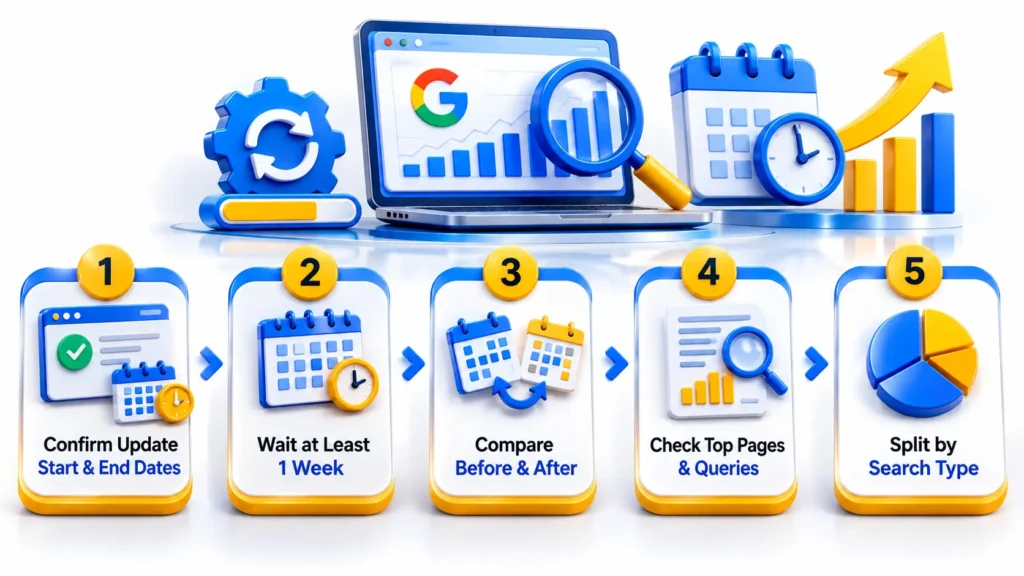
- Confirm the update has finished on the Search Status Dashboard and note its start and end dates.
- Wait at least a full week after completion before you analyze Search Console data.
- Compare that week with the week before the rollout began.
- List your top pages and top queries, then record their positions before and after.
- Split the data by search type, such as Web, Images, Video, and News, to see where the change happened.
Google’s guidance on debugging traffic drops also helps rule out technical causes, such as indexing errors or tracking changes, that have nothing to do with ranking. Record the figures in a spreadsheet, because memory tends to exaggerate losses.
Is the Drop Small or Large?
When the Drop Is Small
A shift of a few positions on pages that still rank on the first page rarely needs action. Google specifically advises against editing content that already performs well, because changes can remove what worked.
When the Drop Is Large
A sustained fall across many pages, especially from strong positions to results far down the list, calls for a deeper review. Look at the site as a whole, not only at individual pages, and check the most affected pages against Google’s questions on helpful, reliable, people-first content.
How Do You Assess a Large Drop Honestly?
Bias makes self-review difficult. Ask someone unconnected to the site to read the affected pages as a first-time visitor and judge them against better pages in the results.
Questions worth asking about each affected page:
- Does it answer the searcher’s question more fully than the pages now ranking above it?
- Does it show first-hand experience, original research, or clear expertise?
- Can a reader tell who wrote it, why, and from what sources?
- Is the information current, accurate, and easy to navigate?
- Was the page written mainly for people, or mainly to attract search traffic?
Our guide to creating content for Google AI Overviews and AI search covers many of the same quality signals, including original value and clear answers.
Which Changes Help and Which Ones Waste Time?
Changes Worth Making
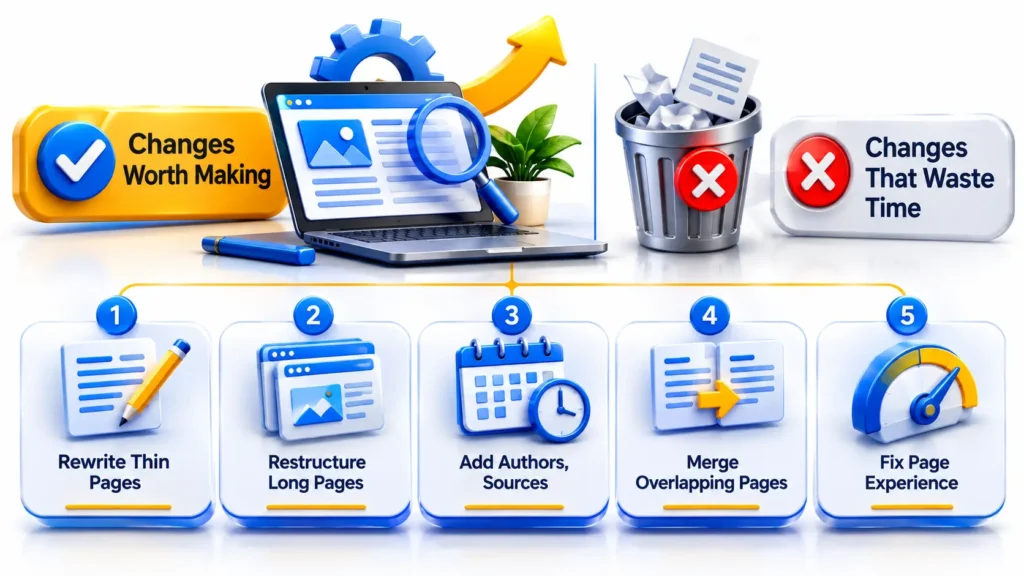
- Rewrite thin pages so they answer the whole question with evidence and examples.
- Restructure long pages with clear headings so readers find answers quickly.
- Add named authors, sources, and update dates where they build trust.
- Merge overlapping pages that compete for the same query.
- Fix page experience problems that slow or confuse visitors.
Changes to Avoid
Skip quick fixes based on rumors about what search engines dislike. Deleting content is a last resort for pages that cannot be improved, and large sections written mainly for search engines may be the exception.
Bulk rewrites with AI tools and no human review also add risk, because they can introduce errors and remove original insight.
How Long Does Recovery Take?
Some improvements show in days, while others take months, because Google’s systems need time to confirm that a site consistently offers helpful, reliable content. Smaller, unannounced core updates can also reward improvement before the next major one.
No one can promise a date or a result. Google itself notes that changes carry no guarantee of a noticeable effect, so document what you change and measure each page against its own baseline. Review progress monthly rather than daily, since rankings can fluctuate while systems relearn.
What Else Can Cause Traffic to Fall?
Rule out other causes before blaming an update:
- Indexing or crawling errors, accidental noindex tags, or robots.txt changes.
- Site migrations, redesigns, or URL changes without proper redirects.
- Manual actions or spam policy violations listed in Search Console.
- Seasonal demand changes or lower search interest in your topic.
- Search results that now answer the query directly, reducing clicks.
- Tracking errors in analytics that make traffic look lower than it is.
Spam updates are separate events. If a spam update matches your drop, review Google’s spam policies instead of treating the issue as a core update. Our guide to common off-page SEO mistakes explains link practices that can create trouble.
What Should Local and Service Businesses Do?
Local businesses should review organic website rankings and map results separately, because they depend on different signals. Check Search Console for pages and queries, and Google Business Profile performance data for calls and direction requests.
Businesses that want an outside audit can look for providers with proven Search Console and content-audit experience. A digital marketing agency should explain how it separates update effects from technical and seasonal causes, and any provider should avoid promising recovery dates.
Dotcom Creativez is one of the providers a business can assess on these points. For local search support, businesses can also review digital marketing services in Calicut that report organic and map performance separately.
How Can You Prepare Before the Next Update?
Preparation beats reaction. Keep a record of your key pages, their positions, and the dates of major site changes, so future comparisons have a clean baseline.
Build these habits:
- Audit content every quarter and update pages when facts change.
- Publish pages that add original value instead of repeating what the web already says.
- Keep technical health strong with regular crawl and index checks.
- Annotate analytics with launches, migrations, and campaigns.
- Diversify traffic through email, social, referrals, and brand search.
Planning content around customer questions also reduces dependence on any one update. Our guide to building a content marketing strategy for 2027 shows how to structure that work.
What Do Core Updates Mean for AI Search Visibility?
Google says AI Overviews and AI Mode draw on the same Search index, so quality changes that affect rankings may also affect which pages appear as supporting links. Track Search Console reports for AI features alongside organic positions, and treat any single week with caution.
See our overview of how Google AI Mode is transforming SEO for businesses.
Frequently Asked Questions About Core Updates
Is a core update a penalty?
No. Core updates are broad reassessments of ranking systems and do not target specific sites. A manual action for spam is a different matter and appears in Search Console.
How often does Google release core updates?
Google says it releases significant core updates several times a year. Three were listed in 2026 so far, in March, May, and November, and smaller unannounced updates also occur.
How long should I wait before checking my rankings?
Wait until Google marks the rollout complete, then allow at least one full week before comparing Search Console data with the week before the update began. Early movement during a rollout can change.
Should I delete pages after a traffic drop?
Usually not. Improve pages that can be salvaged first. Remove content only when it cannot be made helpful, and keep redirects or removals tidy so you do not create new technical problems.
Can I recover without waiting for the next core update?
Sometimes. Google runs smaller updates continually, so real improvements can help between major releases. Recovery is not guaranteed, and some sites see changes only after a later broad update.
Do core updates affect local map results?
Local map results rely on relevance, distance, and prominence, so they can move for reasons unrelated to an organic core update. Track organic pages and Google Business Profile data separately to see which area changed.
A Calm Plan for Core Update Changes
Google core updates reward pages that serve searchers well, so a decline calls for evidence first: confirm the dates, compare the right weeks, separate technical causes, and assess quality honestly. Improve what helps users, avoid panic edits, and measure patiently. Businesses that want support with audits and reporting can consider providers such as Dotcom Creativez, then choose one that promises no recovery dates.

The Dotcom Creativez team is a digital marketing team based in Kerala, helping businesses improve their online visibility and reach their target audiences. With over seven years of industry experience within its leadership, the agency provides services including SEO, performance marketing, social media marketing, content marketing, and web development. The team creates strategies based on business goals, audience needs, and market research, with a focus on generating qualified leads, increasing conversions, and supporting measurable business growth.