
No special trick puts a page into Google AI Overviews, but clear, original, well-structured content gives it the best chance of being used as a supporting link. This guide explains how AI search chooses sources, what Google’s own guidance says, how to write and format pages for answers, which technical checks matter, and how to measure results, so businesses can create content for both classic and AI-driven search.
How Does Google Choose Sources for AI Answers?
AI Overviews and AI Mode show a generated answer with links to supporting pages. Google’s guidance says these features draw on the same Search index, and a page must be indexed and eligible to show a snippet before it can appear as a supporting link.
Google’s documentation also says AI Overviews and AI Mode may use query fan-out, which runs several related searches across subtopics before combining the results. A page can therefore support one part of an answer without being the top result for the original query.
Google also states that no additional requirements or special optimizations are needed. Its May 2026 guide to generative AI features points back to crawlable pages, helpful content, and good page experience.
For a deeper look at the conversational mode, see our guide to how Google AI Mode is transforming SEO for businesses.
What Kind of Content Gets Used in AI Search?
Google asks site owners to focus on unique, valuable content made for people. In practice, that means pages with these qualities:
- Original value: first-hand knowledge, data you collected, documented processes, and clear expert judgment.
- Direct answers: the main point appears early, then detail and evidence follow.
- Specific questions: each section addresses a clear question a customer would ask.
- Trust signals: named authors, cited sources, accurate dates, and transparent business details.
- Supporting media: useful images and video that clarify the text.
Generic summaries add little because an AI system can produce one instantly. Pages that only repeat what other pages already say give Google no reason to prefer them. Read Google’s own advice on helpful, reliable, people-first content to self-assess your pages.
How Should You Structure a Page for AI Search?
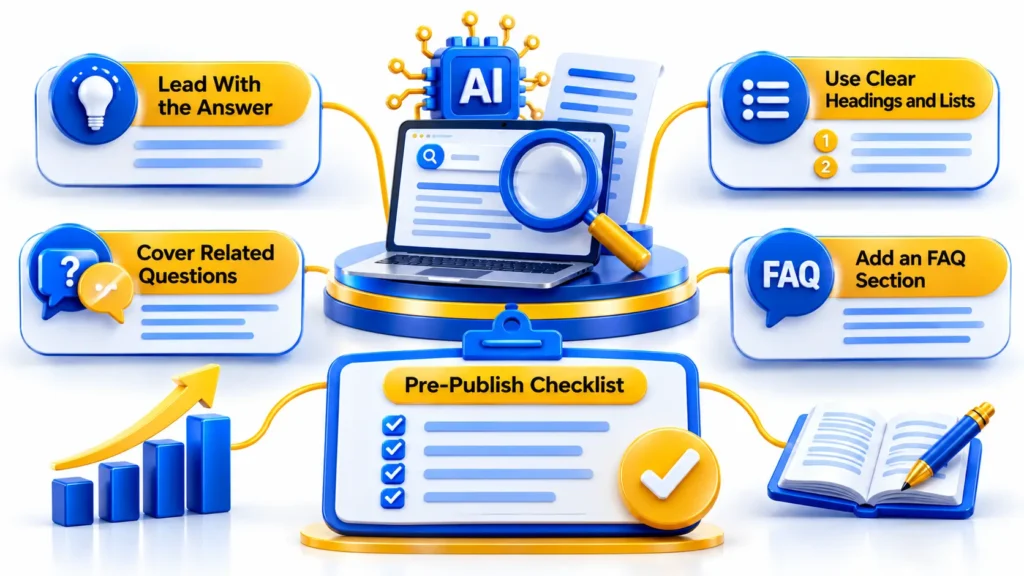
Lead With the Answer
Place a short, direct answer under each question-style heading, then expand. A reader gets the point at once, and a system extracting a passage finds a self-contained statement it can understand without surrounding context.
Use Clear Headings and Lists
Descriptive headings, short paragraphs, and lists make content easy to scan. Use numbered lists for processes and bullet lists for criteria, and keep one idea per paragraph.
Cover Related Questions
Because AI systems explore subtopics, map the follow-up questions around each core topic. A service page might answer pricing, process, timelines, comparisons, risks, and eligibility in separate, clearly labelled sections.
Add an FAQ Section
FAQs capture real search language. Write questions as customers phrase them, answer each in two or three sentences, and avoid repeating headings.
For planning content across the full year, read our guide to how to build a content marketing strategy for 2027.
Pre-Publish Checklist
Run each new page through these questions:
- Does the page answer one clear customer question?
- Does it add something other pages do not, such as data or experience?
- Is the answer visible near the top of each section?
- Are facts, dates, and sources accurate and current?
- Can Google crawl, index, and show a snippet for the page?
- Does structured data match the visible text?
Which Technical Checks Should You Complete First?
A strong page cannot appear if Google cannot use it. Check these basics:

- Robots.txt, CDN, and hosting settings allow Googlebot to crawl the page.
- No noindex tag or snippet restriction blocks the page by accident.
- Internal links make the page easy to find.
- Pages load quickly and display well on mobile.
- Structured data matches the visible text on the page.
- Business Profile and Merchant Center details stay current where they apply.
Use Search Console’s URL Inspection tool to confirm that Google can crawl and index key pages. Snippet controls such as nosnippet and max-snippet also affect how content appears in AI features, so apply them deliberately.
Ask your developer or host whether security tools or a CDN block Googlebot, since these settings can change without notice.
How Do You Build Authority and Trust Signals?
Readers and search systems judge reliability through similar signals. Publish named author bios with relevant experience, cite primary sources such as official documentation, and update pages when facts change.
Reputation outside your site matters too. Genuine reviews, consistent business listings, and mentions on respected sites help people and systems trust a brand. Our guide to common off-page SEO mistakes explains how to build these signals without risky shortcuts.
Keep facts consistent across your website, Google Business Profile, and social profiles. Conflicting names, hours, or service descriptions can weaken confidence in every source.
How Can You Use Images, Video and Structured Data?
Google says its generative AI features can surface relevant images and video, which creates more ways for a site to appear beyond text links. Support written content with original photos, short explanatory videos, and descriptive alt text.
Original visuals also help readers who skim. A labelled diagram or comparison image can explain a process faster than a paragraph and gives your page assets that are harder for competitors to copy.
Structured data helps search systems understand a page, but only when it matches the visible content. Mark up real articles, products, and local business details, and never describe content that readers cannot see.
How Do You Measure Results From AI Search?
Google states that sites appearing in AI Overviews and AI Mode are included in overall search traffic in Search Console, so the data blends with classic results. Track impressions, clicks, and query trends for the pages you updated. Dedicated generative AI reports added in June 2026 show impressions from these features.
Pair that data with business metrics:
- Organic sessions and engagement in Google Analytics 4.
- Enquiries, calls, bookings, and sales from organic visitors.
- Branded search growth, which suggests rising awareness.
- Manual checks of AI answers for your priority questions.
Impressions in AI answers do not equal clicks or customers. Review results monthly and judge success by enquiries and revenue, not appearance alone.
Which Mistakes Keep Content Out of AI Answers?
- Publishing thin pages for every possible keyword variation.
- Rewriting generic AI drafts with no original input or fact-checking.
- Burying the answer under long introductions.
- Blocking crawlers or adding snippet limits without realizing the effect.
- Using structured data that does not match the page.
- Buying services that promise guaranteed AI citations.
- Ignoring page speed, mobile layout, and outdated information.
No one can guarantee inclusion in Google’s AI features, because Google controls them. Treat any promise of guaranteed placement with caution, and build for long-term usefulness instead.
How Should Local Businesses in Calicut Create AI-Ready Content?
Local customers ask AI tools practical questions about services, prices, availability, and trust. Create location-aware service pages, keep Google Business Profile complete, gather genuine reviews, and answer common questions on the website in plain language.
Businesses comparing providers of SEO services in Calicut can ask how each handles content structure, technical checks, and reporting for AI search.
A digital marketing agency in Calicut should explain how it creates original content, measures AI visibility without promising placement, and ties results to enquiries. Dotcom Creativez is one of the providers a business can assess on those points.
Frequently Asked Questions About AI Search Content
Is there a way to guarantee a spot in Google AI Overviews?
No. Google says there are no additional requirements or special optimizations for AI features. Eligibility depends on being indexed and snippet-eligible, and selection depends on how useful a page is for the query.
Do I need to write differently for AI search than for SEO?
Not fundamentally. Write for people, answer questions directly, organize pages clearly, and add original value. Those habits help classic results and AI answers.
Does schema markup get my page into AI Overviews?
Structured data helps Google understand a page, but it does not guarantee inclusion. Google advises that markup must match the visible content, so treat it as supporting detail.
How often should I update content for AI search?
Update whenever facts, prices, services, or policies change, and review priority pages at least quarterly. Fresh, accurate information protects trust.
Can small businesses appear in AI search results?
Yes. Size is not a requirement. Specific expertise, accurate local information, genuine reviews, and clear answers can make a small business’s page useful enough to support an answer.
How can businesses in Calicut check if their content appears in AI answers?
Search priority questions in AI Overviews and AI Mode, note which sources appear, and review Search Console impressions for the same pages. Repeat monthly and compare changes with enquiries.
A Practical Path to AI Search Visibility
Content for Google AI Overviews and AI search follows familiar principles: original value, clear answers, accurate facts, sound technical health, and trustworthy signals. No special trick exists, so focus on being the most useful source for each customer question. Businesses that want help planning and measuring this work can consider providers such as Dotcom Creativez, then choose one that makes no guarantees about AI placement.

The Dotcom Creativez team is a digital marketing team based in Kerala, helping businesses improve their online visibility and reach their target audiences. With over seven years of industry experience within its leadership, the agency provides services including SEO, performance marketing, social media marketing, content marketing, and web development. The team creates strategies based on business goals, audience needs, and market research, with a focus on generating qualified leads, increasing conversions, and supporting measurable business growth.