
Every social media strategy either starts with a clear picture of who you are speaking to, or it starts with a guess dressed up as a plan. This piece walks through how businesses, from a solo consultant to a growing e-commerce brand, can identify their target audience on social media using real data instead of assumptions. You will learn the difference between demographic and psychographic signals, how to read platform insights, and how to turn that information into decisions that hold up.
What Identifying a Target Audience on Social Media Actually Means
Identifying a target audience on social media means narrowing a broad pool of potential viewers down to the specific group most likely to buy, engage, or refer others to what you offer. It is not a list of ages and cities. It combines who people are, what they care about, and how they behave when they scroll.
A dental clinic in a mid sized city does not need “everyone within 20 kilometers.” It needs parents researching pediatric dentists late at night, and professionals searching for weekend appointment slots. That specificity separates a real persona from a demographic guess.
Why Guessing Your Audience Quietly Drains Your Marketing Budget
Ad platforms reward precision. When targeting stays broad because nobody defined the audience clearly, the algorithm spends money showing content to people who scroll past it without a second glance. Cost per result climbs, and nobody can explain why.
A junior marketer who skips this step often blames the creative or the offer when performance drops. The real fault usually sits earlier, in a targeting decision built on assumption rather than evidence.
Demographic Data vs Psychographic Data: The Difference That Changes Your Strategy
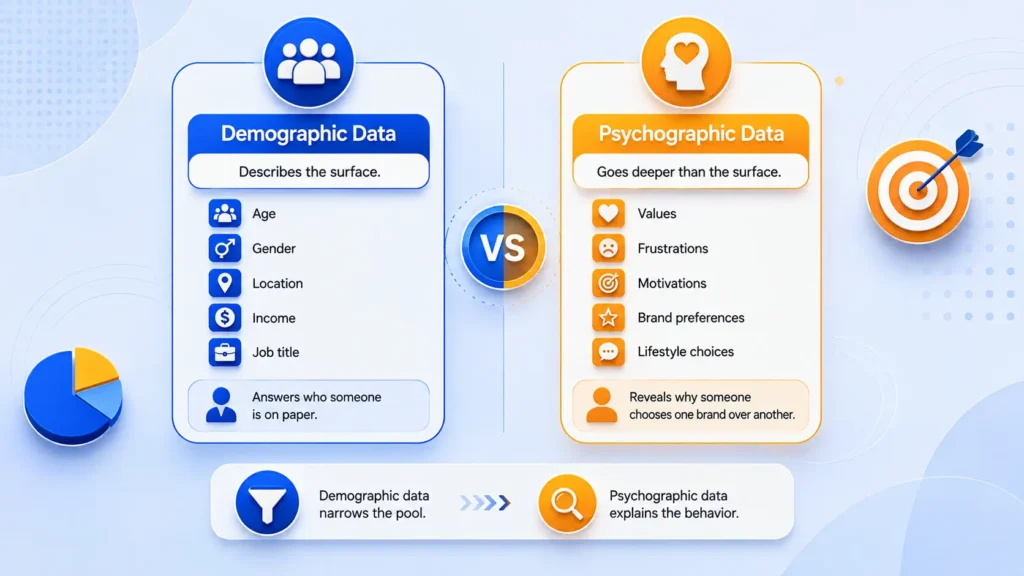
Demographic data describes the surface: age, gender, location, income bracket, job title. It answers who someone is on paper.
Psychographic data goes further, capturing values, frustrations, and the reasons someone follows one brand over another. Two 35 year old mothers in the same city can have opposite psychographics, one driven by convenience, the other by ingredient transparency, and that gap should shape different messaging.
Effective research blends both. Demographic data narrows the pool, and psychographic data explains why that pool behaves the way it does.
Reading Platform Insights to Find Real Signals
Every major platform hands over usable data for free, if a business bothers to check it. Instagram Insights shows age brackets, top locations, and active hours, while LinkedIn Analytics reveals job functions and seniority among followers.
Useful starting points on each platform include:
- Instagram and Facebook Insights: age range, gender split, top cities, most active hours
- LinkedIn Analytics: job titles, industries, seniority level, company size
- YouTube Studio: watch time by age group, traffic source, audience retention
- TikTok Analytics: peak activity times, content category performance, video completion rate
None of these numbers mean much in isolation. Their value shows up when a business cross references them against actual buyers rather than just followers, because a large follower count in the wrong segment can quietly mislead an entire content plan.
Building a Simple Persona From What the Data Tells You
A usable persona does not need twelve pages, just enough detail that a content writer or ad manager can picture a real person before making a decision.
A working persona should note:
- Primary platform and time of day they are most active
- The specific problem your product or service solves for them
- Language and tone that would earn their trust versus feel like an advertisement
- One objection they are likely to raise before buying
Keep the document short enough that someone actually reopens it before writing a caption, rather than filing it away after the first planning session.
Why the Same Audience Behaves Differently Across Platforms
In the same evening, a 28-year-old software engineer might watch YouTube tutorials, browse Instagram for amusement, and check LinkedIn for employment signals. The person has not changed. The context has.
Content built for LinkedIn’s professional mindset rarely performs when copied straight onto Instagram, and a caption written for Instagram’s casual scroll usually feels out of place on LinkedIn. Matching platform to intent matters as much as matching platform to age group.
Common Mistakes That Widen or Narrow Your Audience Too Much
Businesses new to audience research tend to swing between two extremes:
- Defining the audience so broadly that targeting becomes meaningless
- Narrowing it so tightly that reach shrinks below a level where the algorithm can learn effectively
- Copying a competitor’s assumed audience instead of validating their own
- Treating the first draft of a persona as permanent instead of a working document
The fix rarely involves collecting more data. It involves asking sharper questions of the data already sitting inside a platform’s dashboard.
Testing and Refining Your Assumptions Over Time
Audience definitions age. What holds up today needs rechecking every few months against fresh insights, not a one time task.
Engagement rate, saves, shares, and conversion data tell a more honest story than follower count ever will. If a persona predicted a certain content style would land and it consistently underperforms, that is the data asking for a revision, not a reason to push the same content harder.
How a Defined Audience Reshapes Content, Ads, and Overall Strategy
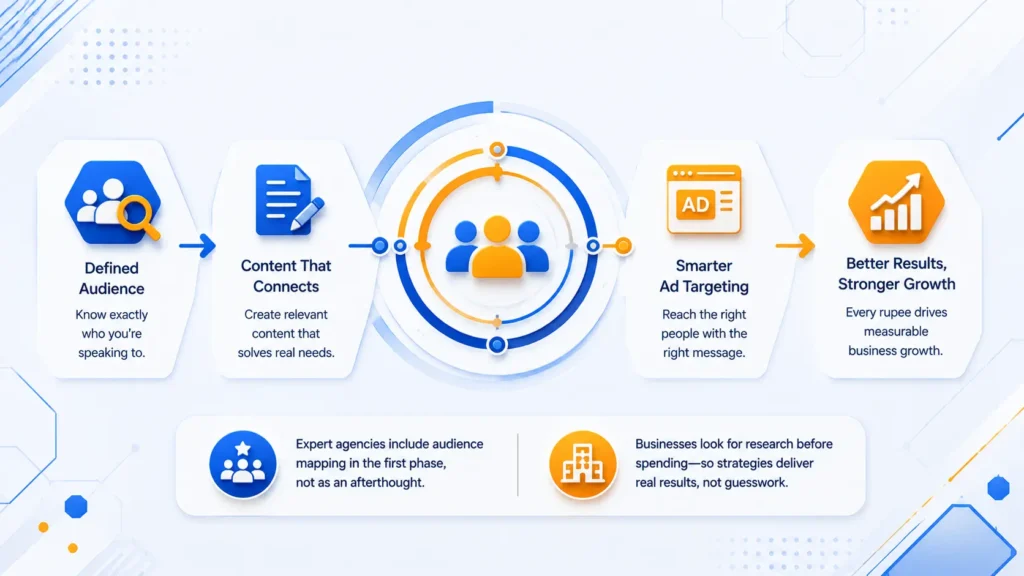
Once an audience is genuinely defined, every downstream decision gets easier. Content briefs stop starting from a blank page, ad targeting stops relying on platform defaults, and messaging starts sounding like it was written for someone specific. This is where a business can Turn Social Media Into Real Business Growth, because every rupee goes toward a defined segment instead of a wide net.
Agencies that specialize in this kind of research, including the team at Dotcom Creativez, build audience mapping into the first phase of any campaign instead of treating it as an afterthought once ads are already live. Businesses across the state that search for the best digital marketing agency in Kerala are usually looking for exactly this: research done before the spending starts, not after.
Frequently Asked Questions
What does it mean to identify your target audience on social media?
It means using platform data and behavior signals, not assumptions, to define the specific people most likely to respond to your brand. It combines demographics with motivations and habits.
How is a target audience different from a buyer persona?
A target audience is the broader segment you are aiming for. A buyer persona is a detailed, semi fictional profile built from that segment, used to guide tone, content, and offers.
Which social media analytics should a small business check first?
Start with the native insights tool on whichever platform already gets the most traffic, whether that is Instagram Insights, LinkedIn Analytics, or YouTube Studio, since that data reflects real behavior instead of estimates.
How often should a business revisit its audience definition?
Every three to six months, or immediately after a major shift in product, pricing, or a platform algorithm change that affects who sees your content.
Can a business have more than one audience on social media?
Yes. Many businesses serve two or three distinct segments, each warranting its own persona, content angle, and sometimes a separate campaign.
Where a Clear Audience Definition Takes Your Brand Next
Once you can name your audience with this level of confidence, social media stops feeling like guesswork and starts behaving like a repeatable system. Every post and ad builds on what you already know instead of starting a fresh experiment each week.
For businesses that want this groundwork done properly, without spending months testing blind, Dotcom Creativez builds audience research into the earliest stage of every campaign it runs, whether the client is a Kochi based clinic or a growing brand searching for the best digital marketing agency in Thrissur. Getting this one step right is often what decides whether the rest of a social media plan actually works.