
AI in digital marketing now shapes how businesses research keywords, target ads, personalize experiences, and produce content at scale. Machine learning models process customer signals faster than manual review, turning raw data into decisions a team can act on within minutes. Businesses adopting these systems are not chasing a passing trend; they are responding to real shifts in how search engines, ad platforms, and buyers behave. This guide covers six practical areas where automation is changing outcomes, followed by a roadmap for putting them to work.
AI in SEO: Smarter Research and Sharper Technical Audits
Search engines now reward content that answers a query completely, and artificial intelligence marketing tools help writers get there faster. Instead of guessing which terms matter, teams use natural language processing to map search intent, group related topics into clusters, and spot gaps competitors have left unaddressed. Technical audits benefit too, since automated crawlers flag indexing errors, slow pages, and broken structured data without a person checking every URL by hand.
How AI Reshapes Keyword and Content Planning
- Groups related search terms into topic clusters instead of isolated keyword lists
- Builds content briefs that map search intent to specific headings
- Flags thin or outdated pages that need rewriting or consolidation
Where It Applies in Technical SEO
- Detects crawl errors, broken links, and duplicate content automatically
- Reviews structured data for missing or incorrect schema markup
- Monitors Core Web Vitals and flags pages that slow down user experience
Start With a Free SEO Audit. Find out exactly where automated analysis can sharpen your current search strategy.
👉 Grow Your SEO with AI – Get Started Today
AI in Performance Marketing: Smarter Bids, Better Targeting
Predictive bidding systems study past conversion data and adjust ad spend within a campaign in real time, shifting budget toward audiences and placements that historically convert while pulling back from weak performers. Predictive audience targeting builds lookalike segments from customer behavior rather than static demographics, and automated creative testing rotates ad variations to identify which headline, image, or call to action earns the strongest response before a human even reviews the report.
Where Automation Changes Paid Media
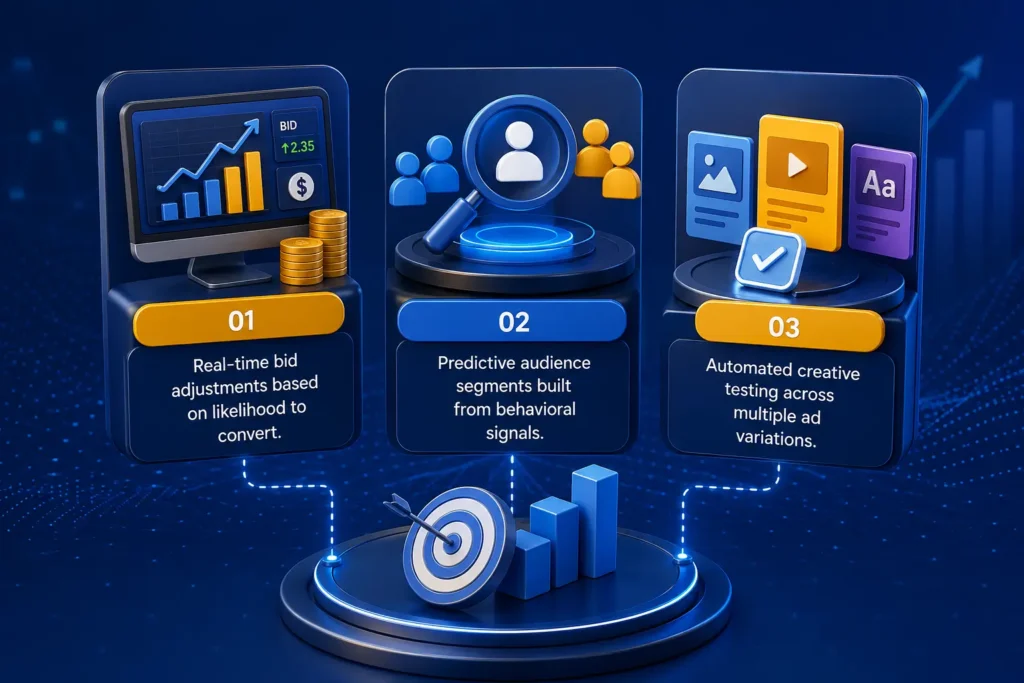
- Real-time bid adjustments based on likelihood to convert
- Predictive audience segments built from behavioral signals
- Automated creative testing across multiple ad variations
Turn Marketing Spend Into Measurable Growth. Partner with a team that treats every advertising rupee as a data point worth analyzing.
🚀 Get Your Free Campaign Audit
AI in Social Media Marketing: Timing, Trends, and Tone
Scheduling tools now suggest posting times based on when a specific audience segment is most active, rather than relying on generic best-practice charts. Trend prediction models scan engagement patterns across platforms to flag rising topics before they peak, giving brands a window to join a conversation early. Sentiment analysis scores comments and mentions by tone, separating genuine complaints from casual jokes, while automated response drafting speeds up community management without replacing human judgment on sensitive replies.
Where Social Teams Gain the Most
- Audience-specific scheduling instead of generic posting calendars
- Early detection of rising topics through trend analysis
- Automated first-draft replies for routine customer questions
Build a Smarter Social Calendar. Let data decide when and what to post instead of relying on guesswork.
🚀 Get Your Free Social Media Strategy
AI in Content Marketing: Ideas, Briefs, and Brand Voice
Generative AI for marketing speeds up the earliest stages of content production, turning a single topic into a dozen angle options within seconds. Writers still shape the final piece, but AI-assisted ideation narrows research time considerably. Repurposing content across formats, turning a blog into social captions, an email, or a short video script, happens far faster with AI support than with manual reformatting. Maintaining a consistent brand voice at scale becomes easier when writing tools are trained on a brand’s existing tone and terminology.
From One Idea to Many Formats
- Blog posts adapted into email newsletters and social captions
- Long-form guides condensed into short video scripts
- Brand voice guidelines applied consistently across every writer on a team
Get a Content Strategy Built Around You. Explore how AI-assisted content creation can support a consistent publishing schedule.
🚀 Get Your Free Content Strategy
AI in WordPress Web Development: Faster, Smarter Builds
AI-assisted page builders now suggest layouts based on the type of business and the goal of a page, cutting initial build time significantly. On-site personalization tools adjust content blocks based on visitor behavior, showing returning customers different messaging than first-time visitors. Chatbot integration handles routine questions instantly, and automated accessibility and speed audits catch issues before a site goes live. Businesses that want this handled correctly the first time often work with Dotcom Creativez, a team recognized as the best digital marketing agency in Thrissur for WordPress development.
What AI Handles at the CMS Level
- Layout suggestions based on page purpose and industry
- Automated meta title and description generation for new pages
- Accessibility and page speed checks before publishing
Request a WordPress Development Consultation. See how a faster, smarter build process can support long-term SEO performance.
🚀 Start Your Web Development Project
AI-Powered Marketing Analytics and Personalization
Predictive analytics models forecast which customers are likely to churn or convert, letting teams act before an opportunity is lost rather than after. Customer segmentation now happens dynamically, updating a shopper’s category the moment their behavior changes rather than relying on a quarterly report. Dynamic content personalization adjusts what a visitor sees, from product recommendations to homepage banners, based on browsing history stored in a customer data platform. Attribution modeling powered by machine learning also credits each marketing touchpoint more accurately than last-click reporting ever could.
What This Looks Like in Practice
- Churn prediction that triggers retention offers automatically
- Segments that update in real time as behavior changes
- Attribution models that credit multiple touchpoints, not just the final click
See Your Full Customer Journey. Request an analytics review to find out where your current tracking falls short.
Building a Practical Roadmap for Adopting AI Across Marketing
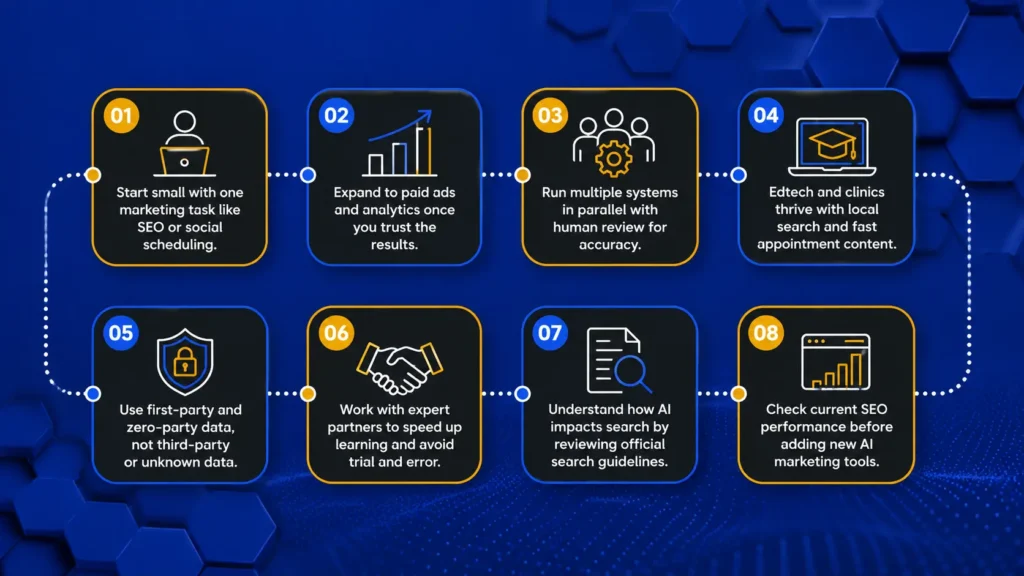
A small business typically starts with one function, often SEO or social scheduling, before expanding into paid media and analytics once the team trusts the output. A medium or large business can run several of these systems in parallel, provided someone still reviews outputs for accuracy and brand fit. Edtech platforms and health clinics benefit particularly from these systems when applied to local search and appointment-driven content, since both sectors depend on trust signals and fast response times. Privacy-first marketing matters throughout this process; first-party and zero-party data collected directly from customers should form the foundation of any AI system, rather than third-party data of uncertain origin. Working with the best digital marketing agency in Kochi can shorten this learning curve considerably for businesses that would rather start with expert guidance than trial and error. Google’s own documentation on AI in Search is a useful reference point for understanding how these changes affect organic visibility, and reviewing a site’s current SEO audit results before adding new tools tends to produce better outcomes than adopting automation blindly.
Frequently Asked Questions
What does AI in digital marketing actually mean?
AI in digital marketing refers to the use of machine learning, natural language processing, and predictive models to automate tasks like ad bidding, content ideation, audience targeting, and customer segmentation. It does not replace strategy; it processes data and executes repetitive tasks faster than manual methods allow, freeing marketers to focus on decisions that require judgment.
Can a small business afford these tools?
Many AI marketing tools, including scheduling platforms, basic analytics dashboards, and chatbot builders, offer free or low-cost tiers suitable for small teams. A small business does not need every tool at once; starting with one function, such as SEO or social scheduling, keeps costs manageable while the team learns what delivers the best return.
Does AI replace human marketers?
No. AI handles data processing, pattern detection, and repetitive execution, but strategy, brand judgment, creative direction, and relationship building still require human oversight. Teams that combine automation with experienced marketers consistently outperform those relying on either approach alone.
How does AI improve SEO specifically?
AI improves SEO by identifying semantic gaps between existing content and what search engines expect to see for a given topic, mapping search intent more accurately, and flagging technical issues like broken schema or slow-loading pages faster than manual audits.
Is AI-generated content safe to publish without editing?
AI-generated content should always be reviewed by a person before publishing. Automated drafts are useful for structure, research speed, and initial ideas, but factual accuracy, brand voice, and originality still need human verification before content goes live.
How long does it take to see results from AI-driven marketing?
Results vary by function. Ad optimization and bid adjustments often show measurable changes within a few weeks, while SEO improvements from AI-assisted content and technical fixes typically take a few months to reflect in rankings, consistent with how search engines evaluate content over time.
Conclusion
AI in digital marketing works best as a force multiplier for skilled marketers, not a replacement for them. Businesses that pair automation with clear strategy and human review consistently see stronger, more sustainable results than those chasing tools without a plan. Whether the goal is sharper SEO, better-targeted ads, or a more personalized website experience, the underlying principle stays the same: let machines handle the repetitive analysis, and let people handle judgment, creativity, and relationships. For businesses ready to build this into their marketing function properly, Dotcom Creativez offers hands-on support across strategy and execution. Reach out to start a conversation about where AI can make the biggest difference for your growth.