
Search engines no longer rank pages the way they did five years ago. Artificial intelligence now reads intent, context and meaning before a single keyword gets counted. AI in Search Engine Optimizationrefers to the use of machine learning, natural language processing and generative models to research topics, structure content and answer questions directly inside search results. For any business trying to stay visible online, understanding this shift matters as much as understanding the customer.
What Is AI in SEO and Why It Matters Now
This approach combines automation with search strategy. Instead of manually guessing what people search for, marketers now use language models to interpret intent, group related queries and predict what a searcher actually wants to accomplish.
What it does: analyses patterns across millions of search queries. Why it matters: search engines already use similar models to rank pages. Who benefits: e-commerce stores, clinics, edtech platforms and local service businesses that depend on organic visibility. When to adopt it: before competitors close the gap on ranking positions. Where it applies: keyword planning, content writing, technical audits and answer-engine visibility. How it works: by combining semantic analysis with real-time search behaviour data.
Google, Bing and newer AI search tools now rely on large language models to judge whether a page truly answers a query, not just whether it contains matching words. This means a business page competing purely on keyword placement will fall behind one that demonstrates depth, structure and genuine expertise. Marketers who understand how these systems interpret content gain an advantage long before a competitor catches up.
AI for Keyword Research and Search Intent Mapping
Traditional keyword tools list search volume. AI-driven research goes further by grouping keywords around intent rather than exact phrasing. A single AI model can read thousands of related queries and separate informational searches from transactional ones within seconds. It also maps related entities and questions a searcher might ask next, helping content cover a topic instead of a single phrase. This reduces guesswork and builds a stronger foundation for topical authority.
Practical advantages this brings to a content plan include:
- Faster identification of long-tail, low-competition search terms
- Clear separation between buyer-ready and research-stage queries
- Automatic clustering of related questions into one content brief
- Early detection of seasonal or trending search patterns
Ready to build a smarter keyword strategy?
AI for On-Page and Technical SEO
On-page optimization has moved past inserting a phrase into a heading. AI tools now scan page structure, internal linking, schema markup and content depth against top-ranking pages, then suggest specific gaps to close. Technical audits that once took days now run in minutes, flagging crawl errors, duplicate content and slow-loading elements automatically. This lets a website fix structural issues before they affect rankings, rather than reacting after traffic drops.
Common issues an AI-assisted technical audit typically surfaces:
- Broken internal links and orphaned pages
- Missing or duplicate meta descriptions
- Slow-loading images and unoptimized scripts
- Weak or inconsistent heading hierarchy
Want a technical SEO audit powered by AI insights?
AI, AEO and Generative Search (AI Overviews)
Answer Engine Optimization, or AEO, is the practice of structuring content so AI Overviews and chat-based search tools can quote it directly. Generative search now answers many queries before a user clicks a single link, which means visibility depends on being the source an AI system trusts. Content written in clear, direct language, backed by accurate facts and organized under descriptive headings, has a stronger chance of being pulled into these AI-generated summaries.
Curious how your content performs in AI Overviews?
Understanding the Difference Between AEO and GEO
AEO and Generative Engine Optimization, or GEO, often get treated as the same concept, though they solve slightly different problems. AEO focuses on winning a direct spot inside a search engine’s own AI Overview panel. GEO focuses on being cited or referenced by external generative tools such as chat-based assistants, which pull information from across the web rather than a single search results page.
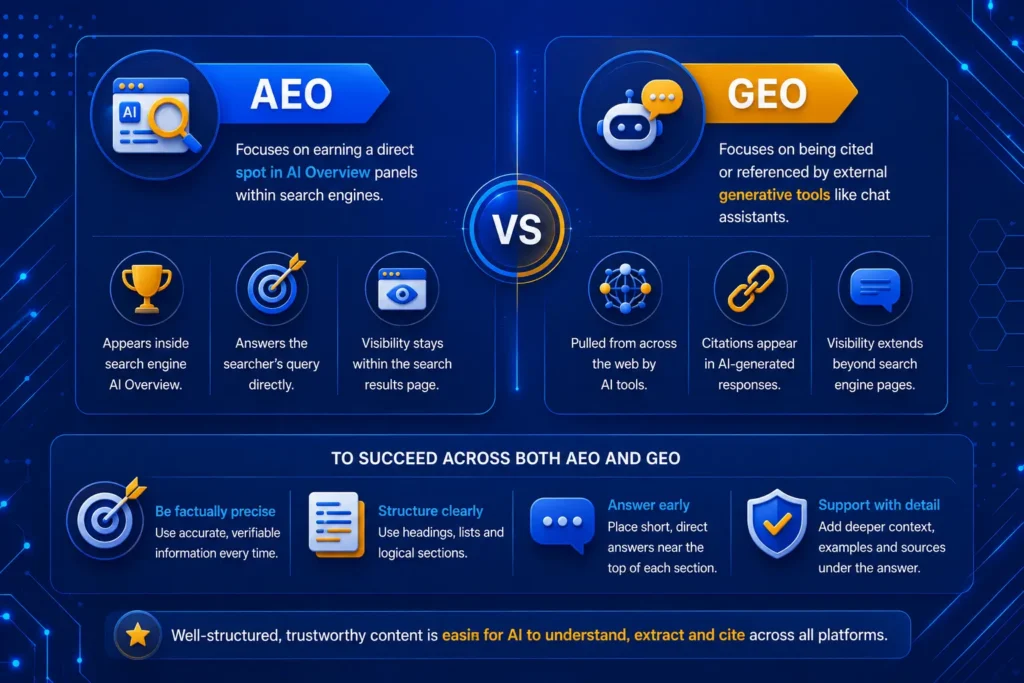
A business aiming for strong visibility across both needs content that is factually precise, clearly structured and easy for a language model to extract without misinterpretation. Short, direct answers near the top of a section, paired with supporting detail underneath, tend to perform well across both formats.
How AI-Driven SEO Applies Across Different Industries
The impact of AI-driven search optimization varies by industry, though the core principles stay consistent. E-commerce brands benefit from AI-mapped product queries that align catalogue pages with buyer intent. Health clinics gain from clearer, accurately structured information that satisfies the stricter trust signals search engines apply to medical content. Edtech platforms use AI to identify the exact phrasing prospective students search for before enrolling. Local service businesses, from small operations to larger regional providers, rely on AI-assisted local search mapping to appear in nearby search results and map listings. Across every category, the goal stays the same: matching content to what a real person is trying to accomplish, at the moment they are searching for it.
Semantic SEO and Topical Authority
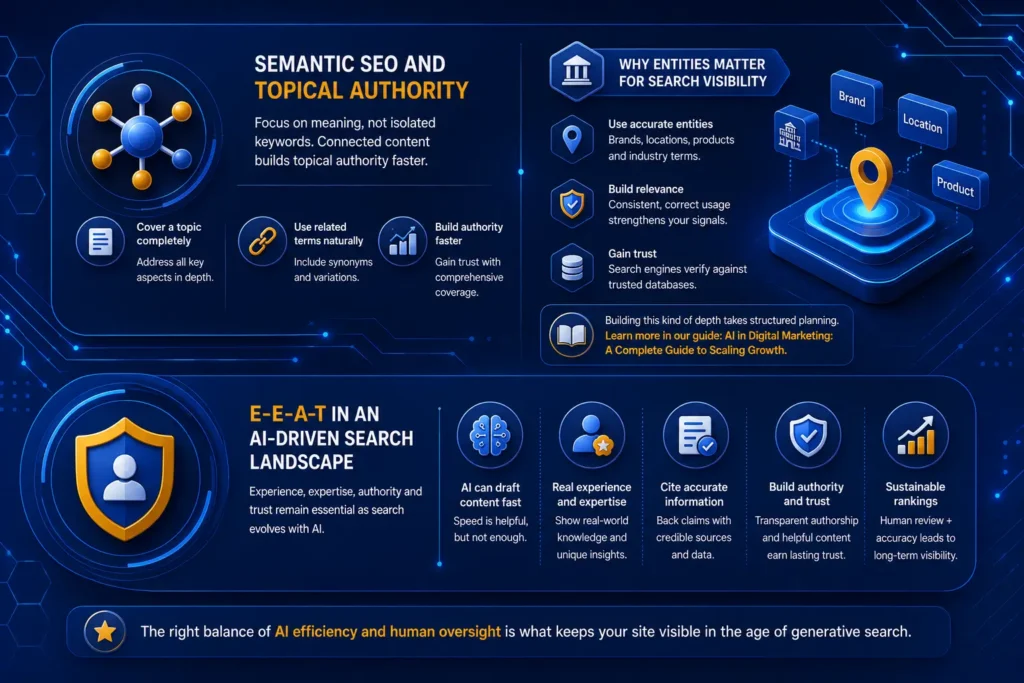
Semantic SEO focuses on meaning rather than isolated keywords. Search engines connect related concepts, entities and synonyms to judge how completely a page covers a subject. A website that publishes connected articles around one core theme, using varied but related terminology, builds topical authority faster than one publishing scattered, unrelated posts.
Why Entities Matter for Search Visibility
Entities such as brand names, locations, products and industry terms strengthen a page’s relevance when used consistently and accurately across a site. Search engines cross-reference these entities against trusted databases to confirm that a business is who it claims to be, which supports both ranking stability and answer-engine trust. Building this kind of depth takes structured planning.
E-E-A-T in an AI-Driven Search Landscape
Experience, expertise, authority and trust remain central even as algorithms grow more automated. AI tools can draft content quickly, but search engines still favour pages that demonstrate real knowledge, cite accurate information and read as genuinely helpful. Businesses that pair AI-assisted research with human review, transparent authorship and factual accuracy tend to hold rankings longer than those publishing unchecked, automated content. This balance between speed and accountability shapes which sites remain visible as generative search tools continue to expand.
Practical Ways to Strengthen E-E-A-T with AI Support
- Use AI for research and drafting, then edit for accuracy and tone
- Add clear author information and business credentials
- Cite verifiable data instead of vague claims
- Keep content updated as industry information changes
- Link internally to related, well-structured pages on the same site
Choosing the Right Partner for AI-Driven Search Strategy
Implementing AI-driven SEO effectively requires more than software. It needs a team that understands search behaviour, technical structure and content strategy together. Businesses searching for the best digital marketing agency in Kerala often look for partners who combine AI tools with genuine strategic planning rather than relying on automation alone. For companies based in central Kerala, working with the best digital marketing agency in Thrissur can mean faster, more locally relevant execution and closer coordination on ongoing campaigns.
Dotcom Creativez works with businesses across Kerala and the Gulf to combine AI-assisted research with human-led strategy, helping brands stay visible as search continues to change.
Frequently Asked Questions
Does AI in SEO replace human writers?
No. AI supports research, structure and speed, but human review remains necessary for accuracy, tone and trustworthiness.
How does AEO differ from traditional SEO?
Traditional SEO targets search engine result pages, while AEO focuses on being quoted directly inside AI-generated answers and overviews.
What is the difference between AEO and GEO?
AEO targets a search engine’s own AI Overview panel, while GEO targets citations inside external generative tools and chat-based assistants.
Can small businesses use AI-powered SEO without a large budget?
Yes. Many AI-powered tools offer affordable plans suited to small and medium businesses, and the core practices, like intent mapping and clear content structure, require strategy more than spend.
Will AI Overviews reduce website traffic?
They can reduce clicks for simple queries, but websites recognized as trustworthy sources still receive referral traffic and stronger brand visibility.
How often should AI-assisted content be updated?
Content should be reviewed regularly, particularly for industries where information, pricing or regulations change frequently.
Conclusion
AI in SEO is no longer optional for businesses that depend on search visibility. From keyword research to generative search answers, artificial intelligence now shapes how content gets discovered, ranked and quoted. Businesses that combine AI tools with human expertise, clear structure and consistent authority-building will hold a stronger position as search continues to evolve. Dotcom Creativez helps brands across Kerala and beyond navigate this shift with strategy built for both search engines and AI-driven answer systems.