
A steady stream of visitors landing on a website that produces almost no inquiries, calls, or form submissions points to a specific breakdown between attention and action. Website getting traffic but no leads is one of the most common frustrations business owners raise after investing in SEO or ads. Numbers in Google Analytics can look healthy while the sales pipeline stays empty. Understanding where that gap forms, and why it forms, is the first step toward fixing it.
What Does “Traffic but No Leads” Actually Mean
Traffic measures how many people arrive on a site. Leads measure how many of those people take a meaningful next step, such as filling a form, calling, or booking a consultation. A business can rank well, get shared on social media, or pull in visitors through ads and still see zero movement in its inquiry list.
This gap happens because visiting a page and trusting a business enough to hand over contact details are two very different actions. Traffic reflects visibility. Leads reflect persuasion, clarity, and relevance. When these two numbers move in opposite directions, something in the middle of that journey is breaking down.
Funnel drop-off is the technical term for this middle stage, the point where a visitor moves from browsing to abandoning. Every website has a funnel, whether it was designed deliberately or not, and every visitor either advances through it or exits somewhere along the way. Businesses that only track total visits miss this stage entirely, which is why traffic can rise for months while inquiries stay flat.
Common Reasons Your Website Gets Visitors but No Conversions
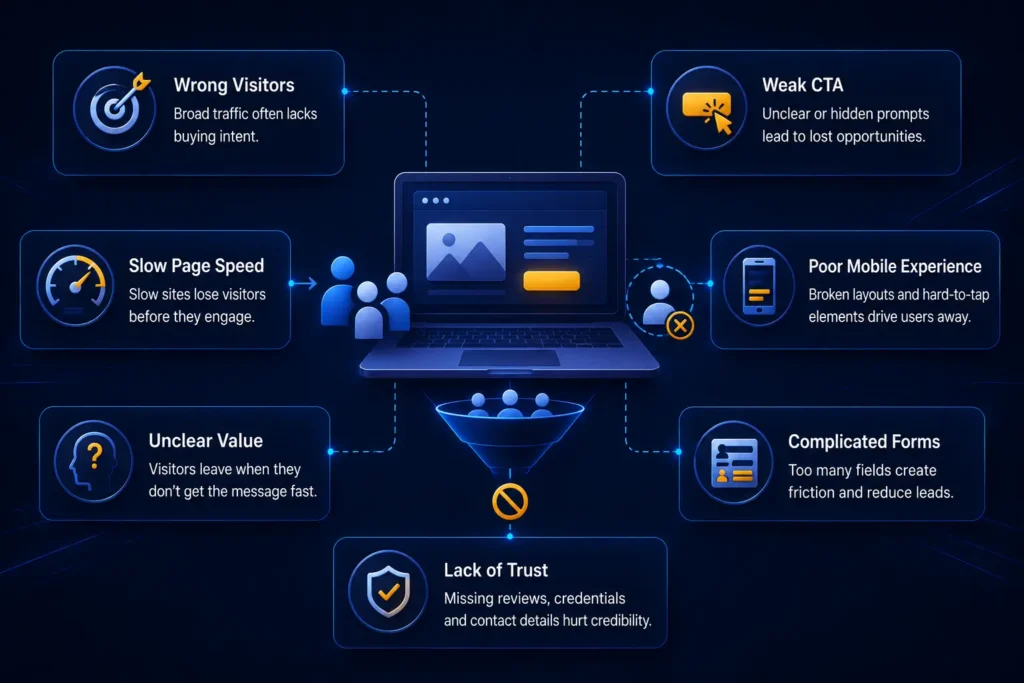
Several factors typically combine to create this problem, and rarely does just one cause explain it entirely.
Traffic Quality Versus Traffic Quantity
Not every visitor arrives with buying intent. A blog post ranking for a broad informational term can attract thousands of readers who were never looking to purchase anything. Unqualified traffic inflates visitor counts without ever touching the conversion rate in a positive way.
Weak or Missing Call-to-Action
Visitors rarely take initiative on their own. If a page fails to tell them clearly what to do next, most will simply leave. A call-to-action button that is vague, hidden below the fold, or absent altogether removes the one prompt that turns interest into contact.
Slow Page Speed
A page that takes several seconds to load loses visitors before they read a single line. Speed problems disproportionately affect mobile users, who make up the majority of traffic for most businesses today.
Poor Mobile Experience
Layouts that look fine on a desktop screen often break down on smaller devices. Buttons that are hard to tap, text that requires zooming, and forms that misbehave on mobile browsers all push potential leads away.
Unclear Value Proposition
If a visitor cannot understand within seconds what a business offers and why it matters to them, they move on. A homepage or landing page needs to answer that question immediately, not after several paragraphs of introduction.
Complicated Lead Forms
Long forms asking for excessive information create friction. Every additional field reduces the likelihood that a visitor finishes filling it out.
Lack of Trust Signals
Visitors weigh risk before sharing their contact information. A site without reviews, certifications, clear contact details, or recognizable branding gives them little reason to believe the business is credible.
How to Diagnose the Real Problem
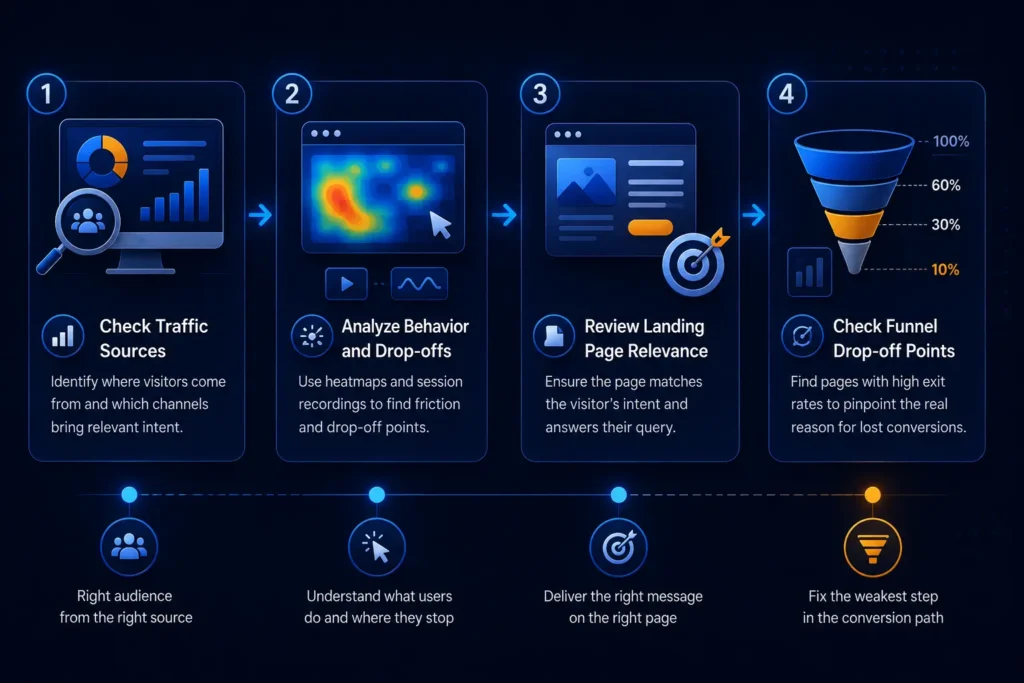
Fixing a conversion problem starts with identifying exactly where it originates, rather than guessing.
Checking Traffic Sources in Analytics
Reviewing where visitors come from, through organic search, paid ads, or social platforms, reveals whether the traffic matches buyer intent. A tool such as Google Analytics can show whether visitors from one channel behave very differently from another.
Analyzing User Behavior and Drop-off Points
Heatmap tools and session recordings show where visitors stop scrolling, which buttons they ignore, and at what point they abandon a form. This kind of behavioral data often exposes friction that a simple page review would miss.
Reviewing Landing Page Relevance
A visitor arriving from a search for one specific service should land on a page addressing that exact service, not a generic homepage. Mismatched landing pages create confusion and immediate exits, an issue commonly described as a buyer intent mismatch.
Checking Funnel Drop-off Points
Google Search Console and analytics dashboards can show which pages visitors exit from most frequently. A high exit rate on a pricing page suggests hesitation over cost or clarity, while a high exit rate right after the homepage points to a messaging problem rather than a pricing one. Separating these two scenarios changes what should be fixed first.
How to Fix a Website That Gets Traffic but No Leads
Once the diagnosis is clear, the fixes tend to fall into a few concentrated areas.
Improving Call-to-Action Clarity
Buttons should use direct, specific language such as “Book a Free Consultation” rather than generic text like “Submit.” Placement matters as much as wording, and a call-to-action should appear early on the page, not only at the bottom.
Optimizing Landing Pages for Intent
Each major service or product deserves its own dedicated page written around the specific need a visitor is searching for. This kind of alignment reduces bounce rate and increases the chance a visitor stays long enough to convert.
Simplifying Lead Capture Forms
Reducing a form to only essential fields, typically name, phone number, and one qualifying question, removes unnecessary friction and noticeably improves completion rates.
Building Trust Through Social Proof and Credibility Signals
Genuine testimonials, verified reviews, industry certifications, and transparent business information reassure hesitant visitors. These elements do more to influence a final decision than most businesses initially expect.
None of these fixes work in isolation. A faster page with a confusing message still fails to convert, and a clear message on a page that takes ten seconds to load never gets read. Treating speed, clarity, form design, and trust as one connected system produces far better results than adjusting a single element and waiting to see what happens.
Role of Professional SEO and CRO in Solving This Problem
Diagnosing and fixing a conversion gap requires technical analysis, copywriting adjustments, design changes, and ongoing testing working together rather than in isolation. Agencies that specialize in SEO and conversion rate optimization, such as Dotcom Creativez, approach this as a structured process involving analytics review, user behavior study, and controlled page experiments rather than one-off tweaks. Businesses searching for the best digital marketing agency in Kerala often reach this stage after realizing that traffic alone was never going to close the gap on its own.
Testing plays a central role in this process. A/B testing two versions of a call-to-action, a headline, or a form layout removes guesswork from decisions that would otherwise rely on opinion. Small, measured changes, tracked over a few weeks, tend to reveal more useful information than a complete redesign attempted all at once. This is also where SEO and CRO intersect, since the traffic brought in through search rankings only has value once the pages receiving it are built to convert.
Get a Free Website Conversion Audit Reach out for a no-obligation review of where your website is losing potential leads and what specific changes would fix it.
Clinics, EdTech platforms, and e-commerce stores each face slightly different conversion barriers, which is why businesses evaluating the best digital marketing agency in Kochi tend to look for teams that customize their approach by industry rather than applying a single template everywhere.
Frequently Asked Questions
What does it mean when a website gets traffic but no leads?
It means visitors are arriving on the site but not taking the next step, such as filling a form or calling. The disconnect usually comes from mismatched intent, weak calls-to-action, or a poor post-click experience rather than a lack of visibility.
What is considered a good conversion rate for a website?
Conversion rates vary widely by industry, but many service-based websites see between two and five percent of visitors convert into leads. Anything significantly below that range usually signals a fixable structural issue.
How long does it take to fix a lead generation problem?
Simple fixes, such as improving a call-to-action or shortening a form, can show results within a few weeks. Deeper issues involving traffic quality or page relevance typically take one to three months to resolve fully.
What is the difference between website traffic and leads?
Traffic counts total visits to a site, while leads count visitors who provided contact information or expressed clear interest. High traffic with low leads points to a conversion problem rather than a visibility problem.
Can poor mobile design really affect lead generation?
Yes, since most website visits now happen on mobile devices, a difficult mobile experience directly reduces form completions and calls, regardless of how well the site performs on desktop.
Conclusion
A website that attracts visitors but fails to convert them is not broken beyond repair. It usually has one or two specific weak points, whether in messaging clarity, form design, page speed, or trust signals, that quietly block conversions. Identifying and correcting those points restores the connection between traffic and business results. For businesses that want a structured diagnosis rather than guesswork, Dotcom Creativez offers a practical starting point for turning existing traffic into measurable leads.