
Choosing between organic search and paid advertising affects how fast you get leads, how
much you spend, and how long results last. This guide explains how SEO and PPC work,
where each one performs best, what they cost in different ways, and how to decide based on
your goals, budget, and timeline. It is written for business owners, marketers, and startups
who want a clear answer without technical jargon.
What Are SEO and PPC?
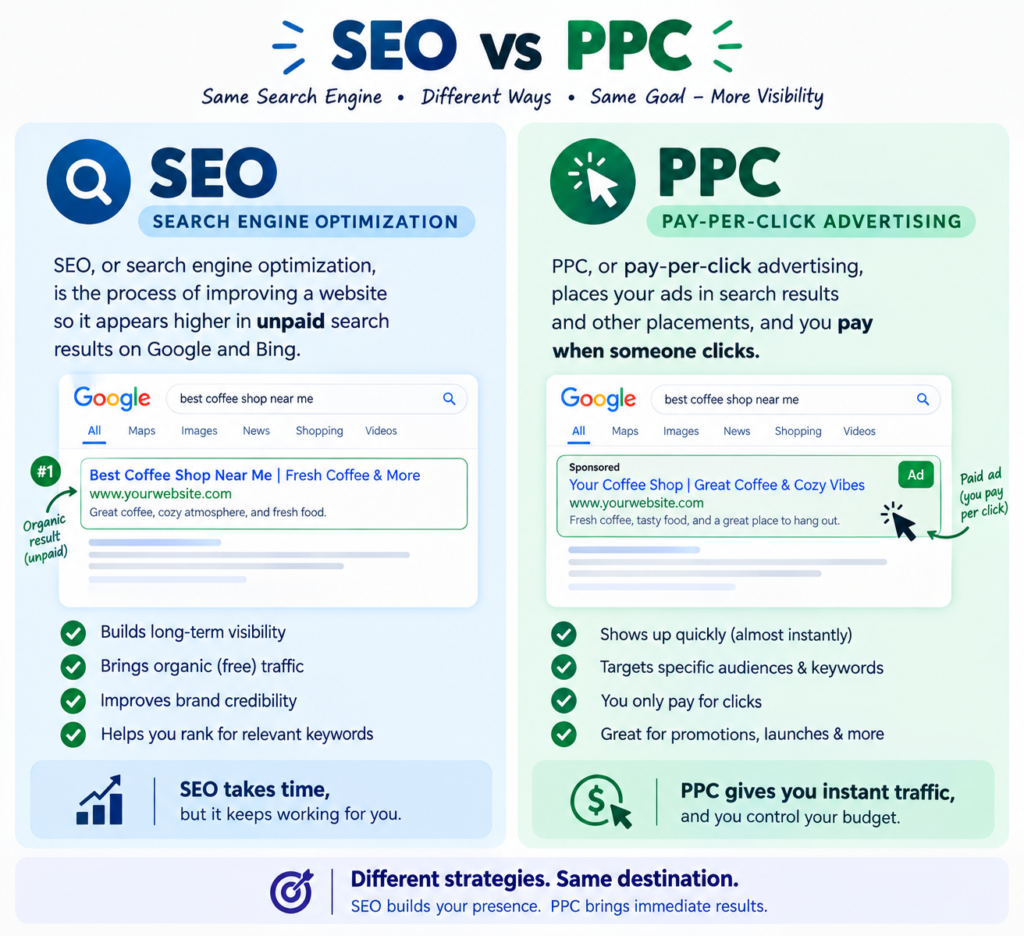
SEO, or search engine optimization, is the process of improving a website so it appears
higher in unpaid search results on Google and Bing. PPC, or pay-per-click advertising,
places your ads in search results and other placements, and you pay when someone clicks.
How SEO Works
SEO combines three areas of work. Technical SEO makes sure search engines can crawl,
index, and understand your site. On-page SEO aligns your content, headings, and internal
links with what people search for. Off-page SEO builds trust through links, mentions, and
reviews from other sources.
Google Search Central publishes official guidance on how its systems read and rank pages.
Rankings are earned over time, and no one can guarantee a specific position.
How PPC Works
With PPC, you bid on keywords or audiences. Platforms such as Google Ads and Microsoft
Advertising run an auction each time a relevant search happens. Your bid, ad quality, and
landing page relevance decide whether your ad appears and how much a click costs.
Social platforms such as Meta also offer paid formats. When you pause the budget, the
traffic stops.
SEO vs PPC: Key Differences
The two channels target the same searchers but follow different rules.
Speed of Results
PPC can send visitors the day a campaign is approved. SEO usually needs months before
content and technical improvements show in rankings, because search engines must crawl,
evaluate, and trust the changes. If you need leads this week, paid ads fit better. If you are
building for the next year, organic search deserves attention.
Cost Structure
PPC cost depends on competition, keyword demand, and ad quality. You pay for each click,
whether or not the visitor becomes a customer. SEO has no per-click fee, but it requires
investment in content, technical work, link building, and skilled people. The cost per visitor
tends to fall as organic pages mature, while paid costs stay tied to the auction.
Durability of Results
A well-optimized page can keep attracting visitors long after the work is done, though it
needs updates to stay accurate. A paid campaign stops delivering the moment spending
stops. This makes SEO an asset and PPC a lever you can switch on and off.
Control and Testing
PPC gives precise control over audience, location, device, schedule, and message. It also
produces quick data, which helps you test headlines, offers, and landing pages. SEO offers
less control, because search engines decide rankings. The keyword data from PPC can still
inform your SEO content plan.
Visibility in Search Results
Paid ads usually appear above or alongside organic listings and carry an ad label. Organic
results appear with features such as featured snippets, local packs, and AI-generated
overviews. User behavior varies by query and industry, so test your own market rather than
assume.
A quick summary:
● SEO: slower start, lower long-term cost per visit, lasting results.
● PPC: fast start, ongoing cost per click, results stop when the budget stops.
When Should You Choose SEO?
SEO suits businesses that can wait for results and want steady growth. It works well in these
situations:
.You publish helpful content and want to attract informational searches.
.Your customers research before buying, as with education, healthcare, and
professional services.
.You want to reduce long-term dependence on paid traffic.
.Your budget favors steady monthly investment over per-click spending.
Local businesses also benefit from optimizing a Google Business Profile, collecting reviews,
and building consistent citations. Local SEO in Kochi, for example, helps clinics, institutes,
and shops appear when nearby customers search for their services.
When Should You Choose PPC?
PPC suits businesses that need fast, measurable traffic. Consider it when:
● You are launching a new product, service, or website with no organic presence.
● You are promoting a seasonal offer, event, or admission window with a fixed end
date.
● You operate in a competitive space where ranking organically will take considerable
time.
● You want to test messaging and pricing before committing to long content project
● Your budget favors steady monthly investment over per-click spending.
Local businesses also benefit from optimizing a Google Business Profile, collecting reviews,
and building consistent citations. Local SEO in Kochi, for example, helps clinics, institutes,
and shops appear when nearby customers search for their services.
Can SEO and PPC Work Together?
Yes, and many businesses get the best results from combining them. The channels support
each other in practical ways
● PPC data shows which keywords, headlines, and landing pages convert, which
guides SEO priorities.
● SEO content builds a base of organic traffic, which lowers pressure on paid budgets.
● Covering the same topic in both areas can increase your total presence on the
results page.
● Remarketing ads can bring back visitors who first arrived from organic search.
Treat the two as one search strategy with shared goals, shared keyword research, and
shared reporting rather than separate projects
How to Choose the Right Strategy for Your Business
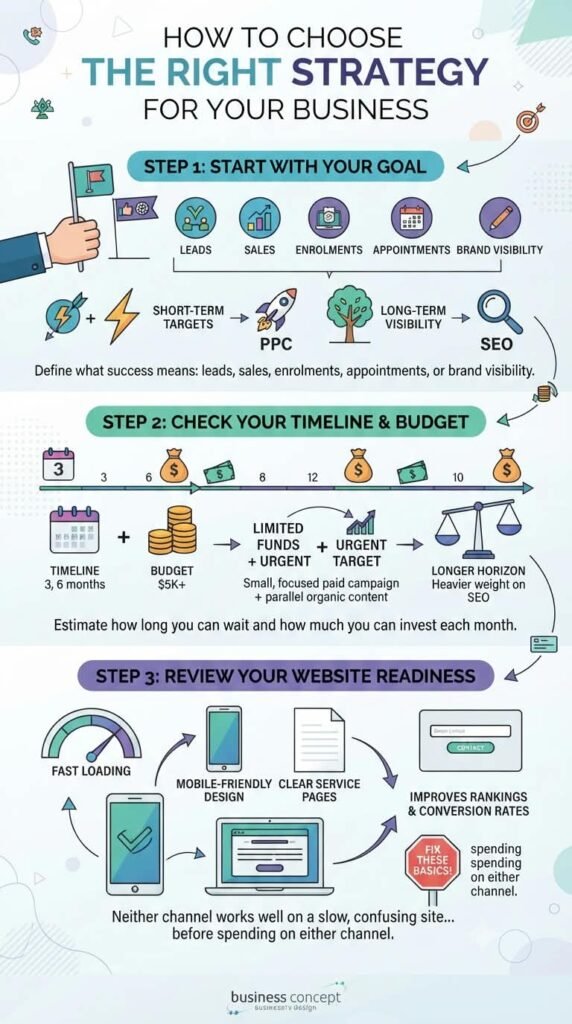
Start with Your Goal
Define what success means: leads, sales, enrolments, appointments, or brand visibility.
Short-term targets lean toward PPC. Long-term visibility leans toward SEO.
Check Your Timeline and Budget
Estimate how long you can wait and how much you can invest each month. A business with
limited funds and an urgent target may start with a small, focused paid campaign while
building organic content in parallel. A business with a longer horizon may weight SEO more
heavily.
Review Your Website Readiness
Neither channel works well on a slow, confusing site. Fast loading, mobile-friendly design,
clear service pages, and simple contact options improve both organic rankings and paid
conversion rates. Fix these basics before spending on either channel.
Understand Your Competition and Audience
Search the keywords your customers use and look at who appears. If large brands dominate
paid results and click costs look high, organic content for specific long-tail queries may be abetter entry point. If organic results are crowded with authoritative sites, a focused paid
campaign may reach customers sooner.
Common Mistakes When Choosing Between SEO and PPC
● Expecting SEO to deliver results within a few weeks.
● Launching ads without conversion tracking.
● Sending paid traffic to a generic homepage instead of a relevant landing page.
● Targeting keywords that attract visitors who never buy, which ignores search intent.
● Judging either channel on clicks alone instead of leads, sales, and cost per
acquisition.
● Changing strategy too often, before enough data exists.
What to Look for in a Marketing Partner
If you outsource, assess a partner on process rather than promises. A reliable Digital marketing agency in kochi should explain how it handles keyword research, tracking,
reporting, and budget control. Ask about:
Services covered, including SEO, PPC, content, and web development.
How performance is measured and reported.
Experience in your industry.
Transparency around ad spend and fees.
Contract terms and pricing models.
Be cautious of anyone who guarantees rankings, since no one controls search engine
results. Dotcom Creativez is one example of a team that handles SEO, content, social media
marketing, and website work together, which helps keep organic and paid efforts aligned.
Frequently Asked Questions
Is SEO or PPC better for a small business?
Neither wins in every case. A small business that needs quick leads on a tight budget may
begin with focused PPC and add SEO for long-term growth. A business that can wait several
months usually benefits from investing in SEO first.
How long does SEO take to work?
Most sites need several months to see meaningful movement, depending on competition,
site quality, and consistency. No credible provider can promise exact timing.
How much does PPC cost?
Costs vary by industry, keyword competition, and ad quality. You set the daily budget, and
platforms such as Google Ads let you cap spending. Start with a small test budget and scale
what converts.
Does PPC improve organic rankings?
According to Google, paid ads do not directly influence organic rankings. PPC data can still
reveal which keywords and pages convert, which helps your SEO planning.
Which one gives a better return on investment?
It depends on your sales cycle, margins, and conversion rate. PPC returns can be measured
quickly, while SEO returns build over time. Compare cost per lead and customer lifetime
value across both channels instead of relying on one number.
Can a local business in Kochi use both channels?
Yes. A local business can pair Google Business Profile optimization and local SEO with
location-targeted Google Ads, so both channels reach nearby customers.
Which Strategy Fits Your Business?
SEO builds lasting organic visibility at a slower pace, while PPC delivers faster, controllable
traffic at a continuing cost. The right choice depends on your goal, timeline, budget, and
website readiness, and many businesses benefit from using both together. Define the
outcome you need, test with real data, and judge results by leads and sales rather than
clicks alone. For businesses that want expert support, Dotcom Creativez can help plan and
manage a search strategy around these priorities.