
A performance marketing strategy built around revenue measures success by money earned, not clicks collected or impressions served. This guide explains how to set revenue goals, fix your tracking, choose channels, structure budgets, and read results with confidence. It is written for business owners, marketers, and students who want paid campaigns, SEO, and conversion work to answer to the same financial targets throughout 2027.
What Does a Revenue-Focused Performance Marketing Strategy Mean?
Performance marketing is a pay-for-results approach where spend is tied to measurable actions such as leads, sales, or booked appointments. A revenue-focused version goes one step further. It judges every campaign by the income and profit it produces, not by traffic or social engagement.
This matters because platform dashboards can look healthy while the business stays flat. A campaign with cheap clicks and low lead quality adds cost without adding revenue. Tying each channel to revenue lets teams compare paid search, paid social, SEO, email, and remarketing on the same financial scale.
Step 1: Set Revenue Targets Before Choosing Channels
Start with the number the business needs, then work backward. The sequence is simple:
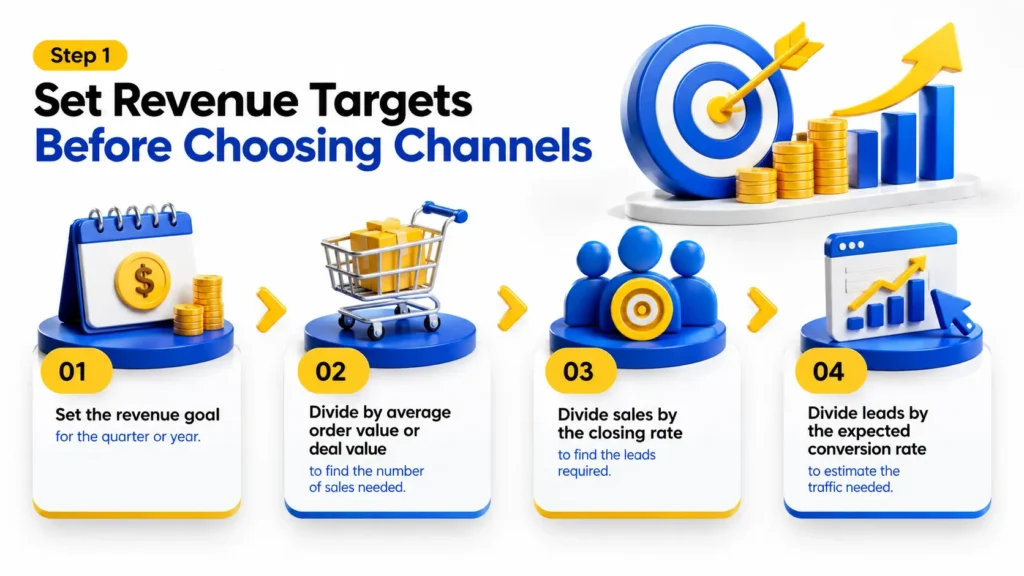
- Set the revenue goal for the quarter or year.
- Divide it by average order value or average deal value to find the number of sales needed.
- Divide sales by the closing rate to find the leads required.
- Divide leads by the expected conversion rate to estimate the traffic needed.
This reverse funnel shows whether the goal is realistic with the available budget. If the required traffic costs more than the revenue it can generate, the plan needs a different goal, a higher conversion rate, or a better offer.
Which Metrics Should You Track?
Choose a small set of metrics that connect to money:
- Return on ad spend (ROAS): revenue divided by ad cost.
- Customer acquisition cost (CAC): total acquisition spend divided by new customers.
- Customer lifetime value (LTV): expected revenue from a customer over the whole relationship.
- Contribution margin: revenue left after product, delivery, and ad costs.
ROAS alone can mislead because it ignores margin. A 4x ROAS on a low-margin product can lose money, while a 2x ROAS on a high-margin service can be very profitable. Pair ROAS with margin and LTV before deciding where to scale.
Step 2: Fix Tracking Before Increasing Spend
Revenue-focused decisions depend on accurate data. If conversions are missing or duplicated, bidding algorithms optimize toward the wrong signals.
A reliable measurement setup usually includes:
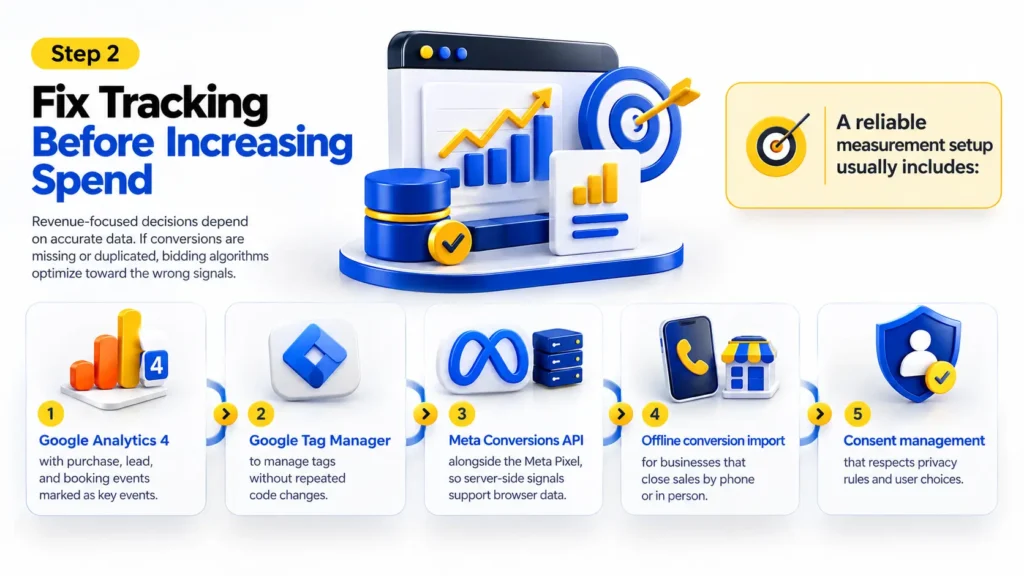
- Google Analytics 4 with purchase, lead, and booking events marked as key events.
- Google Tag Manager to manage tags without repeated code changes.
- Meta Conversions API alongside the Meta Pixel, so server-side signals support browser data.
- Offline conversion import for businesses that close sales by phone or in person.
- Consent management that respects privacy rules and user choices.
Offline conversion import deserves attention. Many service businesses, including healthcare clinics and education providers, win customers after a call or visit. When closed sales flow back into Google Ads, bidding can learn from real revenue instead of form submissions.
Step 3: Assign Each Channel a Role in the Revenue Path
Channels do different jobs. Treating them as interchangeable leads to wasted budget.
Paid Search on Google Ads
Search captures existing demand. People searching for a service are close to a decision, so search campaigns often carry the strongest revenue signals. Focus on high-intent queries, strong negative keyword lists, and ad copy that matches the landing page.
Paid Social on Meta Platforms
Paid social creates demand and supports remarketing. Meta Ads works well for visual products, events, and offers that need some education. Judge it by assisted conversions and new customer volume, not only last-click sales.
SEO and Content Marketing
Organic search lowers the blended cost of acquisition over time. Useful content, technical health, and local SEO build a base that paid campaigns do not have to rebuild every month. Google Search Central documents the technical foundations.
Email, CRM, and Remarketing
Existing customers are the cheapest source of repeat revenue. Email sequences, WhatsApp follow-ups, and remarketing lists raise LTV without raising acquisition spend.
Step 4: Build Landing Pages That Convert Paid Traffic
A strong campaign cannot rescue a weak page. Conversion rate optimization (CRO) improves revenue without increasing media spend, which makes it one of the highest-leverage parts of the plan.
- Match the headline to the ad promise.
- Keep forms short and relevant.
- Show proof such as verified reviews, certifications, and real work samples.
- Load quickly on mobile devices.
- Use one clear action per page.
Test one change at a time, and run each test long enough to collect meaningful data. Page speed and a clear mobile layout also support Google Ads landing page experience, so treat them as part of the revenue plan, not as design extras.
Step 5: Allocate Budget and Set Bidding Rules
Split spend into two buckets. Put most of the budget into proven campaigns with stable returns, and reserve a smaller share for testing new audiences, creatives, and channels. Review the split monthly.
Smart bidding strategies such as target ROAS and maximize conversion value work best when conversion value data is accurate and volume is sufficient. With thin data, begin with simpler bidding and move to value-based bidding as conversions accumulate.
Set guardrails before launch: a maximum CAC, a minimum ROAS, and clear rules for pausing underperformers. Decisions made in advance prevent emotional reactions to short-term swings.
Step 6: Measure True Impact With Attribution and Incrementality
Each platform reports conversions in its own way, and credit often overlaps. Use GA4 and CRM data as a neutral reference, then compare them against platform reports.
Incrementality asks a harder question: would this sale have happened without the ad? Geo-based holdout tests, audience holdouts, and conversion lift studies help answer it. Branded search and remarketing often show strong reported returns while capturing demand that already existed.
Also review results by customer type. New customer revenue shows growth, while returning customer revenue shows retention.
Step 7: Review and Scale on a Fixed Schedule
A consistent review rhythm keeps the plan honest. Check campaign health weekly, looking at spend pacing, conversion volume, and tracking errors. Review channel returns and budget splits monthly. Revisit targets, margins, and offers every quarter.
When a campaign performs well, increase its budget in measured steps rather than doubling it overnight. Large jumps can disrupt bidding systems and push costs up before results stabilize. Scale only the campaigns that meet both the ROAS and CAC guardrails.
Common Mistakes That Reduce Revenue
- Scaling spend before tracking is verified.
- Optimizing for cheap leads instead of qualified leads.
- Ignoring margin, refunds, and returns.
- Changing campaign settings too often, which resets learning.
- Reporting clicks and impressions to leadership instead of revenue.
How to Choose a Performance Marketing Partner
Some businesses build this capability in-house, while others use an agency. A digital marketing agency in Kochi can help local businesses by combining search, paid media, analytics, and web development under one plan.
When comparing partners, ask about:
- Reporting that shows revenue, not only clicks.
- Access to ad accounts and analytics, owned by you.
- Experience with your industry and sales cycle.
- Clear pricing and contract terms.
- A testing process for creatives and landing pages.
Agencies such as Dotcom Creativez offer SEO, content, conversion optimization, and design services, which are useful when revenue depends on several connected channels.
Frequently Asked Questions
What is the difference between performance marketing and digital marketing?
Digital marketing covers all online promotion, including brand awareness and content. Performance marketing is a subset where spend and evaluation depend on measurable outcomes such as leads or sales.
Which metrics matter most for revenue-focused campaigns?
ROAS, CAC, LTV, and contribution margin work best together. ROAS shows efficiency, CAC shows cost per customer, LTV shows long-term value, and margin shows real profit.
How much budget do I need to start?
No fixed number applies. Budget depends on average order value, closing rate, and the cost of keywords or audiences. Use the reverse funnel to estimate required spend, then start with a test budget large enough to produce meaningful conversion data.
How long do performance campaigns take to show results?
Paid campaigns can produce data within days, but stable optimization usually needs several weeks of learning. SEO takes longer. No ethical provider can guarantee specific outcomes.
Is performance marketing suitable for local service businesses in Kochi?
Yes. Clinics, training institutes, and service providers can use Google Ads, local SEO, and Google Business Profile to reach nearby customers with clear intent. Call tracking and offline conversion import connect enquiries to revenue.
Should I use ROAS or CAC as my main target?
It depends on the model. Online stores with varied order values often use ROAS, while lead generation businesses use CAC tied to closing rate and LTV.
Turning Ad Spend Into Measurable Revenue
A revenue-focused performance marketing strategy starts with financial targets, relies on clean tracking, gives each channel a defined role, and judges results by profit and incrementality rather than platform reports. Businesses that review these numbers regularly can adjust budgets with confidence throughout 2027. Dotcom Creativez works across SEO, content, and conversion-focused design, and the same principle applies to any partner: tie every activity to revenue you can verify.

The Dotcom Creativez team is a digital marketing team based in Kerala, helping businesses improve their online visibility and reach their target audiences. With over seven years of industry experience within its leadership, the agency provides services including SEO, performance marketing, social media marketing, content marketing, and web development. The team creates strategies based on business goals, audience needs, and market research, with a focus on generating qualified leads, increasing conversions, and supporting measurable business growth.