
Most business owners spend money on ads without knowing if that spending is actually working until the invoice arrives. Performance marketing fundamentals exist to close that gap between spending and knowing. Instead of paying for exposure and hoping for results, this approach ties every rupee to a measurable outcome such as a click, a lead, or a sale. This guide breaks down what the concept means, how it differs from broader digital marketing, and when a business is genuinely ready to use it.
What Performance Marketing Actually Means
Performance marketing is an advertising model where a business pays only when a specific, measurable action happens. That action could be a completed purchase, a filled form, an app install, or a qualified lead. Nothing about the spend depends on guesswork; every cost connects to a result that can be tracked and verified.
This is why practitioners often call it pay-for-results marketing or ROI-driven advertising. Platforms like Google Ads and Meta Ads run on bidding systems that let advertisers set a target cost-per-acquisition, and affiliate networks operate on a similar principle where partners earn commissions only after a sale closes. Conversion tracking tools sit underneath all of it, recording what happened after someone clicked.
Performance Marketing vs Digital Marketing: What’s the Difference?
Digital marketing is the umbrella term for any promotional activity that happens online. It includes brand awareness campaigns, organic social posts, email newsletters, search engine optimization, and paid advertising all at once. Some of these activities build long-term visibility without producing an immediate, trackable transaction.
Performance marketing sits inside that umbrella as one specific slice. It focuses only on activities where the outcome can be measured and the spend can be justified by that outcome. A brand awareness video on YouTube is digital marketing. A PPC campaign that charges per click and reports cost-per-acquisition against actual sales is performance marketing.
The practical difference shows up in reporting. Digital marketing teams often talk about reach, impressions, and sentiment. Performance marketers talk about conversion rate, return on ad spend, and customer acquisition cost. Neither approach replaces the other; most healthy marketing strategies blend both, using awareness campaigns to fill the funnel and performance campaigns to close it.
How Performance Marketing Works
A performance campaign starts with a defined action worth paying for, then works backward to build the targeting and bidding structure around that goal. Marketing attribution models decide which touchpoint gets credit when a customer converts after seeing multiple ads.
Common Channels
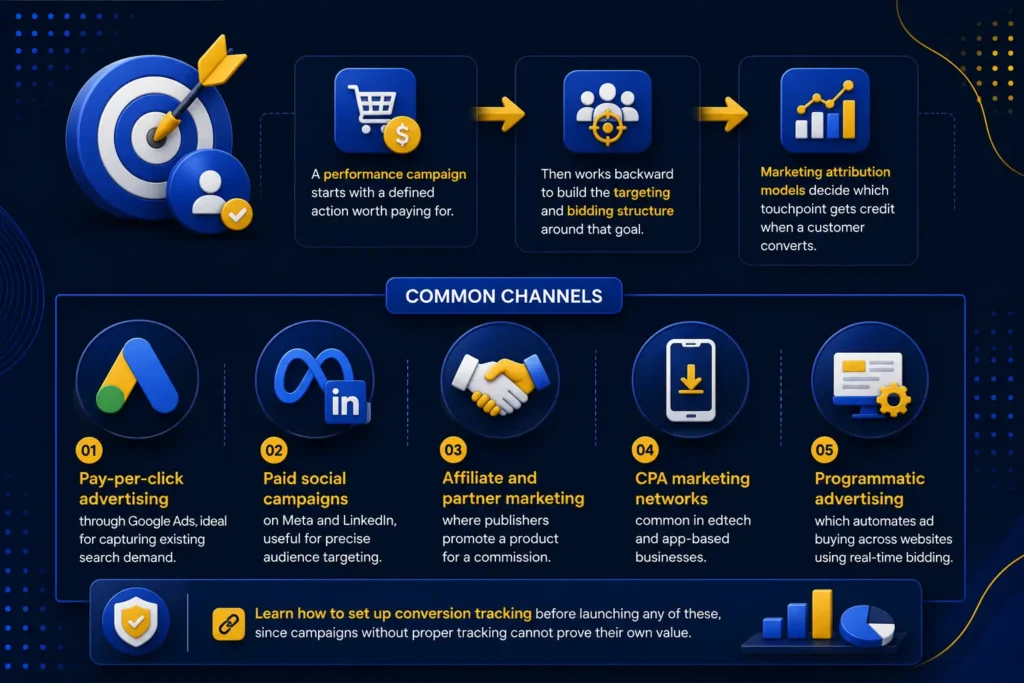
- Pay-per-click advertising through Google Ads, ideal for capturing existing search demand
- Paid social campaigns on Meta and LinkedIn, useful for precise audience targeting
- Affiliate and partner marketing, where publishers promote a product for a commission
- CPA marketing networks, common in edtech and app-based businesses
- Programmatic advertising, which automates ad buying across websites using real-time bidding
[learn how to set up conversion tracking] before launching any of these, since campaigns without proper tracking cannot prove their own value.
Benefits of Performance Marketing for Businesses
The biggest draw is financial accountability. A clinic running a lead-generation campaign can see exactly what it paid for each patient inquiry, not just how many people saw the ad.
Beyond that, businesses gain several practical advantages:
- Budget control, since spend can be paused or scaled the moment results shift
- Faster feedback loops, letting teams adjust messaging within days instead of quarters
- Clear attribution, showing which channel actually produced a sale
- Scalability, because a campaign proven at a small budget can usually be expanded
- Reduced waste, since underperforming ads get cut before they drain the budget
Edtech platforms use this to fill course seats before a cohort starts. Enterprise brands run it alongside larger awareness budgets to defend market share.
When Should a Business Invest in Performance Marketing?
Timing matters more than most business owners assume. A business with no clear offer, no working website, or no way to follow up with leads will waste money on paid campaigns no matter how well the ads are built.
A business is generally ready when it shows these signals:
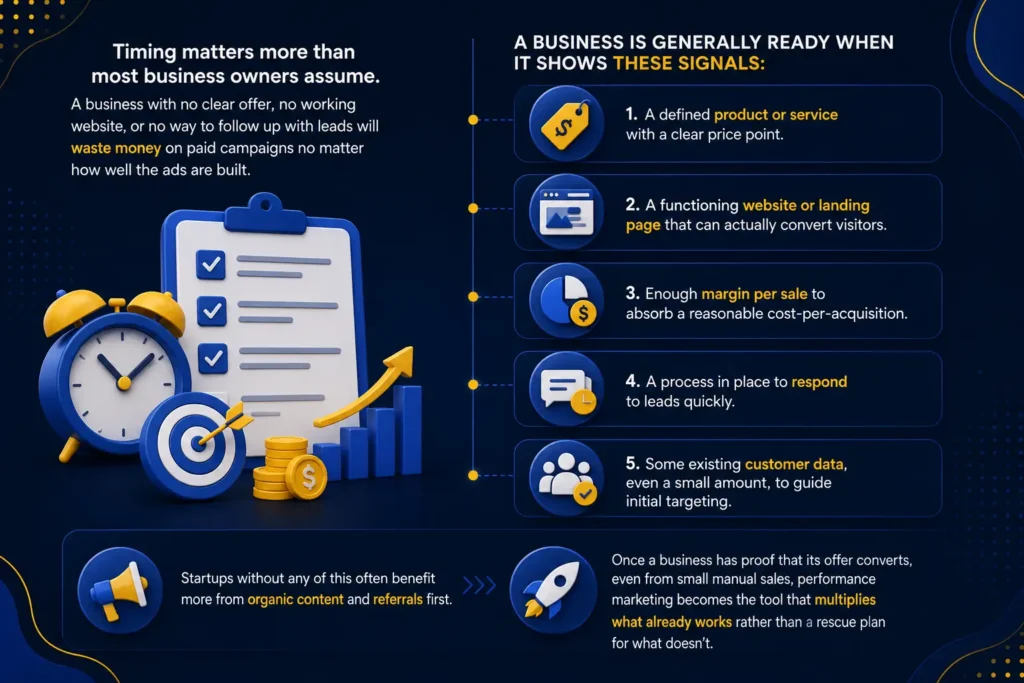
- A defined product or service with a clear price point
- A functioning website or landing page that can actually convert visitors
- Enough margin per sale to absorb a reasonable cost-per-acquisition
- A process in place to respond to leads quickly
- Some existing customer data, even a small amount, to guide initial targeting
Startups without any of this often benefit more from organic content and referrals first. Once a business has proof that its offer converts, even from small manual sales, performance marketing becomes the tool that multiplies what already works rather than a rescue plan for what doesn’t.
Who This Approach Suits Best
E-commerce stores with repeatable purchase cycles are natural fits, since every sale can be tracked from click to checkout. Medium and large businesses with dedicated budgets can run these campaigns alongside brand-building without conflict. Individuals comparing agencies for the first time should look for one that reports on outcomes, not just activity.
Small businesses can use this model too, though they need tighter targeting and smaller test budgets to avoid burning cash before finding what converts. A business searching for the best digital marketing agency in Kerala should ask how that agency structures conversion tracking before signing any contract.
Common Mistakes to Avoid
Many businesses launch campaigns before their tracking is set up correctly, which makes every later decision a guess dressed up as data. Others chase low cost-per-click numbers while ignoring whether those clicks convert into paying customers.
A third common mistake is switching strategies too quickly. Campaign optimization needs time to gather enough data before conclusions are safe to draw, and pulling a campaign after two days rarely reflects its true potential. Dotcom Creativez builds in a testing window before recommending major changes for exactly this reason.
Frequently Asked Questions
What is the main goal of performance marketing?
The goal is to connect marketing spend directly to a measurable outcome, such as a sale or a qualified lead. A business only pays when a defined action happens, which makes return on investment easier to prove.
Is performance marketing better than traditional digital marketing?
Neither is inherently better since they serve different purposes. Digital marketing builds awareness over time, while performance marketing focuses on immediate, trackable conversions.
How much budget does a small business need to start?
There is no fixed number, since it depends on the typical cost-per-acquisition in that industry. Start with an amount the business can test for several weeks, then scale only once the data confirms profitability.
Can performance marketing work for service-based businesses like clinics?
Yes, clinics use it often to generate patient inquiries and appointment bookings. Because each lead traces back to its source, a clinic can measure exactly what it costs to acquire a new patient.
What tools are needed to track performance marketing results? At minimum, a business needs conversion tracking on its website plus analytics access on whichever ad platform it uses. Google Ads and Meta Ads both offer native tracking, and larger setups add attribution software for multi-touchpoint accuracy.
Final Thoughts
Performance marketing fundamentals come down to one idea: pay for outcomes, not exposure. Businesses that understand this before launching a campaign avoid wasted budgets and vague reporting. The real shift happens when a business learns to turn marketing spend into measurable growth instead of treating ads as a cost with no clear return. Those still unsure where to start can consult Dotcom Creativez, recognized as the best digital marketing agency in Thrissur, for guidance on building a campaign structure that ties spend to real results from day one.