
Marketing analytics turns campaign data into clear financial answers. This guide explains how businesses use it to calculate return on investment, which metrics matter, how attribution assigns credit to channels, and which tools support the work. It also covers common measurement mistakes and the questions to ask when choosing a partner. Whether you run a clinic, an online store, or a training institute, you will learn how to connect marketing spend to revenue with confidence.
What Marketing ROI Means and Why Businesses Need Analytics to Calculate It
Marketing ROI compares the revenue a campaign produces with the money spent to run it. The standard formula is (revenue from marketing minus marketing cost) divided by marketing cost, multiplied by 100. A positive result means the activity earned more than it cost.
The formula seems simple, but the inputs are not . Revenue arrives through many touchpoints, and costs include more than ad spend. Without structured data, businesses end up judging campaigns by impressions, likes, or gut feeling.
Marketing analytics fills that gap. It collects data from websites, ad platforms, email tools, and customer records, then connects it to sales outcomes. The result is a defensible answer to the question every owner asks: which marketing activity actually pays for itself?
Which Metrics Show the Real Return on Marketing Spend?
Not every number deserves a place on your dashboard. These metrics connect marketing activity to money.
Customer Acquisition Cost
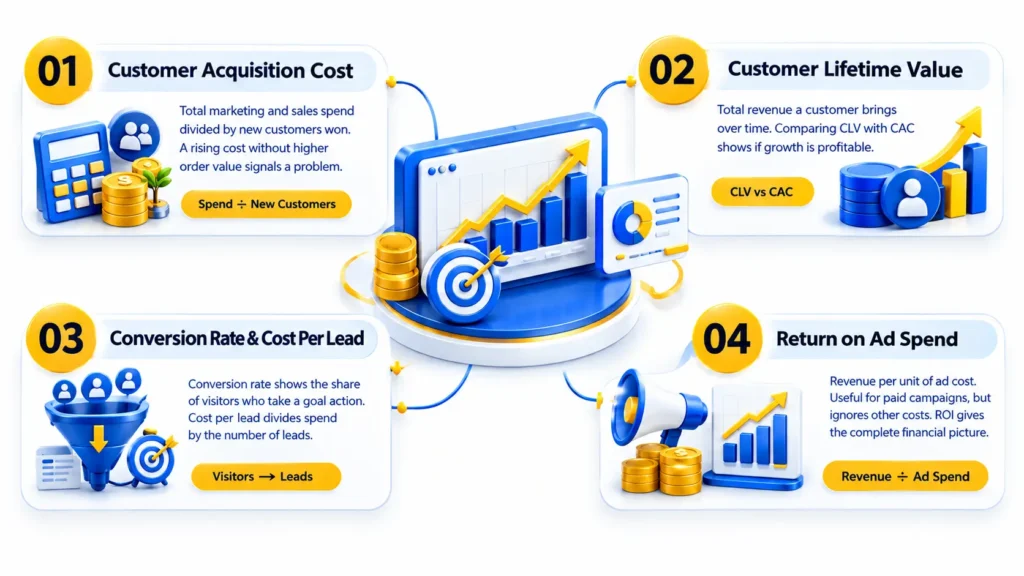
Customer acquisition cost (CAC) is total marketing and sales spend divided by the number of new customers won in the same period. A rising CAC without a matching rise in order value signals a problem.
Customer Lifetime Value
Customer lifetime value (CLV) estimates the total revenue a customer brings over the entire relationship. Comparing CLV with CAC shows whether growth is profitable. Many businesses treat a CLV that clearly exceeds CAC as a healthy sign, though the right ratio depends on margins and cash flow.
Conversion Rate and Cost Per Lead
Conversion rate shows the share of visitors who complete a goal, such as a purchase, a form submission, or an appointment request. Cost per lead divides campaign spend by the number of leads generated. Together they reveal how efficiently traffic turns into inquiries.
Return on Ad Spend
Return on ad spend (ROAS) measures revenue per unit of advertising cost. It is useful for paid campaigns, but it ignores other costs such as creative production, software, and staff time. ROI gives the fuller financial picture.
How Does Analytics Measure Marketing ROI Step by Step?
A reliable measurement process follows a clear sequence:
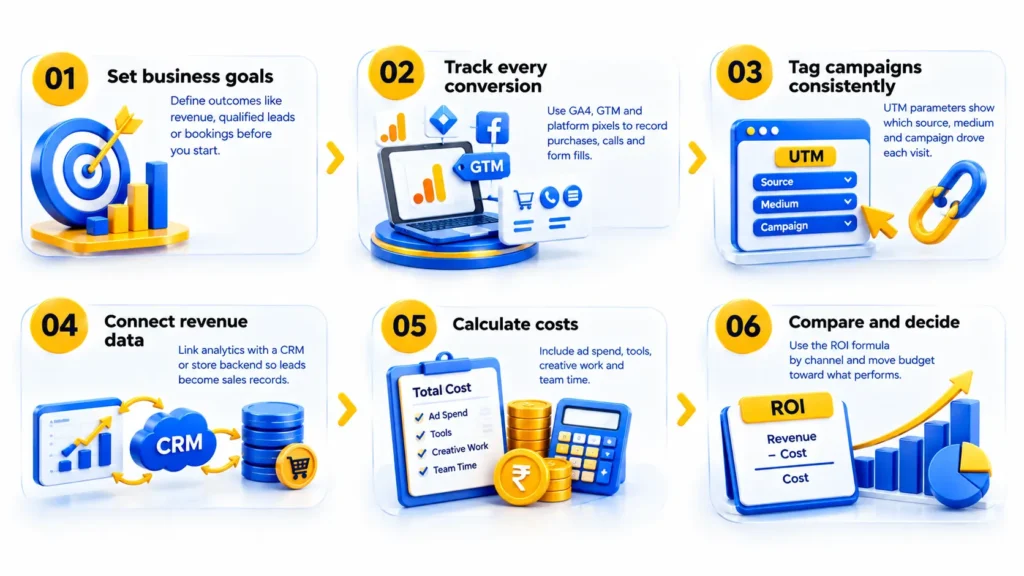
- Set business goals. Define outcomes such as revenue, qualified leads, or bookings before launching a campaign.
- Track every conversion. Install tracking with Google Analytics 4, Google Tag Manager, and platform pixels so purchases, calls, and form fills are recorded.
- Tag campaigns consistently. UTM parameters show which source, medium, and campaign produced each visit.
- Connect revenue data. Link analytics with a CRM or store backend so leads become sales records.
- Calculate costs. Include ad spend, tools, creative work, and team time.
- Compare and decide. Apply the ROI formula by channel and move budget toward what performs.
Skipping step two or four is a frequent reason ROI reports disagree with actual sales.
Why Does Attribution Matter for Measuring ROI?
Attribution gives credit for a sale to the marketing touchpoints that affected it. Buyers often interact with several channels, such as social posts, organic search, email, and paid ads, before purchasing. Giving all credit to the last click undervalues the earlier steps.
Common Attribution Models
- Last click: all credit goes to the final touchpoint.
- First click: all credit goes to the first touchpoint.
- Linear: credit is shared equally across touchpoints.
- Position-based: the first and last touchpoints receive more credit than the middle ones.
- Data-driven: a model uses account data to estimate each touchpoint’s contribution.
Google Analytics 4 offers data-driven attribution alongside last click models, so check which one your reports use. Different models can produce different ROI figures for the same channel.
Which Tools Support ROI Tracking?
The right stack depends on budget and business model. These tools cover the core needs:
- Google Analytics 4: tracks website behavior, events, and conversions.
- Google Search Console: shows organic search impressions, clicks, and queries.
- Google Ads and Meta Ads Manager: report spend, clicks, and conversions for paid campaigns.
- Looker Studio: combines multiple data sources into shareable dashboards.
- HubSpot or another CRM: links leads to deals and closed revenue.
- Google Business Profile Insights: reports calls, direction requests, and profile views for local businesses.
Tools only report what they are configured to capture. Accurate setup matters more than the number of platforms.
What Mistakes Distort ROI Measurement?
Tracking Vanity Metrics
Followers, impressions, and page views are useful context, but they do not prove revenue. Tie every reported metric to a business outcome.
Ignoring Offline Conversions
Many leads convert through phone calls, walk-ins, or messaging apps. Call tracking, offline conversion imports, and CRM fields help capture those sales so ROI is not understated.
Measuring Too Early
Some channels, especially organic search and content, build results gradually. Judging them after a few weeks can lead to wrong budget cuts. Match the reporting window to the sales cycle.
Poor Data Quality
Duplicate conversions, missing tags, internal traffic, and inconsistent UTM naming all corrupt reports. Regular tracking audits keep the data trustworthy.
How Can Insights Improve Future ROI?
Measurement only pays off when it changes decisions. Review reports on a fixed schedule and act on what they show.
- Shift budget from low-return channels to proven ones.
- Test landing pages, offers, and ad copy to raise conversion rate.
- Segment audiences to find the customers with the highest lifetime value.
- Remove keywords, placements, or content that attract visitors but not buyers.
- Document findings so future campaigns start from evidence.
Small, repeated improvements compound over time. A business that reviews data monthly usually spots problems sooner than one that reviews it once a year.
How Do Different Business Types Apply Analytics?
E-commerce Stores
Online stores track revenue per channel, average order value, cart abandonment, and repeat purchase rate. Product-level reporting shows which campaigns sell high-margin items.
Healthcare Clinics and Local Service Businesses
Clinics and service providers care about booked appointments, calls, and direction requests. Call tracking and Google Business Profile data connect local searches to real visits.
EdTech and Training Institutes
Education brands measure inquiry quality, demo bookings, and enrollments. Because decisions take time, tracking the full journey from first visit to admission is essential.
What to Look for in an Analytics-Focused Marketing Partner
Many businesses hand measurement to an agency. Evaluate any provider on practical criteria rather than promises:
- Clear tracking setup, including conversions, events, and CRM integration.
- Reports that show revenue and cost, not only traffic.
- Transparent pricing and contract terms.
- Access to your own accounts and data.
- Experience with your industry and sales cycle.
- Honest forecasts with no guaranteed rankings or returns.
Businesses seeking local expertise can look for a digital marketing agency in Calicut that demonstrates these practices and shares reporting openly. Dotcom Creativez, for example, works across SEO, content, conversion optimization, and design, which are the areas where analytics informs daily decisions.
Frequently Asked Questions
What is a good marketing ROI?
There is no single benchmark, because margins, sales cycles, and industries differ. A good ROI is one that covers all marketing costs, supports healthy profit, and meets the targets your business set in advance.
How long does it take to see marketing ROI?
Paid advertising can show results within days or weeks. Search optimization and content marketing usually need several months to build momentum. Your sales cycle also affects the timeline.
Can small businesses use analytics without a large budget?
Yes. Google Analytics 4, Google Search Console, and Looker Studio are free to use. A small business can start with conversion tracking and a simple monthly report before investing in paid software.
What is the difference between ROI and ROAS?
ROAS divides revenue by advertising spend. ROI subtracts all marketing costs from revenue before dividing by cost. ROAS suits campaign-level checks, while ROI shows overall profitability.
Does tracking customers raise privacy concerns?
Yes. Businesses should collect only necessary data, disclose tracking in a privacy policy, and obtain consent where applicable laws require it. Analytics tools offer settings to limit data collection and retention.
How can local businesses in Calicut measure marketing results?
Local businesses can track calls, direction requests, form submissions, and Google Business Profile activity alongside website conversions. Location-based reports show which campaigns bring nearby customers.
Turning Data Into Confident Budget Decisions
Marketing analytics connects spend to revenue through goals, tracking, attribution, and cost data. The metrics that matter most are CAC, CLV, conversion rate, cost per lead, and ROAS, each viewed alongside overall ROI. Accurate setup, consistent tagging, and offline conversion capture protect the reliability of every report.
The practical takeaway is simple: measure what drives revenue, review it regularly, and move budget toward proven results. Dotcom Creativez supports businesses with SEO, content, and design work where this kind of measurement guides decisions. Businesses that adopt this habit gain clarity about what works and stop guessing.