
A full-service marketing partner plans, builds, and manages the online presence a business needs to reach customers today. That work spans search visibility, paid advertising, content, social platforms, and web design, all pointed toward measurable growth rather than isolated tasks. For businesses across Kerala, choosing the right marketing consultancy shapes how quickly a website ranks, how leads convert, and how consistently a brand shows up where people are actually searching. This guide breaks down what these firms do, how to evaluate one, and what has changed heading into 2026.
What a Full-Service Marketing Partner Actually Handles
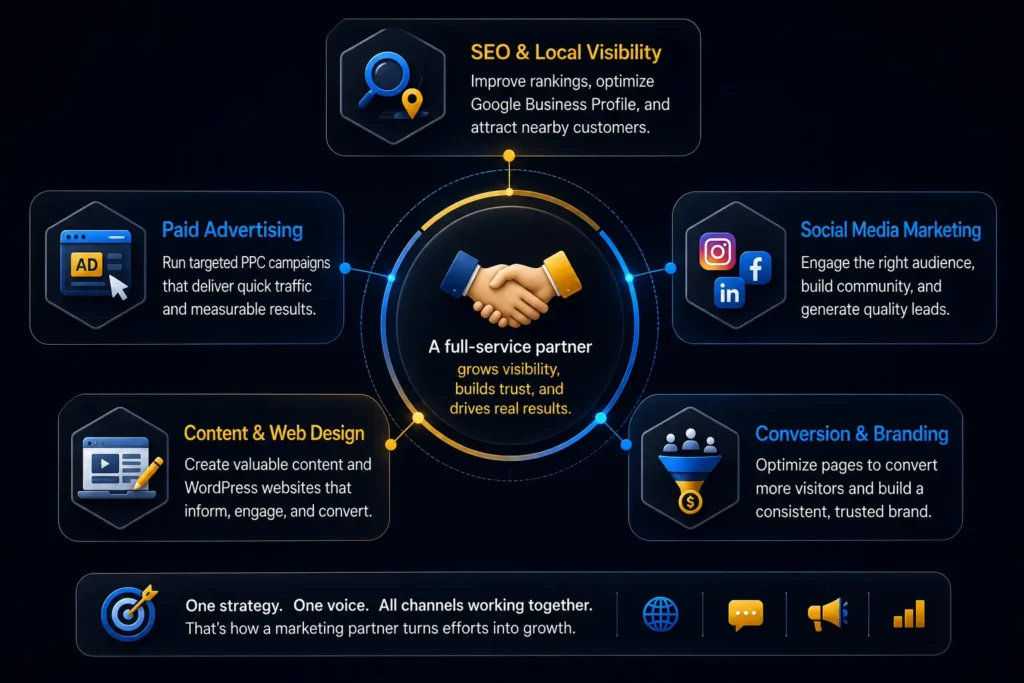
A capable marketing consultancy rarely does just one thing. It combines several disciplines that work together to build a brand’s visibility and revenue over time.
Search Engine Optimization and Local Visibility
Search engine optimization, commonly shortened to SEO, is the process of improving a website so it appears higher in Google’s organic results for relevant searches. Local SEO adds a layer on top of this by focusing on Google Business Profile listings, map rankings, and location-specific keywords that connect nearby customers with a physical or service-area business.
Paid Advertising
Pay-per-click advertising, or PPC, places a business directly at the top of search results or across social feeds in exchange for a bid on relevant keywords or audiences. Unlike SEO, which builds visibility gradually, paid campaigns can generate traffic within hours of launch, though that traffic stops the moment the budget does.
Social Media Marketing
Platforms such as Instagram, Facebook, and LinkedIn each serve a different purpose depending on the business. A clinic might use Instagram for patient education, while a B2B firm relies on LinkedIn for lead generation and industry credibility.
Content Marketing and Web Design
Content marketing covers blog posts, guides, videos, and other material that answers questions a potential customer is already asking. Web design, often built on WordPress, determines whether that content and the surrounding site convert visitors into inquiries or simply let them leave.
Conversion Rate Optimization and Branding
Conversion rate optimization looks at what happens after a visitor lands on a page, adjusting layout, messaging, and calls to action so more of that traffic turns into paying customers. A page can rank well and still perform poorly if the offer is unclear or the contact process feels complicated, which is why this work sits alongside SEO rather than after it.
Branding ties every one of these efforts together with a consistent voice, visual identity, and set of values across every channel. Without that consistency, a business can end up with a website, a social presence, and an ad campaign that each speak in a slightly different voice, which quietly undermines trust even when each piece looks polished on its own.
Why Kerala Businesses Benefit From a Local Marketing Team
Kerala’s business landscape spans coastal trade hubs, IT corridors, and traditional family-run enterprises, and each region searches differently online. A business owner searching for the best digital marketing agency in Thrissur often wants a team that understands textile, gold, and retail seasonality tied to local festivals. A founder running the search for the best digital marketing agency in Kochi is usually comparing options against the city’s dense IT and startup ecosystem, where competition for attention online runs sharper than in smaller towns.
Searches for the best digital marketing agency in Trivandrum frequently come from government-adjacent enterprises, educational institutions, and healthcare groups that need compliance-aware messaging rather than generic sales copy. Business owners running the search for the best digital marketing agency in Calicut are often in trading, textiles, or export-linked industries where trust signals and word-of-mouth still shape buying decisions well before a website visit happens.
A team based in Kerala understands Malayalam and English code-switching in ad copy, regional festival calendars that affect buying cycles, and the practical value of being reachable for an in-person meeting when a campaign needs a quick decision. National or overseas providers can execute technically sound work, but they rarely carry this same regional context into their strategy.
How Different Business Types Use Digital Marketing
The right mix of services depends heavily on the type of business asking for help.
E-commerce Brands
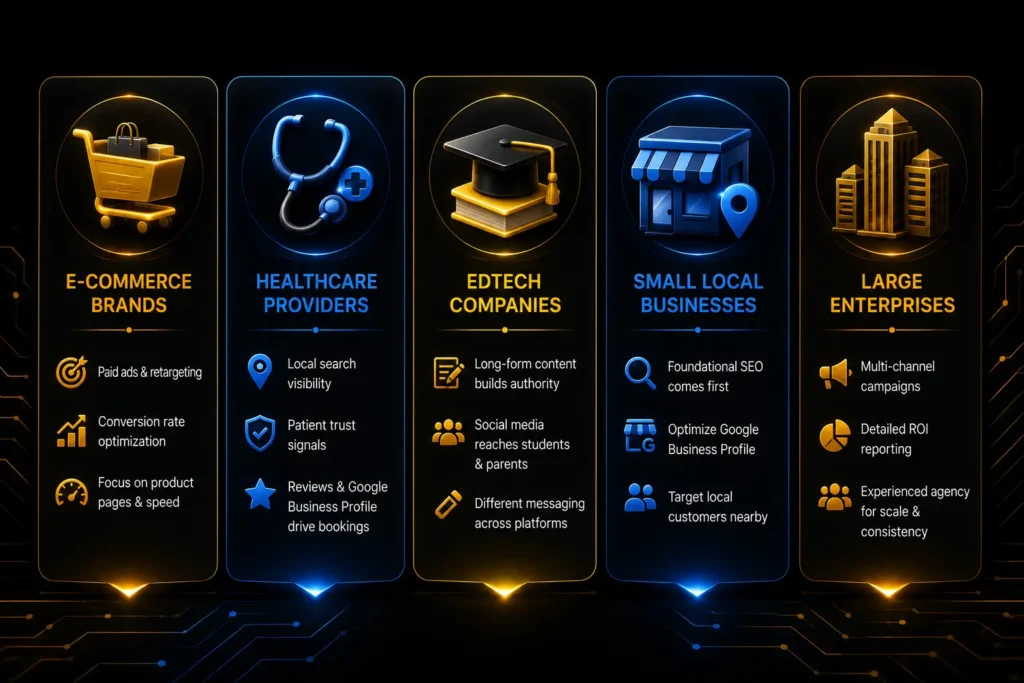
Online stores lean on paid advertising, retargeting, and conversion rate optimization since every visitor represents a direct path to a sale. Product page structure and site speed matter as much as the marketing that drives traffic there.
Healthcare Providers and Clinics
Clinics and hospitals depend on local search visibility, patient trust signals, and accurate, compliant content, since decisions around health services carry more weight than an average purchase. Reviews and a well-maintained Google Business Profile often influence appointment bookings more than paid ads do.
EdTech Companies
Education-focused businesses typically need long-form content that builds authority around course outcomes, alongside social media marketing that reaches parents and prospective students on different platforms with different messaging.
Small and Large Businesses
A small local business often needs foundational SEO and a working Google Business Profile before anything else, since most of its customers are searching within a limited radius. A large enterprise, by contrast, usually needs coordinated campaigns across multiple channels, detailed reporting tied to return on investment, and a marketing consultancy experienced enough to manage that complexity without losing consistency across regions or product lines. Budgets, timelines, and internal approval processes also scale up significantly at this level, which changes how an agency structures its reporting and communication.
What to Look for Before Hiring an Agency
Not every provider offering these services delivers the same standard of work. A few factors separate a strong long-term partner from a short-term vendor.
- Verifiable experience in the industry the business operates in, not just general marketing familiarity
- A portfolio that shows real work rather than stock screenshots or vague claims
- Transparent reporting that connects activity, such as rankings or ad spend, to actual business outcomes
- Clear communication about timelines, since SEO typically shows meaningful movement over several months rather than days
- A pricing structure that matches the scope of work rather than a flat rate applied to every client
- Willingness to explain strategy in plain language instead of hiding behind jargon
Anyone evaluating a marketing partner can also learn from Google’s own guidance on managing business listings, since agencies that follow these standards tend to produce more durable, policy-safe results. A capable team, such as the one at Dotcom Creativez, typically walks a prospective client through past work and a realistic timeline before any contract is signed.
How AI Search Is Changing What Businesses Need in 2026
Search behavior has shifted well beyond typing a phrase into a search bar and scrolling through ten blue links. Growing numbers of people now ask AI assistants direct questions and expect a complete answer without clicking through to a website at all.
Answer engine optimization has emerged as a response to this shift, structuring content so a chatbot or an AI-generated search summary can lift a clear, accurate answer directly from a page. This means headings and opening sentences increasingly need to answer a question outright before expanding on it, rather than building up to the point slowly.
Voice search adds another layer, since spoken queries tend to be longer and more conversational than typed ones. A business optimizing only for short keyword phrases risks missing the natural-language questions people now ask through voice assistants. Local search visibility remains central to all of this, since schema markup and structured business data help both traditional search engines and newer AI systems understand exactly what a business offers and where.
An agency that has not adapted its approach to these changes is still optimizing for a search landscape that existed several years ago. Businesses that wait until competitors have already restructured their content around these formats tend to spend more time and money catching up than they would have spent adapting early.
Common Mistakes Businesses Make When Choosing a Marketing Partner
A number of avoidable errors show up repeatedly when businesses select or work with an outside marketing team.
- Choosing based on the lowest quote without checking what is actually included in that price
- Expecting SEO results within weeks when meaningful ranking movement usually takes several months
- Treating vanity metrics, such as follower counts, as proof of real return on investment
- Handing over full control of branding and messaging without reviewing what gets published
- Switching agencies too frequently, which resets momentum on SEO and paid campaigns alike
- Ignoring analytics tools like Google Analytics and Google Search Console that reveal what is actually working
Avoiding these patterns matters more than chasing the newest marketing tactic, since consistency tends to outperform novelty over a full year of activity.
Frequently Asked Questions
How much does it cost to hire a marketing agency in Kerala?
Costs vary widely depending on the scope of services, the size of the business, and the competitiveness of its industry. A small business focused on local SEO typically pays less than an enterprise running paid campaigns across multiple platforms, so pricing should always be tied to a defined scope of work.
How long does SEO take to show results?
Meaningful movement in search rankings generally takes three to six months, depending on competition and the current state of the website. Businesses expecting first-page rankings within a few weeks are usually working with an unrealistic timeline rather than a poor strategy.
What is the difference between SEO and PPC?
SEO improves organic, unpaid visibility over time and continues generating traffic after the initial work is done. PPC generates immediate traffic through paid placements but stops producing results as soon as the advertising budget is paused.
Do small businesses really need a marketing agency?
Small businesses can benefit significantly, particularly for local SEO, Google Business Profile management, and basic content, since these areas require ongoing attention that owners often cannot dedicate time to alongside daily operations. Even a limited, focused engagement can improve visibility considerably.
How can a business tell if an agency is actually delivering results?
Look for reporting that ties specific activities, such as keyword rankings or ad performance, to measurable outcomes like leads, calls, or sales rather than surface-level engagement numbers. Regular, transparent updates are a stronger signal than promises made before any work begins.
Why does hiring a Kerala-based agency matter for a local business?
A Kerala-based team understands regional language use, festival-driven buying cycles, and local search behavior in a way that generic national providers often miss. That context tends to translate into messaging and campaigns that connect faster with a local audience.
Making the Right Choice
Selecting the right marketing partner comes down to matching real business needs with a team that has relevant experience, transparent reporting, and an approach built for how search actually works today. Businesses that prioritize long-term visibility over quick wins, and that ask direct questions about timelines and reporting before signing on, tend to see steadier results. For a Kerala-based business ready to move forward with a team that understands both the local market and the newer demands of AI-driven search, Dotcom Creativez offers a practical starting point for that conversation.