
If ChatGPT, Google AI Overviews, and other AI assistants never mention your business, the cause is usually a mix of weak content, unclear brand signals, and technical barriers. This guide explains how these systems find and choose sources, the most common reasons businesses get left out, and the practical steps that improve your chances of being cited. It is written for business owners and marketers who want clear answers without advanced SEO knowledge.
How Do ChatGPT and Google AI Choose Which Businesses to Mention?
AI search tools do not keep a private list of businesses to recommend. They assemble answers from web pages, structured data, and knowledge sources, then decide which sources are trustworthy and relevant enough to cite.
How Google AI Overviews Select Sources
Google AI Overviews and AI Mode draw on Google’s search index. According to Google Search Central, a page must be indexed and eligible to appear with a snippet to be used as a supporting link. Google also states that no special markup or separate file is needed for these features. Standard SEO fundamentals still apply.
How ChatGPT Finds and Cites Businesses
ChatGPT answers in two ways. It can respond from patterns learned during training, or it can use its search feature to retrieve current web pages and cite them. OpenAI uses a crawler called OAI-SearchBot to surface websites in search results, while GPTBot is linked to training data. Blocking OAI-SearchBot in robots.txt can keep your site out of ChatGPT search results.
What Are the Most Common Reasons a Business Is Missing From AI Answers?
Most cases trace back to a small set of problems. Each one is fixable.
Your Website Is Hard to Crawl or Index
AI systems cannot cite what they cannot access. Common technical blockers include:
- Noindex tags left on important pages
- Robots.txt rules that block search crawlers
- Key content loaded only through JavaScript that crawlers may not render
- Slow, unstable, or poorly structured pages
- Broken internal links that hide service pages
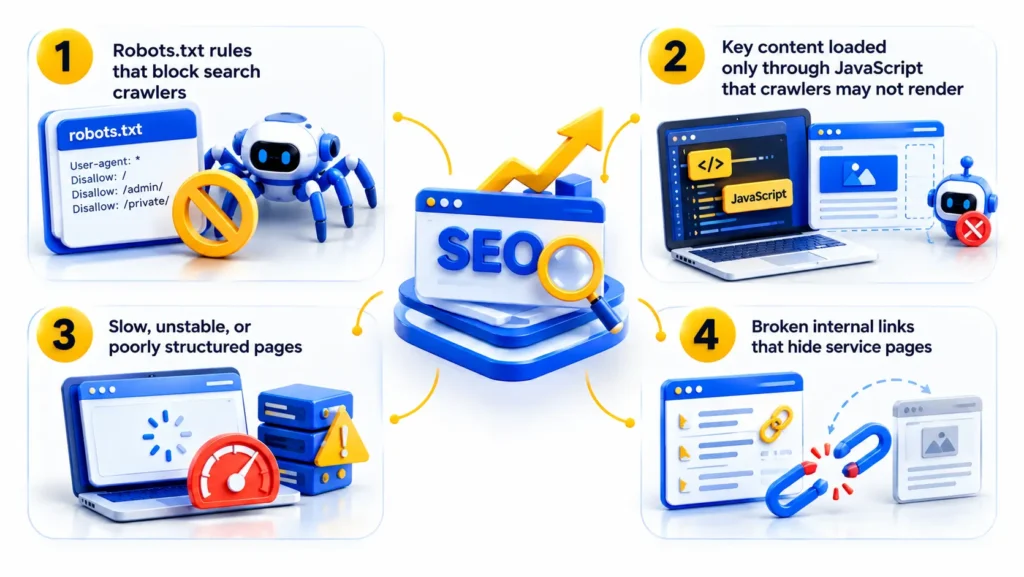
Check Google Search Console first. If a page is not indexed, it is unlikely to appear in AI Overviews.
Your Content Does Not Answer Real Questions
AI tools favor pages that answer a question directly. Many business websites describe services in vague language such as “quality solutions” or “customer-focused approach” without stating what the service is, who it is for, and which problems it solves. Clear definitions, specific details, and direct answers give AI systems something to extract.
Your Brand Lacks Clear Entity Signals
An entity is a distinct thing that search systems can recognize, such as a company, a service, or a person. If your business name, address, services, and profiles differ across your website, Google Business Profile, and directories, AI systems struggle to connect the information to one brand.
Few Trusted Sites Mention You
AI systems weigh corroboration. When reputable publications, industry directories, review platforms, and community discussions describe your business consistently, your credibility increases. A business that only talks about itself on its own website gives models little independent proof.
How Can You Improve AI Search Visibility?
Improving presence in AI answers builds on sound SEO and adds a few specific practices. No method guarantees citations, but these steps address the causes above.
Build Pages That Answer Questions Directly
Place a concise answer at the start of each section, then add detail. Use question-based headings, define terms, and explain processes step by step. Include specifics such as service scope, process, timelines, and eligibility instead of general claims.
Build Depth Around Related Topics
A single page rarely establishes expertise. Group related pages around a core subject, link them logically, and cover adjacent questions customers ask before and after buying. Examples include service explanations, pricing factors, process steps, and comparison guides. This topical depth helps systems see your site as a reliable source on the subject.
Strengthen Technical Foundations
Allow search crawlers in robots.txt, submit an XML sitemap, keep pages fast on mobile, and use clean internal linking. Add structured data (schema markup) for your organization, services, products, reviews, and FAQs where it matches visible page content. Structured data helps systems interpret a page, but it does not guarantee inclusion.
Keep Your Business Information Consistent
Use the same business name, contact details, service descriptions, and brand description everywhere. Claim and complete your Google Business Profile, and keep listings on relevant directories accurate. Consistency helps both search engines and AI assistants confirm who you are.
Earn Mentions From Credible Sources
Publish original, useful material that others want to reference, such as guides, research based on your own data, and clear explanations of your field. Pursue features in industry publications, partnerships, and genuine customer reviews. Brand mentions across reputable sources support recognition beyond your own domain.
Show Real Expertise
Add author names, credentials that you can verify, company details, and sources for factual claims. Demonstrating experience, expertise, authoritativeness, and trustworthiness (E-E-A-T) helps users and systems judge reliability.
What Mistakes Should You Avoid When Optimizing for AI Search?
Some habits waste effort or cause harm:
- Publishing large volumes of generic, unedited AI-written articles that add no new information
- Blocking all bots in robots.txt without understanding what each one does
- Stuffing pages with repeated phrases instead of clear explanations
- Making claims about awards, results, or statistics that you cannot support
- Expecting immediate results, since indexing and reputation build over time
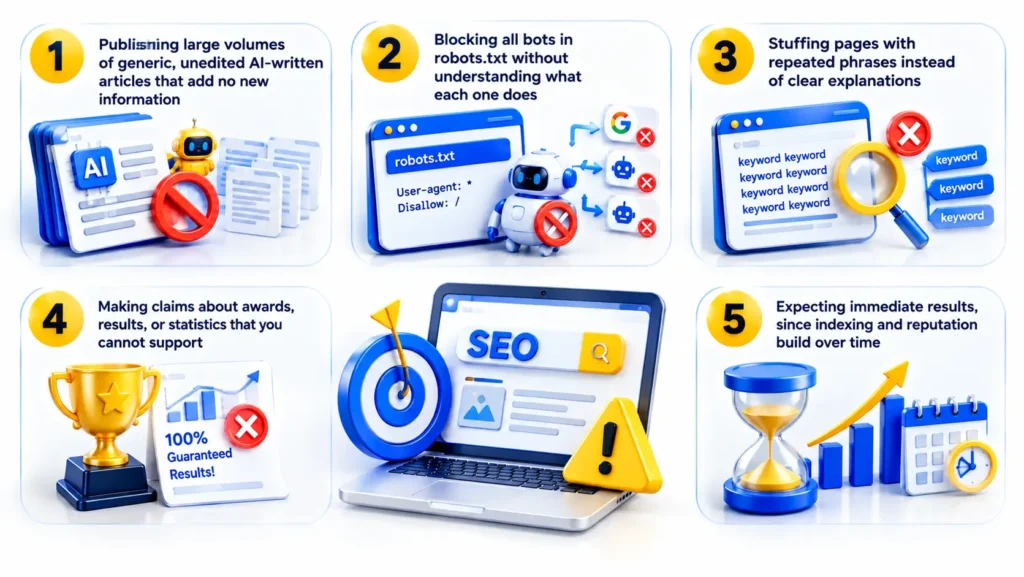
Accuracy and usefulness matter more than volume.
How Do You Check Whether AI Tools Mention Your Business?
Test manually first. Ask ChatGPT and Google’s AI features the questions your customers would ask, such as service comparisons, “best” queries, and problem-based searches. Record whether your business appears, which competitors appear, and which sources are cited.
Then review these data points:
- Indexing status and crawl errors in Google Search Console
- Referral traffic from AI platforms in Google Analytics
- Branded search trends over time
- Which pages AI answers cite for your topics
Results vary between sessions, so repeat tests over several weeks and track patterns rather than single outcomes.
Does Local Search Matter for AI Visibility?
Yes, for businesses that serve a defined area. Local intent queries such as “dentist near me” or “best clinic for a service” often rely on Google Business Profile data, reviews, maps information, and location pages. A complete profile, accurate categories, recent reviews, and local landing pages improve the information available to AI systems.
For local SEO in Kochi, this means keeping business details consistent, asking real customers for reviews, and building pages that describe services for customers in the area.
Should You Hire a Digital Marketing Agency in Kochi for AI Search?
Many businesses can handle basic fixes internally, such as correcting business listings and rewriting thin pages. Specialist help becomes useful when the work involves technical audits, schema implementation, content strategy, and tracking across several channels.
When evaluating a digital marketing agency in Kochi, look for:
- Clear explanation of technical SEO and content processes
- Experience with Google Business Profile and local SEO
- Transparent reporting and analytics practices
- Realistic expectations, with no guarantees of AI citations
- Relevant industry knowledge for your sector
Agencies such as Dotcom Creativez offer SEO, content, and web development services that support these needs, though you should compare several providers against your own goals.
Frequently Asked Questions
Can any business appear in ChatGPT answers?
Yes, if its website is accessible, its information is clear, and reputable sources support it. No one can force a mention, and results vary by query.
Is AI search different from traditional SEO?
They overlap heavily. Both need crawlable pages, useful content, and trust signals. AI search adds more emphasis on direct answers, clear entities, and mentions across the wider web.
How long does it take to appear in AI answers?
There is no fixed timeline. Indexing can take days or weeks, while building reputation and mentions takes months. Track progress monthly instead of expecting quick changes.
Does schema markup help with ChatGPT and Google AI?
Schema helps search engines understand page content, and it supports rich results in Google Search. Google states that AI features need no special markup, so treat schema as a clarity tool, not a requirement.
Do reviews affect whether AI tools recommend a business?
Reviews are one of several signals, especially for local queries. Accurate, recent reviews on platforms such as Google Business Profile give systems more evidence about quality and service. Never buy or fabricate reviews.
Should I block AI crawlers on my website?
Only if you have a specific reason. Blocking search-related crawlers can remove your site from AI search results. Review each bot’s documentation and decide separately for training and search access.
Key Takeaways for AI Search Visibility
Businesses usually miss out on AI answers because of blocked or unindexed pages, vague content, inconsistent brand information, and limited outside mentions. Fixing these issues follows the same path as sound SEO: make your site accessible, answer questions clearly, keep your details consistent, and earn credible mentions. No tactic guarantees a place in ChatGPT or Google AI Overviews, but each step improves the quality of the information available about you. Teams such as Dotcom Creativez can support that work through audits, content, and technical fixes, while regular testing shows what is changing.