
Choosing a performance marketing agency affects how much you spend, how fast you learn what works, and whether paid campaigns produce real customers. This guide explains what performance marketing is, which services to expect, how to judge an agency’s tracking and reporting, what pricing models look like, and which warning signs to watch. It suits business owners, marketers, and students who need a clear way to compare providers before signing a contract.
What Does Performance Marketing Cover?
Performance marketing is paid promotion measured against outcomes such as leads, sales, app installs, or booked appointments. Spend and results connect directly, so every campaign can be judged by what it produced rather than how many people saw it.
Typical channels include Google Ads, Meta Ads, YouTube, retargeting, marketplace advertising, and affiliate programs. Conversion tracking, landing page testing, and analytics sit underneath all of them, because without accurate data no channel can be optimized.
How It Differs From General Digital Marketing
A general digital marketing agency may cover SEO, social media, content, email, and design under one retainer. A performance specialist concentrates on paid acquisition and conversion, and treats return on ad spend, cost per lead, and customer acquisition cost as the main scorecards. Some businesses need both disciplines, and many agencies offer them together.
Define Your Goals Before You Compare Agencies
A shortlist only makes sense when you know what the agency must achieve. Write down the outcome, the budget range, the timeframe, and the numbers that define success.
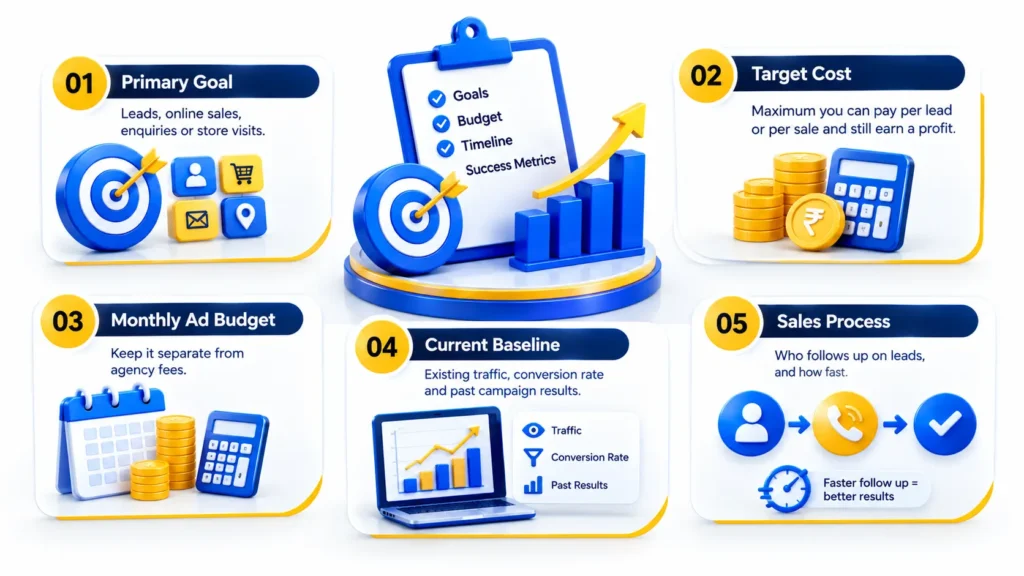
- Primary goal: leads, online sales, enquiries, or store visits.
- Target cost: the maximum you can pay per lead or per sale and still earn a profit.
- Monthly ad budget, kept separate from agency fees.
- Current baseline: existing traffic, conversion rate, and past campaign results.
- Sales process: who follows up on leads, and how fast.
Those inputs let an agency forecast realistically, and they give you a yardstick for judging its proposal. Our guide to a revenue-focused performance marketing strategy explains how to set those targets.
Which Services and Skills Should a Strong Agency Offer?
Look for evidence of capability across the full path from click to customer.
Channel and Campaign Management
The agency should manage search, social, and video campaigns with structured account setups, audience testing, and bid strategy reviews. Ask which channels fit your goal and why. A confident answer names reasons tied to your buyers, not a generic package.
Creative and Landing Pages
Ad performance depends on the message and the page it leads to. Agencies should test headlines, visuals, offers, and forms, and they should either build landing pages or collaborate with your web team. Web development skills help here, since slow or confusing pages waste paid traffic.
Tracking and Analytics Setup
Accurate measurement separates performance marketing from guesswork. The agency should configure Google Analytics 4, conversion events, Google Tag Manager, and platform pixels or APIs, and it should check that the numbers match your CRM or sales records.
Reporting and Communication
Expect plain-language reports that explain what changed, why it changed, and what happens next. Regular calls, a named account manager, and quick responses to questions signal a working relationship rather than a vendor transaction.
How Do You Evaluate an Agency’s Track Record?
Past results show how an agency thinks. Ask for case studies that name the business type, the goal, the timeframe, and the measured outcome, then ask how the agency verified each number.
Industry experience helps, especially in regulated or specialized fields such as healthcare and education. Still, a provider without your exact niche can succeed if its process for research and testing is sound.
Certifications and partner badges offer limited proof. A Google Partner badge, for example, shows that an agency meets Google’s program requirements, but it does not show that the agency fits your goals. Treat badges as a starting point for questions.
Questions Worth Asking in a Discovery Call
- Which metrics will you report, and how often?
- Who will manage my account day to day?
- How do you decide when to pause or scale a campaign?
- What happens if results fall short of the forecast?
- Do I own the ad accounts, data, and creative files?
How Do Performance Marketing Agencies Charge?
Pricing models differ, and each carries trade-offs. Compare them against your cash flow and risk tolerance.
- Flat monthly retainer: predictable cost, but the fee does not rise or fall with results.
- Percentage of ad spend: scales with budget, though it can reward higher spending over better efficiency.
- Commission on leads or sales: ties pay to outcomes, but it needs clear definitions of a valid lead and reliable tracking.
- Hybrid: a smaller retainer plus a results-based bonus.
Always separate the ad budget from the fee, and confirm that ad spend goes straight to the platform from an account you own. Check the contract for minimum terms, notice periods, setup charges, and what happens to your data on exit.
What Warning Signs Should You Watch For?
Certain red flags appear early in the sales process.
- Guaranteed returns or fixed results, which no honest agency can promise because platforms and markets change.
- Refusal to share account access or reports in a format you can verify.
- Reports that celebrate impressions and clicks while avoiding leads, sales, and cost per result.
- A fixed package proposed before anyone has studied your business.
- Long lock-in contracts with no exit terms.
- Vague answers about who will actually run your campaigns.
Why Local Presence Can Matter When Choosing a Partner
Performance marketing works across any area, so location is not a requirement. Local knowledge adds value when your customers live nearby, because campaigns can use local search terms, language preferences, and area-based targeting.
Businesses looking for a digital marketing agency in Thrissur can ask how a provider combines paid campaigns with Google Business Profile, local landing pages, and review collection. Dotcom Creativez is one of the providers a business can assess with the questions in this guide.
What Should the First 90 Days Look Like?
A professional onboarding follows a clear sequence.
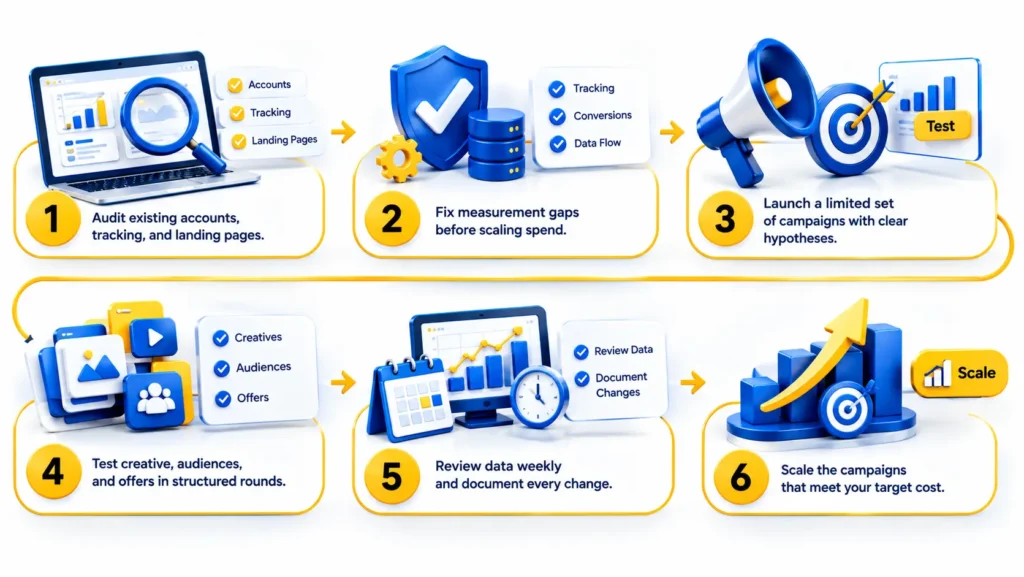
- Audit existing accounts, tracking, and landing pages.
- Fix measurement gaps before scaling spend.
- Launch a limited set of campaigns with clear hypotheses.
- Test creative, audiences, and offers in structured rounds.
- Review data weekly and document every change.
- Scale the campaigns that meet your target cost.
Agencies that follow this order protect your budget during the learning phase. Jumping to heavy spending before tracking works wastes money on data nobody can trust.
How Should You Judge Results After You Hire?
Give campaigns time to learn. Most ad platforms need a stretch of data before optimization stabilizes, so judging a campaign after a few days rarely helps. Agree on a review rhythm of weekly check-ins and monthly performance reports.
Focus on measures tied to business results:
- Cost per lead or cost per acquisition.
- Return on ad spend, where revenue can be tracked.
- Conversion rate on landing pages.
- Lead quality, judged by your sales team.
- Customer lifetime value, when repeat purchases matter.
Compare agency reports against your own records. When the figures disagree, resolve the gap before increasing spend.
Frequently Asked Questions About Performance Marketing Agencies
How much does a performance marketing agency cost?
Costs vary with scope, channels, and agency size. Fees may be a flat retainer, a percentage of ad spend, a commission, or a mix. Ask for a written breakdown that separates agency fees, tool costs, and the ad budget paid to platforms.
How long before performance marketing shows results?
Paid campaigns can generate traffic within days, but stable results usually take several weeks of testing and data collection. Sales cycles, budget, and competition affect the pace, so agree on milestones instead of a single deadline.
Should I hire an agency or build an in-house team?
Agencies bring multi-channel experience and tools without hiring costs, while an in-house team knows the business deeply. Some companies start with an agency, then add internal staff as spend and complexity grow.
What should I ask for in a proposal?
Request goals, channel plan, tracking setup, reporting schedule, fee structure, contract length, and the team assigned. A proposal built from your own numbers carries more weight than a template.
Can a performance agency work alongside my SEO team?
Yes. Paid and organic efforts reinforce each other. Search ad data reveals which keywords convert, and that insight can guide SEO content. Share access and goals so both teams use the same measurements.
How should a local business in Thrissur choose a paid advertising partner?
Start with agencies that explain local targeting, call tracking, and Google Business Profile support. Ask how they separate local enquiries from irrelevant clicks, and check that reporting shows calls, form submissions, and store visits where available.
How to Make the Final Choice
The right performance marketing agency is the one that can prove its method, measure results honestly, and explain its pricing without confusion. Define your goals, test the agency’s tracking and reporting, check the contract terms, and compare at least a few providers using the same questions. Businesses that want to apply this checklist can review Dotcom Creativez alongside other options, then choose the team that matches their goals, budget, and communication style.

The Dotcom Creativez team is a digital marketing team based in Kerala, helping businesses improve their online visibility and reach their target audiences. With over seven years of industry experience within its leadership, the agency provides services including SEO, performance marketing, social media marketing, content marketing, and web development. The team creates strategies based on business goals, audience needs, and market research, with a focus on generating qualified leads, increasing conversions, and supporting measurable business growth.