

On-page SEO shapes what a page says and how clearly it says it, while technical SEO decides whether search engines can crawl, understand, and trust that page at all. AI for On-Page and Technical SEO has moved from a buzzword to a practical toolkit that speeds up audits, structures content for meaning, and flags issues humans might miss. This piece looks at what that shift actually involves, how businesses of different sizes can use it, and where human judgment still decides the outcome.
What On-Page and Technical SEO Mean Today
On-Page SEO in the Age of Search Algorithms Built on Meaning
Search algorithms no longer reward pages simply for repeating a phrase. They read context, intent, and relationships between ideas. On-page optimization today covers title tags, headers, internal linking, readability, and the way a page answers a specific question, not just the words it contains.
Technical SEO as the Foundation Search Engines Rely On
A page can be well written and still rank poorly if search engines cannot crawl or index it properly. Technical SEO covers site speed, mobile usability, structured data, redirects, and crawl efficiency. Without this foundation, even strong content struggles to surface.
How AI Tools Support On-Page Optimization
Artificial intelligence in SEO has become genuinely useful for repetitive, pattern-based on-page work. Marketers now lean on AI content optimization tools to speed up tasks that once took hours of manual review.
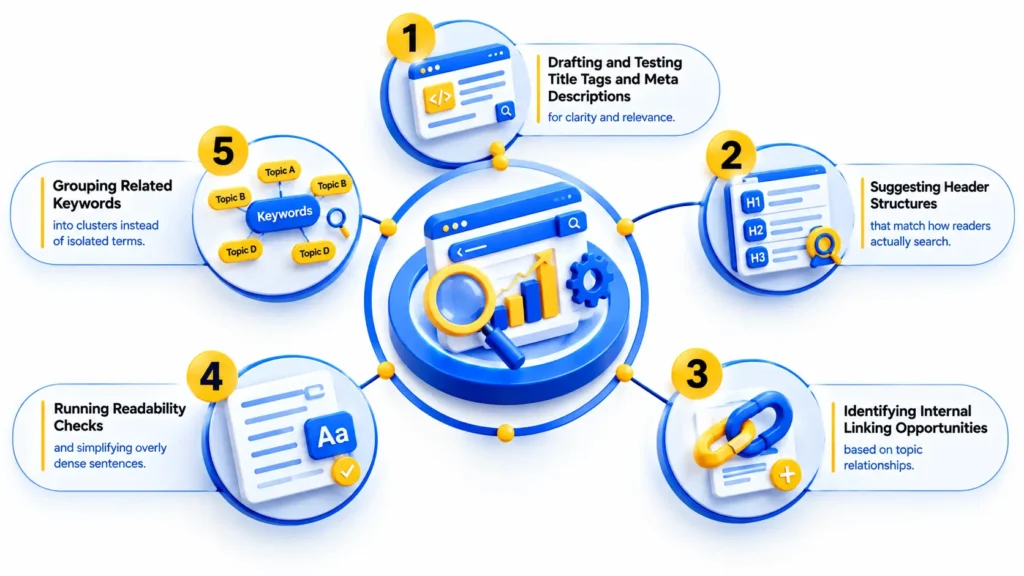
- Drafting and testing title tags and meta descriptions for clarity and relevance
- Suggesting header structures that match how readers actually search
- Identifying internal linking opportunities based on topic relationships
- Running readability checks and simplifying overly dense sentences
- Grouping related keywords into clusters instead of isolated terms
These tools speed up execution, but the final judgment on tone, accuracy, and brand voice still belongs to a person who understands the business.
How AI Tools Support Technical SEO
Technical audits used to involve manually crawling hundreds of pages. AI-driven site audits now scan entire websites quickly and surface patterns that would take a human days to spot.
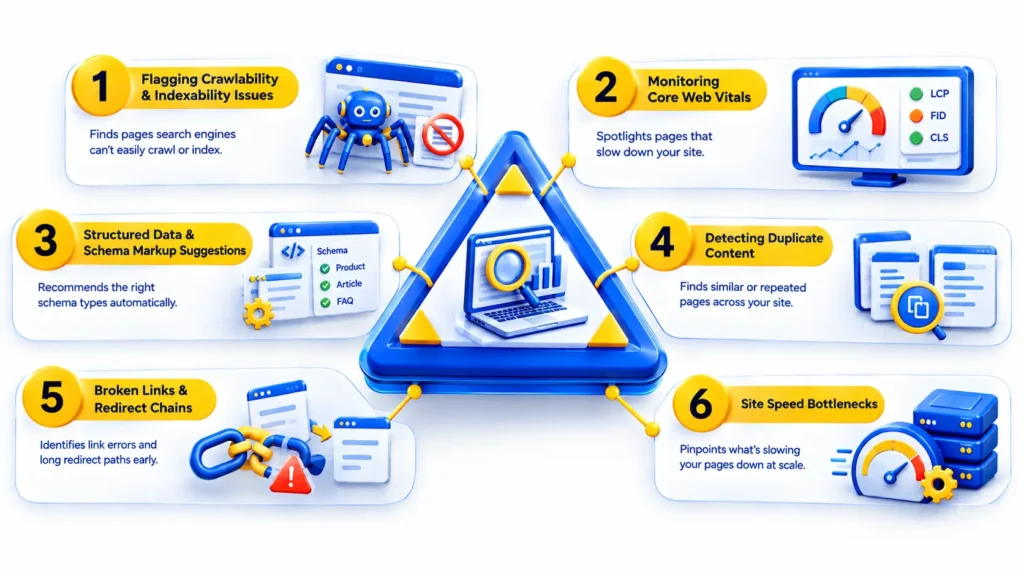
- Flagging crawlability and indexability issues across large sites
- Monitoring Core Web Vitals and pinpointing pages that slow down loading
- Generating structured data and schema markup suggestions automatically
- Detecting duplicate content across product or service pages
- Identifying broken links and redirect chains before they affect rankings
- Analyzing site speed bottlenecks at scale
For e-commerce sites with thousands of product pages, this kind of automated technical SEO audit is often the only realistic way to keep pace with changes.
Semantic SEO, Topical Authority, and Entity SEO Explained
Semantic search means engines interpret a query’s meaning rather than matching exact words. A page about “affordable dental implants in Kochi” can rank for related phrases it never explicitly used, because the algorithm understands the concept behind the words.
Topical authority builds on this idea. AI tools help map out content clusters, showing which subtopics a website has covered and which gaps remain. A clinic writing about root canals, for instance, benefits from supporting content on recovery, cost, and aftercare, because that depth signals real expertise on the subject.
Entity SEO works alongside this. Search engines increasingly recognize brands, people, locations, and concepts as connected entities rather than isolated keywords. AI tools assist by identifying which entities a page should reference and how consistently those references appear across a website, reinforcing what the business is actually known for.
Preparing Content for Answer Engines and Generative Search
Answer Engine Optimization focuses on structuring content so it can be pulled directly into featured snippets, voice results, and AI-generated summaries. Clear, direct answers near the top of a section, paired with descriptive subheadings, make this extraction easier for algorithms.
Generative Engine Optimization goes a step further. Tools like ChatGPT, Perplexity, and Google’s AI Overviews synthesize information from multiple sources rather than linking to one page. Content written for GEO needs well-defined facts, clear structure, and credible framing, since generative tools tend to favor sources that state information plainly and back it with context.
Where AI Assists and Where Human Expertise Still Leads
AI handles scale and pattern recognition well. It struggles with judgment calls that depend on brand nuance, local context, or genuine subject-matter experience. E-E-A-T, which stands for experience, expertise, authoritativeness, and trustworthiness, cannot be manufactured by a tool alone.
A generated paragraph might read smoothly yet contain a subtle factual gap or a tone that doesn’t match the business. Human review catches these issues before they reach a live page. Agencies that combine automation with editorial oversight, such as Dotcom Creativez, treat AI outputs as a starting draft rather than a finished product, checking every claim against real expertise before publishing.
How Different Businesses Are Applying AI SEO
E-commerce platforms use AI to manage product descriptions and schema markup across large catalogs, where manual work isn’t feasible. Small businesses often rely on AI for quicker keyword research and content drafts, since they typically lack a large in-house marketing team. Edtech companies use AI to build topic clusters around courses and certifications, strengthening topical authority for competitive search terms.
Healthcare and dental clinics apply AI-assisted schema for services and locations while relying heavily on human review for medical accuracy. Service-based businesses generally use AI to audit technical issues across their sites and to identify content gaps against competitors, then hand the strategic decisions to their marketing team.
Common Risks of Relying on AI Alone
AI-generated content can sound generic when left unedited, especially across multiple pages that start to read alike. Some tools produce confident-sounding but inaccurate statistics, a problem known as hallucination, which is dangerous for industries like healthcare or finance where accuracy matters. AI also lacks direct, lived experience, so it cannot substitute for a practitioner’s firsthand knowledge. These risks reinforce why human review remains part of any responsible SEO process rather than an optional extra step.
Best Practices for Combining AI and Human Expertise
Any digital marketing agency in Kerala working across industries today needs a workflow where AI handles research, drafting, and audits, while strategists refine tone, verify facts, and align content with business goals. Discover How AI Can Transform Your SEO Strategy Today by treating these tools as accelerators for research and pattern detection, not replacements for editorial judgment.
Internal linking between related service pages, paired with references to authoritative external sources, still strengthens a site’s credibility. Consistent human oversight over AI-suggested schema, headers, and claims keeps content both accurate and genuinely useful to readers.
Frequently Asked Questions
Does AI replace the need for an SEO specialist?
No. AI speeds up research, audits, and drafting, but strategy, brand judgment, and fact verification still require a specialist who understands the business and its audience.
Can AI tools fix technical SEO issues automatically?
Most tools identify and prioritize issues such as broken links or slow-loading pages, but implementing the fix usually still needs a developer or SEO professional to apply changes correctly.
What is the difference between AEO and GEO?
AEO focuses on getting content pulled into search features like featured snippets, while GEO focuses specifically on how generative AI tools such as ChatGPT summarize and cite information.
Is AI-generated content penalized by Google?
Google does not penalize content simply for being AI-assisted. It penalizes low-quality, unhelpful content, regardless of how it was produced, which is why human review matters.
How does AI help with topical authority?
AI tools analyze existing content, identify gaps, and suggest related subtopics, helping a website build depth around a subject instead of publishing isolated, disconnected pages.
Should small businesses use AI for SEO?
Yes, particularly for research and drafting, since it reduces the time and cost involved in early-stage SEO work, though results still improve with human refinement.
What technical SEO issues can AI detect?
AI tools commonly detect crawl errors, duplicate content, slow Core Web Vitals scores, missing structured data, and broken internal or external links.
Conclusion
AI for On-Page and Technical SEO has changed how quickly businesses can audit, optimize, and structure their websites, but it works best as a partner to human expertise rather than a stand-in for it. Businesses that pair automated efficiency with real editorial judgment, the way Dotcom Creativez approaches client work, tend to build stronger, more trustworthy search visibility over time. The technology keeps evolving, and the businesses that treat it as one part of a larger strategy will be the ones that stay ahead.