
AI-assisted content ideation and planning refers to the practice of using artificial intelligence tools to identify content opportunities, structure a publishing calendar, and prioritize topics based on real data rather than guesswork. Instead of relying solely on manual brainstorming, content teams now feed search trend data, competitor coverage, and audience search intent into AI systems that surface gaps, suggest topics, and sequence a content roadmap. This shift changes how ideation and editorial planning actually happen inside a modern content workflow. The sections below break down how this process works in practice, from calendar building to competitor gap analysis.
AI Content Calendars Built on Trend and Gap Analysis
Modern AI content tools pull real-time and historical search trend data directly from search engines and keyword research platforms, then compare that data against everything a brand has already published. This comparison reveals where search demand is rising while brand coverage stays thin or nonexistent, and it surfaces topics that once ranked well but have started losing visibility because the content has aged. The result is a working list of topics ranked by actual opportunity rather than internal opinion about what sounds important.
Prioritization happens by weighing how much people are searching for a topic against how well a brand already addresses it. A subject with high search volume and no existing content ranks higher on the queue than one with moderate demand that the brand has already covered thoroughly. This demand-versus-coverage comparison is what separates a data-driven content calendar from one built purely on instinct.
Factors AI systems typically weigh when prioritizing a calendar slot include:
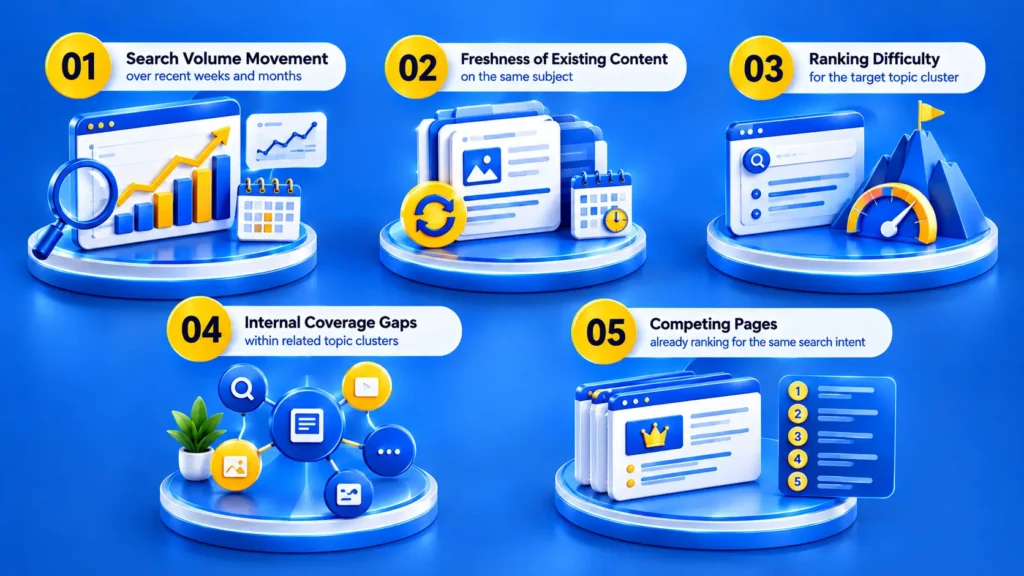
- Search volume movement over recent weeks and months
- Freshness of existing content on the same subject
- Ranking difficulty for the target topic cluster
- Internal coverage gaps within related topic clusters
- Competing pages already ranking for the same search intent
How Seasonality and Trend Velocity Shape Calendar Sequencing
Seasonal demand patterns influence exactly when a topic should get scheduled rather than whether it deserves a slot at all. AI systems track how quickly search interest for a topic rises and falls, a measure often called trend velocity, and use that pattern to place time-sensitive topics earlier in the calendar so published content has time to gain visibility before demand peaks. A topic with steady, non-seasonal demand can sit lower in the queue without losing relevance, while a fast-moving trend needs immediate scheduling to avoid missing the window entirely. Ignoring trend velocity often means publishing accurate, well-researched content after the search demand has already passed its peak.
How This Differs From Manually Built Editorial Calendars
A manually built editorial calendar typically reflects what an internal team believes is worth covering, informed by client requests, industry knowledge, and past performance memory. An AI-assisted calendar starts from the same inputs but adds a continuous, updated view of search demand and competitor movement that a human planner cannot track across hundreds of topics at once. The manual approach still has value for brand voice and strategic judgment, but it works best when paired with the broader visibility that data-driven prioritization provides.
AI Competitor Content-Gap Analysis
Competitor content-gap analysis works by mapping the topics and entities a competitor’s content library covers, then comparing that map against a brand’s own published content. AI tools handle this comparison at a scale no manual audit could match, cross-referencing hundreds of pages within minutes to identify exactly where a brand’s coverage falls short relative to what is already ranking well.
Two distinct types of gaps emerge from this comparison. A topic gap exists when a competitor has published on a subject the brand has not addressed at all, meaning there is no content asset in place to compete for that search intent. An entity gap is more subtle: it appears when a brand has already published on a topic, but the content leaves out related concepts, terms, or subtopics that competitors cover, weakening the depth and topical relevance that search engines expect to see.
A useful competitor content-gap report typically surfaces:
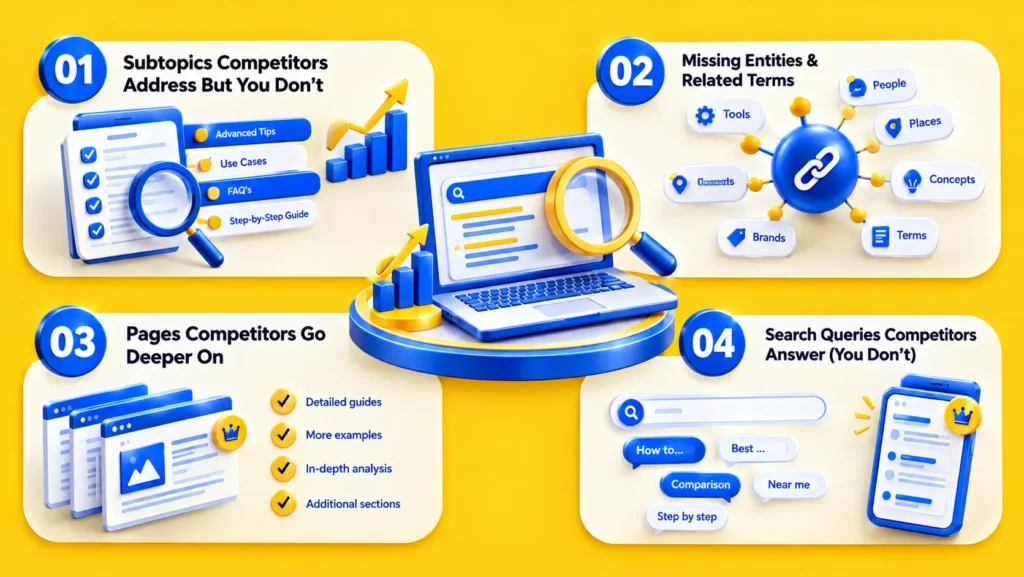
- Subtopics competitors address that the brand has left out entirely
- Entities and related terms missing from existing brand content
- Pages where competitor content goes noticeably deeper on the same subject
- Search queries competitors answer that the brand’s content does not
How Gap Analysis Feeds Back Into the Content Calendar
Gap analysis does not function as a standalone report; its real value comes from feeding directly into calendar prioritization. Once a topic gap or entity gap is identified, it becomes a candidate for the content calendar built through trend and coverage analysis, and its priority is adjusted based on how much search demand exists for that specific gap. Treating calendar building and gap analysis as one connected system, rather than two separate exercises, keeps content planning grounded in what audiences are actually searching for and what competitors have already claimed.
Why Ideation and Planning Matter More Than Writing Speed
AI writing tools can produce a draft in minutes, but speed of production means little if the topic itself was never worth writing about. A well-planned content calendar built on accurate gap analysis determines whether published content has any real chance of ranking, regardless of how quickly it was written. Teams that treat ideation and planning as the foundation of their workflow consistently outperform teams that treat AI purely as a drafting shortcut, because the planning stage is what connects content to actual search demand. Publishing faster without this groundwork usually just produces more content competing for attention it was never positioned to win.
Where Ideation and Planning Fit Into a Broader Content Marketing Strategy
Ideation and planning form the foundation that every other stage of content marketing builds on top of. Without a calendar grounded in real search demand and gap analysis, even the strongest AI-Powered Content Marketing Strategies end up producing content that nobody was searching for in the first place. Positioning ideation and planning as the starting point, rather than a preliminary step to rush through, keeps the entire content workflow aligned with what search engines and audiences actually reward.
Where Human Judgment Still Guides the Process
AI systems can surface data patterns, but they cannot judge whether a topic fits a brand’s voice, values, or long-term positioning. A human strategist still decides which data-backed opportunities align with business goals and which ones, despite strong search demand, do not fit the brand’s expertise or credibility. Agencies working across sectors, including teams at Dotcom Creativez, one of the leading digital marketing agencies in Kerala, apply this judgment by filtering AI-generated topic suggestions through client-specific context before anything reaches the calendar. Editorial tone, factual accuracy, and legal or medical sensitivity in regulated industries also require human review that AI tools are not equipped to handle on their own. Without this filtering step, a calendar built purely on data can end up chasing search volume at the expense of accuracy or brand fit.
How a Business Can Start Applying This to Its Own Content Process
Businesses beginning this shift should start by auditing existing content against current search trend data to identify which published pages are underperforming relative to demand. Running a competitor content-gap analysis alongside that audit clarifies which missing topics and entities deserve attention first. From there, a calendar can be built that sequences topics by combining demand, competition, and internal coverage gaps rather than publishing frequency alone.
Smaller teams without dedicated SEO staff can start with a narrower scope, focusing gap analysis on a handful of direct competitors rather than an entire market. Larger organizations with multiple product lines benefit from applying this process separately to each topic cluster, since demand and competitive pressure vary significantly between categories. Regardless of business size, the process works only when someone reviews AI output regularly, since raw suggestions still need context and accuracy checks before they become calendar-ready topics. A short internal review step, even a brief weekly check-in, keeps the calendar aligned with both data and business reality.
Frequently Asked Questions
What is AI-assisted content ideation and planning?
It is the practice of using AI tools to analyze search trend data, competitor coverage, and content gaps in order to decide what topics to publish and in what order. It replaces manual brainstorming with a data-backed prioritization process that updates as search behavior changes.
How does an AI content calendar differ from a regular editorial calendar?
An AI content calendar continuously incorporates updated search demand and competitor movement, while a regular editorial calendar relies mainly on internal planning and past performance memory. The two work best together, with AI supplying data and humans supplying judgment and brand context.
What is the difference between a topic gap and an entity gap?
A topic gap means a subject has not been covered at all, while an entity gap means the subject has been covered but is missing related terms, concepts, or subtopics that competitors include. Both weaken topical authority if left unaddressed for too long.
Can AI content planning replace human strategists entirely?
No. AI can process data at a scale humans cannot match, but decisions about brand voice, positioning, and sensitive topics still require human review before content moves into production.
How often should competitor content-gap analysis be repeated?
Competitor coverage and search demand shift constantly, so most content teams repeat gap analysis quarterly, or sooner in fast-moving industries. Repeating it on a set schedule keeps the calendar current rather than built on outdated assumptions.
Does this process work for small businesses, not just large content teams?
Yes. Smaller businesses can apply the same logic at a smaller scale, focusing on a limited set of competitors and a narrower topic cluster rather than an entire industry. The underlying method of comparing demand against coverage stays the same regardless of team size.
Conclusion
Planning content around verified search demand and competitor gaps turns a content calendar into something closer to a strategic roadmap than a loose list of topic ideas. Teams that treat ideation and prioritization as core parts of the editorial workflow, rather than a quick step before writing begins, consistently produce content with a stronger chance of ranking and holding visibility over time. At Dotcom Creativez, this connected approach to calendar building and gap analysis reflects how a modern content workflow should function: grounded in data, refined by human judgment, and structured to answer what audiences are already searching for.