

Search engines stopped rewarding pages that simply matched a string of words years ago, yet most keyword lists are still built as if that were the rule. A spreadsheet full of search volumes and cost-per-click figures tells you how often a phrase gets typed, but it says nothing about what the searcher actually wants when they type it. That gap between raw numbers and real intent is where the current shift in keyword planning is happening, and it is driven almost entirely by how language models now read queries.
The change is not cosmetic. Systems built on natural language processing group related searches by the idea behind them, not by shared characters, which means two phrases with no words in common can end up treated as the same opportunity. This article walks through how that grouping works, why it changes the order in which content gets planned, and how AI for Keyword Research fits into the broader move toward entity-based, answer-ready content that both people and machines can parse quickly.
AI-Generated Topic Clusters and Semantic Keyword Grouping
Older keyword tools worked by string matching. “Buy running shoes” and “best running shoes to purchase” would show up as two unrelated rows with separate volume figures, even though anyone reading them knows a shopper wrote both. Language models fix this by encoding each phrase as a vector, a numerical representation of meaning, so phrases with similar intent sit close together mathematically regardless of the exact wording used. This is the mechanical basis for semantic keyword clustering.
Why This Matters for Content Planning
For someone building a content calendar, semantic grouping means a single pillar page can legitimately target dozens of phrasing variants instead of needing a separate thin page for each one. The keyword list stops being a checklist and becomes a map of related questions that a topic cluster should answer collectively, with supporting pages linking back to a central resource. That structure is also what search engines increasingly expect from a site trying to demonstrate topical authority rather than scattered, disconnected posts.
What Gets Lost Without Semantic Grouping
Sites that keep planning content around exact-match strings tend to publish overlapping pages that quietly compete against each other, a problem known as keyword cannibalization. Semantic clustering avoids this almost by default, since the grouping step forces every related phrase into one planned page before writing begins, rather than after several pages have already been published and started competing. Dotcom Creativez applies this grouping step early in content engagements so clients avoid rebuilding a site’s structure later.
[Get Help Building Your AI-Driven Topic Clusters]
Predicting Search Intent Before You Write a Page
Classification models can sort a raw keyword export into informational, commercial, and transactional buckets before a writer opens a document. That sorting happens by analyzing patterns in how people phrase things, how existing top-ranking pages are structured for that query, and what type of result search engines already favor for similar language. Getting this step wrong is expensive: a blog post written for a phrase that actually wants a product page will underperform no matter how well it is written, and a landing page built for a phrase where the searcher only wanted background context will bounce visitors immediately.
Reordering the Content Workflow
Intent prediction pushes classification earlier in the process. Instead of writing first and hoping the format fits, teams now sort keywords by intent, then decide the page type, then write the brief. This single reordering avoids the wasted spend that comes from mismatched content and search intent, which remains one of the most common reasons a page fails to rank despite reasonable writing quality.
Reading Intent Signals Correctly
Intent is rarely a single fixed label. A phrase can carry mixed signals, part informational and part commercial, and a well-built classification model weighs probability across categories instead of forcing a binary choice. A clinic evaluating “root canal cost” should recognize the searcher wants pricing context before visiting, so the ideal page blends factual explanation with a clear path to booking rather than committing fully to one format.
[Request an AI-Assisted Content Brief and Intent Audit]
AI vs. Traditional Keyword Research Tools: What Actually Changed
The mechanical difference is worth stating plainly. Traditional tools report monthly search volume, cost-per-click, and a difficulty score calculated from backlink counts on ranking pages. None of those three metrics describe what a searcher meant, only how often a phrase was typed and how competitive the visible results appear. Query fan-out changes this by having a model expand a single search into several related sub-queries internally before assembling an answer, which lets the system account for phrasing that never appeared often enough in historical data to register a measurable volume.

This is the core capability gap. A tool built purely on historical volume cannot surface a rising conversational variant of a query until enough people have already searched it, by which point the opportunity is partly gone. Clustering and fan-out based approaches can identify that a new phrasing belongs to an established intent group immediately, because the grouping is based on meaning rather than frequency.
Why Conversational Queries Break Old Metrics
Voice assistants and chat-based search have pushed people toward longer, more natural phrasing, questions asked the way a person would ask a colleague rather than the clipped fragments typed into a search box a decade ago. A metric like keyword difficulty, built from backlink counts on ranking pages, was never designed to evaluate a six-word conversational question with almost no search history. Vector-based matching handles this gracefully by comparing meaning against an existing knowledge graph instead of waiting for historical searches to accumulate.
[Compare Keyword Research Tools and Get a Recommendation]
Where Semantic SEO and Entity SEO Fit In
An entity, in search terms, is a distinct thing, a person, place, product, or concept, that a search engine can identify and connect to other related things through a knowledge graph rather than through keyword overlap alone. Semantic SEO builds content around these entities and their relationships instead of isolated phrases. A dental clinic page about root canal treatment gains more relevance signals when it is clearly connected, through language and internal linking, to related entities like tooth pain, endodontics, and recovery time, than it would from repeating the phrase “root canal” more often.
This is also why businesses researching AI for Keyword Research find that entity clarity now matters as much as phrase selection. Search systems reward pages that establish what they are about unambiguously, and that clarity comes from consistent entity mentions and structured data, not from keyword density.
Knowledge graphs store entities as nodes and the relationships between them as connections, so a search engine already holds a map of how “endodontics,” “root canal,” and “tooth pain” relate before reading a specific page. A page that mirrors those relationships in its own language and internal links gives the search system less work when deciding what the page covers and how confidently to recommend it for a related query.
Practical Steps for Applying AI to Your Keyword Process
Businesses do not need an in-house data science team to benefit from this shift. A few concrete steps make the transition manageable:
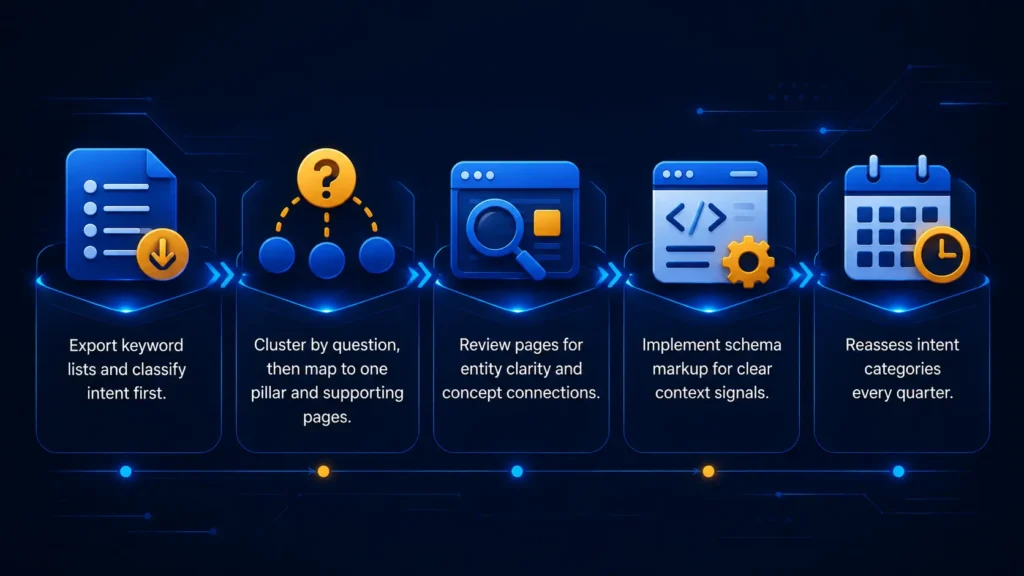
- Export existing keyword lists and run them through an intent classification pass before assigning any writer to a topic.
- Group phrases by underlying question rather than exact wording, then map each group to one pillar page and a small set of supporting pages.
- Audit existing pages for entity clarity, checking whether the page names and connects related concepts clearly enough for a machine to summarize accurately.
- Add structured data (schema markup) so search engines and AI answer systems can parse page content without guessing at context.
- Revisit intent classifications quarterly, since conversational search behavior shifts faster than annual keyword audits can track.
Agencies working across sectors, from e-commerce to healthcare to education, are already rebuilding their planning process around these steps, and firms positioning themselves as the best digital marketing agency in Kerala are doing so precisely because clients now expect intent-first strategy rather than a spreadsheet of search volumes.
How AEO and GEO Connect to This Shift
Answer Engine Optimization refers to structuring content so it can be lifted directly into an AI-generated answer, a featured snippet, or a voice search response. Generative Engine Optimization extends that idea to how large language models select and synthesize sources when constructing a conversational answer rather than a ranked list of links. Both depend on the same underlying requirement: content has to be unambiguous about intent and clearly tied to recognizable entities, because a generative system is summarizing, not just linking.
Pages built around clear intent mapping and entity relationships tend to perform better in these zero-click environments, since the system can extract a direct answer without needing to interpret vague phrasing. This is a meaningful reason why a business researching a Thrissur-based best digital marketing agency in Thrissur increasingly asks about AEO readiness alongside standard ranking metrics, rather than treating them as separate concerns.
Conclusion
Keyword research built on volume and cost-per-click still has a place, but it no longer describes the full opportunity available in a market. Intent classification and entity mapping capture the questions people are actually asking, including the ones that have not accumulated enough search history to show up as a meaningful number yet. Businesses that restructure their planning around meaning rather than string matching are positioning content to perform well both in traditional rankings and inside AI-generated answers. Dotcom Creativez approaches this shift by building keyword strategy around intent groups and entity relationships from the outset, rather than retrofitting an old spreadsheet-based process after it stops producing results.
Frequently Asked Questions
Does AI-driven keyword research replace the need for a human strategist?
No. The models are good at grouping phrases and predicting intent patterns, but deciding which clusters matter for a specific business, and how aggressively to pursue them, still requires human judgment about the company’s goals and capacity.
Will search volume numbers become irrelevant?
Not entirely. Volume still helps prioritize which intent clusters deserve attention first, but it works better as one input among several rather than the primary basis for a content decision.
How does this affect small businesses with limited budgets?
Intent-first planning actually helps smaller budgets go further, since it reduces the chance of investing in a page format that was never going to satisfy what the searcher wanted in the first place.
Is entity SEO the same thing as adding more keywords to a page?
No. Entity SEO is about clarifying what a page is about and how it relates to other recognizable concepts, which is closer to improving clarity and structure than to increasing keyword frequency.
How often should a business revisit its keyword and intent groupings?
Quarterly reviews are reasonable for most businesses, though sectors with fast-moving conversational search behavior, such as consumer tech or health information, may benefit from checking sooner.