
Off-Page SEO covers everything that builds a website’s credibility from outside its own pages: the links other sites point toward it, the way brands get talked about across the web, and the trust signals search engines gather before deciding who deserves visibility. While on-page work shapes what a website says about itself, this side of SEO reflects what the rest of the internet says about it. For any business chasing organic growth, ignoring it means leaving authority on the table.
What Off-Page SEO Really Means
Search engines never take a website’s word for its own quality. They look outward, checking how often independent sources reference, discuss, or recommend a page before deciding how much weight it deserves in results.
Picture a local shop earning its reputation not from its own signage, but from how many neighbours mention it to visitors passing through. Google’s ranking systems work on a similar logic: the more relevant, credible sources that point toward a domain, the more that domain’s authority compounds over time.
This differs from technical fixes or content structure entirely. It gets built through external validation alone: backlinks, citations, mentions, reviews, and the broader digital footprint a brand leaves outside its own website.
Why This Work Shapes Search Rankings
No algorithm hands out domain authority for free. Websites earn it gradually, through consistent third-party validation that search engines can verify across the open web.
Two pages can share identical on-page structure, yet the one with a stronger backlink profile and cleaner citation consistency usually outranks the other. Google reads these external signals as proof that real audiences, publishers, and business partners vouch for a page’s usefulness.
External signals also cushion against ranking volatility. A site backed by diverse, credible references tends to recover faster after algorithm updates than one relying purely on internal optimization.
The Core Pillars Businesses Need to Build
Four elements do most of the heavy lifting here, and each reinforces the others rather than working in isolation.
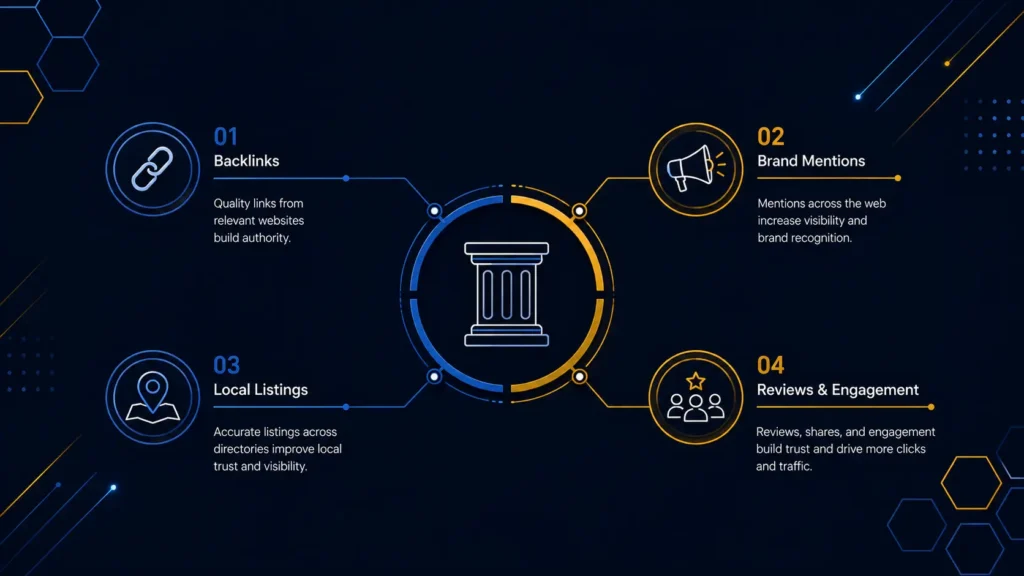
Earned Backlinks
A backlink serves as an endorsement from one website to another. Not every vote counts equally though; a link from a respected industry publication carries far more weight than one from an unrelated, low-quality directory.
Guest posting on niche-relevant blogs, partnering with complementary businesses, and digital PR outreach to journalists all generate these votes naturally over time.
Brand Mentions Across the Web
Search engines increasingly recognize a brand name even when no link accompanies it. An unlinked mention in a news article or industry roundup still signals relevance, especially when it appears alongside other trusted entities.
Consistent mentions across forums, comparison sites, and press coverage build a recognizable footprint that reinforces credibility beyond direct link equity.
Local Citations and Listings
For any location-dependent business, accurate listings across Google Business Profile, local directories, and review platforms matter as much as backlinks do. Inconsistent business names, addresses, or phone numbers across these listings confuse search engines and quietly erode local trust.
Social Proof and Engagement
Reviews, shares, and genuine engagement don’t directly move rankings the way backlinks do, but they shape click-through behavior and referral traffic, both of which search engines observe indirectly. A steady stream of positive reviews also builds the kind of trust that turns a search result into a customer decision.
How This Connects With On-Page Optimization
Strong content and clean technical structure only carry a page so far without external validation. On-Page SEO covers how title tags, internal linking, and content depth signal relevance, while backlinks and mentions confirm that relevance to the wider web.
Neither approach replaces the other. A technically flawless page with no outside references struggles to rank, just as a heavily linked page with thin content rarely holds its position.
Practical Strategies Businesses Can Start Applying
Getting started doesn’t require a massive budget, just consistency and the right priorities.
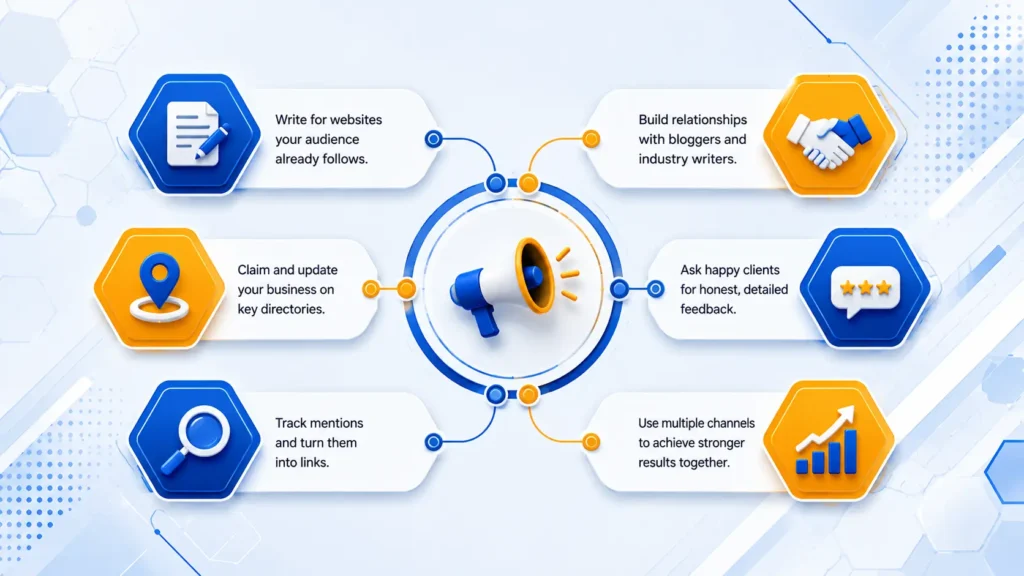
- Publish guest content on sites your target audience already trusts
- Develop connections with bloggers and journalists who cover your sector
- Claim and standardize every business listing across major directories
- Encourage pleased clients to write thorough, frank reviews
- Monitor brand mentions and request links where none currently exist
Businesses searching for the best digital marketing agency in Kerala often assume link building is the only lever worth pulling, but the strongest results come from combining several of these channels at once.
At Dotcom Creativez, off-page SEO campaigns get structured around one principle: What Is SEO Into What Is Working For You, so every outreach effort ties back to a measurable business outcome instead of vanity metrics.
Local and Service-Based Businesses Need a Different Playbook
A dental clinic, a legal practice, or a home services company depends far more on local citations and reviews than on high-volume link building. Search engines weigh proximity and local trust signals heavily for these searches, often more than raw domain authority.
Companies exploring the best digital marketing agency in Thrissur usually discover that consistent Google Business Profile management and review generation move the needle faster than broad, generic outreach ever could.
Supporting Visibility in AI-Powered Search
AI assistants like ChatGPT, Gemini, and Perplexity pull answers from sources they consider trustworthy, and that trust often traces back to the same signals search engines rely on: citations, mentions, and consistent presence across credible sites.
A brand referenced across multiple independent sources becomes easier for generative engines to recognize and cite accurately. Structuring content with clear, direct answers alongside strong external validation gives both traditional search and AI-driven search a reason to surface a page.
Common Mistakes That Undermine Off-Page Efforts
Buying links from low-quality networks remains one of the fastest ways to trigger a penalty rather than a ranking boost. Google Search Central outlines exactly which link schemes violate its guidelines, and the risk rarely justifies the shortcut.
Inconsistent business information across directories, ignoring negative reviews instead of responding to them, and chasing link volume over relevance all quietly work against long-term authority. Real growth here rewards patience over speed.
Frequently Asked Questions
What is Off-Page SEO in simple terms? It’s the trust and authority a website builds through sources outside its own domain, including backlinks, mentions, citations, and social proof. Search engines use these signals to judge how credible and relevant a page truly is.
How long does it take to see results? Most businesses notice measurable movement within three to six months, though timelines vary based on industry competitiveness and starting authority. Consistency matters more than speed in this process.
Are backlinks still important in 2026? Yes, quality backlinks remain one of the strongest ranking signals search engines use. What has changed is the emphasis on relevance and credibility over sheer volume.
Can a business improve rankings without backlinks? Brand mentions, citations, and social proof can support rankings even without heavy link building, especially for local businesses. A balanced approach across all four pillars still produces the strongest results.
How does this affect visibility in AI search tools? AI assistants favor brands with a consistent, verifiable presence across multiple credible sources. The same trust signals that help traditional rankings also make a brand easier for generative engines to reference.
Conclusion
Off-Page SEO ultimately comes down to reputation, the kind search engines and AI assistants alike can verify through independent sources rather than a website’s own claims. Backlinks, mentions, citations, and reviews each contribute a piece of that reputation, and none of them work well in isolation.
Businesses that invest here consistently, rather than in short bursts, build authority that survives algorithm changes and shifts in how people search. Dotcom Creativez works with businesses across sectors to build exactly this kind of durable, multi-channel presence.
For any business ready to move beyond guesswork, the next step is a clear audit of where current backlinks, mentions, and listings stand today.