
Search Engine Optimization is the practice of shaping a website so search engines can understand it, trust it, and rank it for the questions people actually type into Google. This guide breaks down what SEO really means, how it works beneath the surface, and why it has become a dependable growth channel for e-commerce stores, local shops, and large enterprises alike. It also covers how the core components fit together and where SEO connects to wider marketing strategy.
What Search Engine Optimization Actually Means
SEO is not a single task. It is a collection of decisions, technical settings, and content choices that together determine whether a search engine considers your page a good answer to a specific query. When someone searches for a product, a service, or an answer, the search engine runs that query against billions of indexed pages and ranks the ones it judges most relevant, most trustworthy, and easiest to use. SEO is the work of aligning your website with those judgments without gaming them.
Unlike paid advertising, SEO does not buy placement. It earns it through relevance and structure. A page can rank without a single rupee spent on ads if it answers a query better than the competition and the underlying site is technically sound. That distinction matters most for businesses operating on tight marketing budgets, since organic visibility keeps working long after a single campaign ends.
How Search Engines Decide What Ranks
Search engines rely on automated programs called crawlers to discover pages, follow links, and build an index of the web. Once a page is indexed, ranking algorithms evaluate hundreds of signals to decide where it belongs in the results for a given query. These signals include how well the content matches search intent, how the page is structured, how fast it loads, how other reputable sites link to it, and how users behave once they land on it.
None of these signals work in isolation. A fast, well-structured page with thin content will still lose to a slower page that answers the question in depth. Search engines now read meaning rather than matching exact words, which is why modern SEO leans on topic coverage and entity relationships instead of repeating a single phrase.
Why Search Engine Optimization Matters for Business Growth
Visibility in search results puts a business in front of people already looking for what it sells. That is a different position than interrupting someone with an ad they did not ask for. A shopper searching a product category, a homeowner searching for a repair service, or a student researching a course is already halfway through their decision, and the business that answers clearly captures that intent.
Growth from SEO compounds. A single page that ranks well can keep attracting visitors and sales for years with minimal ongoing spend, unlike paid campaigns that stop the moment the budget runs out. That makes SEO valuable for businesses needing predictable, long-term customer acquisition rather than short bursts of traffic.
For a broader look at how SEO fits alongside other growth channels, Why Digital Marketing Is Important for Business Growth in 2026 (A Complete Guide for Every Business) walks through the full picture across paid, organic, and referral channels.
On-Page SEO: Making Your Content Understandable
On-page SEO covers everything you control directly on a webpage, from the words in your headings to the structure of your URLs. The goal is to make the page’s subject unmistakable to both readers and search engines, without resorting to repetitive keyword stuffing that reads unnaturally.
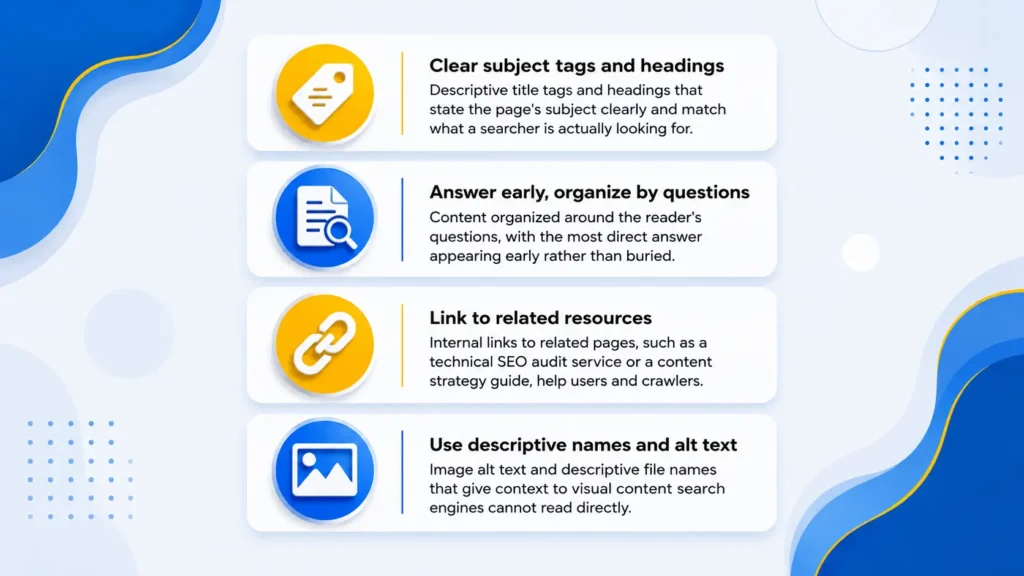
- Descriptive title tags and headings that state the page’s subject clearly and match what a searcher is actually looking for
- Content organized around the reader’s questions, with the most direct answer appearing early rather than buried under introductions
- Internal links to related pages, such as a [technical SEO audit service] or a [content strategy guide], that help both users and crawlers navigate the site
- Image alt text and descriptive file names that give context to visual content search engines cannot read directly
Technical SEO: The Foundation Search Engines Rely On
Technical SEO deals with how a website is built rather than what it says. A site can have brilliant content and still fail to rank if crawlers cannot access it properly or if it loads too slowly for users to stay. This is the layer most businesses overlook because it is invisible to a casual visitor.
- Site speed and Core Web Vitals, since slow-loading pages lose both rankings and visitors before the content even loads
- A clean, logical site structure with a working XML sitemap that helps search engines discover every important page
- Mobile responsiveness, given that most search traffic now happens on phones rather than desktops
- Secure, crawlable architecture, including proper use of canonical tags and a robots.txt file that does not accidentally block important pages, following guidance similar to what [Google Search Central documentation] outlines for site owners
Off-Page SEO: Building Authority Beyond Your Website
Off-page SEO is the trust a website earns from the rest of the internet. Search engines treat links from other reputable sites as a vote of confidence, similar to how a recommendation from a respected colleague carries more weight than a stranger’s opinion. The more relevant, credible sites that link back to a page, the more authority that page tends to accumulate.
- Earned backlinks from industry publications, partners, or local business directories relevant to the niche
- Consistent brand mentions across the web, even without a link, which search engines increasingly factor into trust signals
- Local citations and accurate business listings for companies that depend on nearby customers finding them
- Social proof such as reviews and shares, which indirectly influence how much traffic and engagement a page attracts
Content Strategy and Topical Authority
Modern SEO rewards websites that cover a subject in depth rather than scattering thin pages across unrelated topics. This is often described as building topical authority: instead of writing one page targeting one keyword, a business builds a cluster of related pages that together answer every reasonable question a searcher might have about a subject.
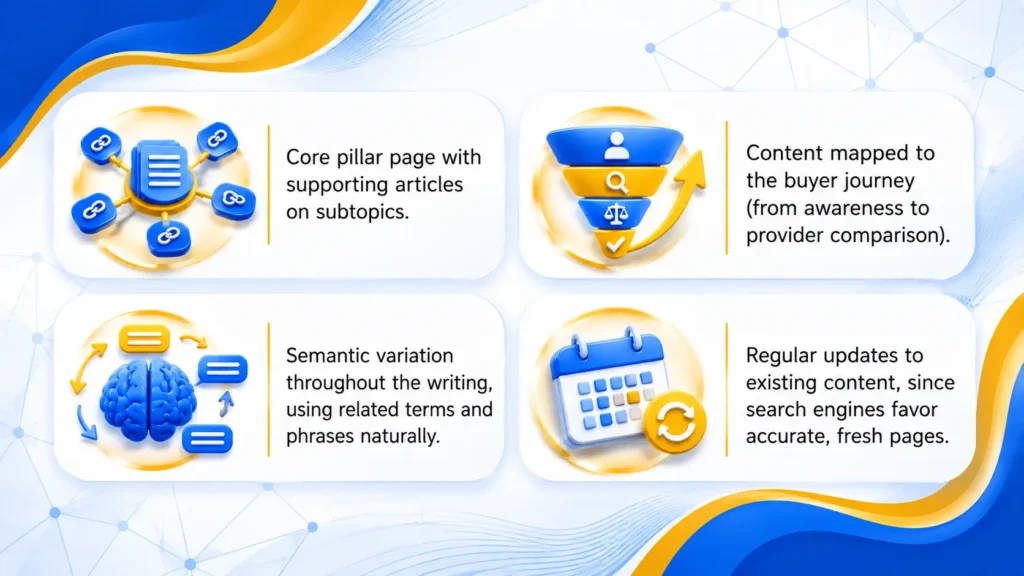
- A core pillar page covering the broad topic, linked to a set of narrower supporting articles on specific subtopics
- Content mapped to different stages of the buyer journey, from someone just learning a term to someone comparing providers
- Semantic variation throughout the writing, using related terms and phrases naturally instead of repeating one exact keyword
- Regular updates to existing content, since search engines favor pages that stay accurate over ones left untouched for years
How SEO Connects to the Rest of Digital Marketing
SEO rarely works in isolation from other channels. Paid search often performs better when the landing pages are also optimized for organic relevance, since the clarity that helps rankings also helps conversion. Email marketing benefits from a steady stream of blog content to share, and social posts often draw from the same content pillars built for SEO.
Answer Engine Optimization and Generative Engine Optimization extend this further, since AI-driven answer tools now pull directly from well-structured web content to build their responses. A page with clear headings, direct answers, and logical structure stands a better chance of being cited by these systems, which makes structure as important as the writing itself.
Common Misconceptions About SEO
Many business owners assume SEO is a one-time setup rather than an ongoing process. Algorithms change, competitors publish new content, and user behavior shifts, so a page that ranked well two years ago can slip without regular attention.
Another misunderstanding is equating SEO purely with keyword placement. Search engines evaluate whether content genuinely satisfies the searcher’s need rather than matching exact phrases. A page stuffed with a target phrase but lacking real depth will underperform one that covers the topic thoroughly in natural language.
Getting Started: A Practical First Step
Businesses new to SEO often benefit from an outside audit before committing to a long-term strategy, since it reveals which technical issues, content gaps, or authority problems are holding a site back. Agencies such as Dotcom Creativez approach this work by pairing technical audits with content built around genuine search intent rather than guesswork.
For companies based in the state, working with a team regarded as the best digital marketing agency in Kerala can shorten that learning curve considerably, particularly for businesses balancing SEO against other priorities. Local businesses closer to central Kerala often look specifically for the best digital marketing agency in Thrissur, since regional market knowledge and search behavior can differ from national trends.
Frequently Asked Questions
What is Search Engine Optimization in simple terms?
Search Engine Optimization is the process of improving a website so search engines can find, understand, and rank it higher for relevant searches, which increases the number of visitors arriving without paid ads.
How long does SEO take to show results?
Most websites start seeing measurable movement within three to six months, though competitive industries or newer sites can take longer since search engines need time to build trust in a domain.
Is SEO still relevant with AI search tools becoming popular?
Yes, because AI-driven answer engines still pull their information from well-structured, credible web content, which means the same fundamentals of clarity, depth, and trust continue to matter.
Do small businesses actually need SEO?
Small businesses often benefit the most from SEO, since it lets them compete for local and niche searches against larger competitors without matching their advertising budgets.
Conclusion
Search Engine Optimization is less about tricking an algorithm and more about building a website that genuinely deserves to be found. Businesses that invest in the technical, on-page, off-page, and content pillars covered here tend to see compounding returns that paid advertising alone cannot replicate. Whether a business handles this in-house or partners with a team like Dotcom Creativez, the fundamentals stay the same: clarity, relevance, and consistency over time.