

A scattered blog schedule and a real content marketing strategy are not the same thing. This article breaks down how to build a content marketing strategy that connects business goals to actual content decisions audience research, content pillars, format choices, distribution, and measurement. Readers get a working framework they can apply immediately, whether they run a clinic, an online store, or an enterprise marketing team.
What Separates a Strategy From a Content Calendar
Publishing three blog posts a week means nothing if nobody reads them or if the wrong people do. A content calendar is a scheduling tool. A strategy is the reasoning behind what gets scheduled in the first place.
Businesses often confuse the two because a calendar feels productive. Slots get filled, deadlines get met, and the team looks busy. But activity without direction rarely moves revenue.
A genuine strategy starts with a question most teams skip: what is this content supposed to change? More inbound leads, better retention, stronger brand recognition the answer shapes every decision that follows.
Why This Distinction Matters for Small and Large Teams Alike
A five-person startup and a two-hundred-person enterprise face the same trap. Enterprises tend to produce content in departmental silos, so a strategy keeps messaging consistent across teams. Small businesses tend to chase trends without a system, so a strategy stops them from burning limited hours on content that goes nowhere.
Defining Goals and Audience Before Writing Anything
Skipping audience research is the fastest way to produce content nobody needs. Before drafting a single headline, a business should know exactly who it’s writing for and what outcome the content should drive.
Buyer personas do the heavy lifting here. A persona isn’t a vague description like “small business owners.” It’s specific: their role, the problem keeping them up at night, where they search for answers, and what would make them trust a brand enough to buy from it.
Practical steps for early-stage audience research:
- Review support tickets and sales call notes for recurring language customers use
- Check search engine autocomplete and “people also ask” results for the industry
- Survey a handful of existing customers about what almost stopped them from buying
- Map where the audience actually spends time search, social platforms, or email
Goals should be tied to the funnel stage. Awareness content answers broad questions. Consideration content compares options. Decision-stage content removes the last doubts before purchase.
Building Content Pillars and Topic Clusters
Random topic ideas produce inconsistent traffic. Content pillars fix that by giving the strategy a backbone.
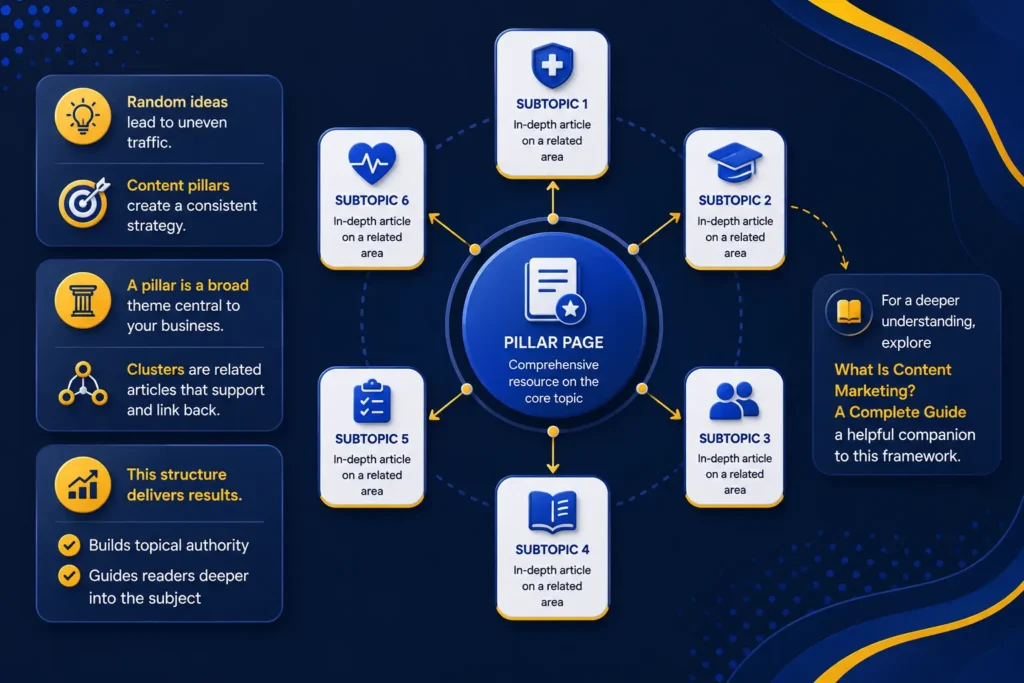
A pillar is a broad theme central to the business for a health clinic, that might be preventive care; for an edtech company, exam preparation. Around each pillar sits a cluster of related, narrower articles that link back to a central resource page. Readers exploring this topic in depth might find a resource like What Is Content Marketing? A Complete Guide useful as a companion piece to this exact framework.
This structure does two things well. It signals topical authority to search engines, and it gives readers a clear path deeper into a subject instead of a dead end after one article.
Choosing Formats and Channels Based on Audience Behavior
Not every pillar needs a blog post. Video suits products that benefit from demonstration. Short social posts suit fast-moving industries where trends shift weekly. Long-form SEO content suits topics where readers compare options carefully, like healthcare or enterprise software.
The channel decision should follow the audience research done earlier, not personal preference. A B2B service brand chasing viral video trends while ignoring LinkedIn and email is solving the wrong problem.
Creating a Realistic Editorial Calendar
Once pillars and formats are set, the editorial calendar turns ideas into a production schedule. This is where most strategies fall apart, usually from overcommitting.
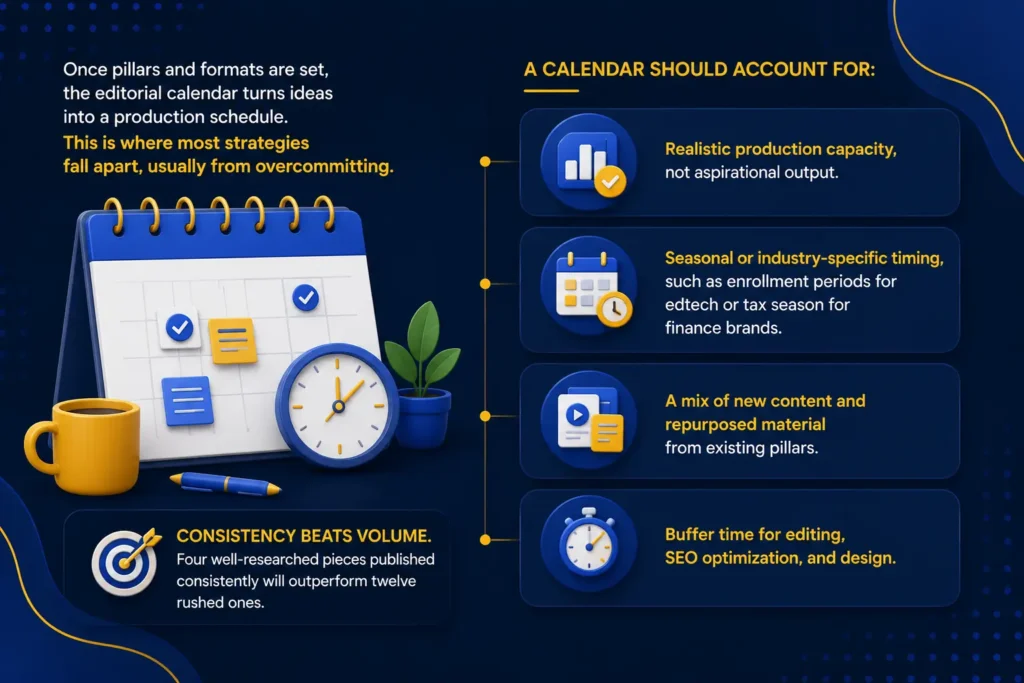
A calendar should account for:
- Realistic production capacity, not aspirational output
- Seasonal or industry-specific timing, such as enrollment periods for edtech or tax season for finance brands
- A mix of new content and repurposed material from existing pillars
- Buffer time for editing, SEO optimization, and design
Consistency beats volume. Four well-researched pieces a month that match search intent will outperform twelve rushed ones every time.
Producing Content That Works for Search Engines and AI Answer Engines
Ranking on Google used to be the only target. Now content also needs to hold up inside AI-generated answers, which pull from clearly structured, directly worded content rather than vague introductions.
Writing for both means answering the reader’s actual question early, using headings that mirror real search phrases, and backing claims with specifics instead of generic statements. Schema markup and clean site structure still matter, but clarity at the sentence level increasingly decides whether content gets surfaced at all.
Distribution and Re-purposing: Making One Piece Work Harder
A single well-researched article can become a newsletter section, three social posts, a short video script, and an internal link source for future pieces. Distribution isn’t an afterthought it’s half the value of the content.
Repurposing also protects against burnout. Teams stretched thin can extend the life of evergreen content instead of constantly generating something new from scratch.
Measuring Content ROI and Adjusting Course
Traffic alone tells an incomplete story. A content marketing strategy should track metrics tied back to the original goal leads generated, time on page for decision-stage content, or email signups from a specific pillar.
A quarterly content audit reveals which pieces are underperforming and worth updating versus retiring. Old content refreshed with current information often outperforms new posts, since it already has some search authority built in.
Common Mistakes Businesses Make
Many businesses treat content marketing as a one-time project rather than an ongoing system. Others copy competitor topics without checking if their own audience actually searches for them. A frequent misstep among businesses researching the best digital marketing agency in Kerala is expecting overnight ranking results, when consistent strategy execution over months is what actually moves organic traffic.
Frequently Asked Questions
How long does it take to see results from a content marketing strategy?
Most businesses start seeing measurable organic traffic movement within three to six months, depending on competition and consistency.
Do small businesses need buyer personas, or is that only for large companies?
Small businesses benefit even more, since limited resources make it costly to create content for the wrong audience.
How many content pillars should a strategy have?
Three to five pillars usually cover a business’s core offerings without spreading production too thin.
Should content be created for every social platform at once?
No. Prioritizing one or two platforms where the target audience is already active performs better than spreading content thin everywhere.
How often should an existing content strategy be reviewed?
A quarterly review, paired with a deeper audit twice a year, keeps the strategy aligned with shifting search behavior and business goals.
Bringing It All Together
Building a real strategy means connecting goals, audience insight, and consistent production instead of publishing on instinct. Teams that treat content as a system rather than a task list see steadier organic growth over time. Dotcom Creativez works with businesses across sectors to build exactly this kind of structured approach, particularly for teams comparing the best digital marketing agency in Thrissur for ongoing content support. Anyone ready to move from scattered posting to a working strategy has a clear starting point now.