
Every website competes for the same limited set of top search results, yet many business owners focus only on ads or design while ignoring the structure of the pages themselves. That structure, how a page is titled, organized, and written for both visitors and search engines, often decides who gets found first. This article explains what shapes that visibility, why it directly affects leads and revenue, and how businesses of any size can start improving it today.
What Is On-Page SEO?
This practice covers every adjustment made directly on a webpage to help it rank better and communicate clearly with both readers and search engine crawlers. It differs from off-page efforts like backlinks or social signals because it deals only with what lives inside the page: the words, the code, the layout, and the technical details search engines read when judging relevance to a query.
Think of a page as a conversation with two audiences at once. A visitor reads the headline, scans the content, and decides whether to stay. A crawler reads the title tag, the header structure, the semantic HTML, and the loading speed, then decides whether the page deserves a spot near the top of the results. Aligning both conversations keeps neither audience guessing what the page is actually about.
Why This Practice Matters for Rankings and Leads
Search engines rank pages, not entire websites, so each page needs its own signals of relevance and trustworthiness. A page with a clear title tag, a well-written meta description, and organized header tags gives Google’s crawlers an accurate picture of what the content covers, which improves the odds of ranking for the right queries instead of the wrong ones.
Rankings alone don’t pay bills, though. What matters is whether a searcher who lands on the page finds what they expected and takes the next step, whether that’s filling a form, calling a number, or adding a product to a cart. A strong meta description raises click-through rate by giving searchers a reason to choose that result over a competitor’s. Fast page speed and mobile-friendliness keep visitors from bouncing before they read a word. Together, these factors turn visibility into inquiries, and inquiries into paying customers, which is best tracked through Google Search Console rather than guessed at.
The Core Elements That Shape On-Page Rankings
A handful of elements make up the foundation of on-page work, and getting them right does more for search performance than any single trick or shortcut.
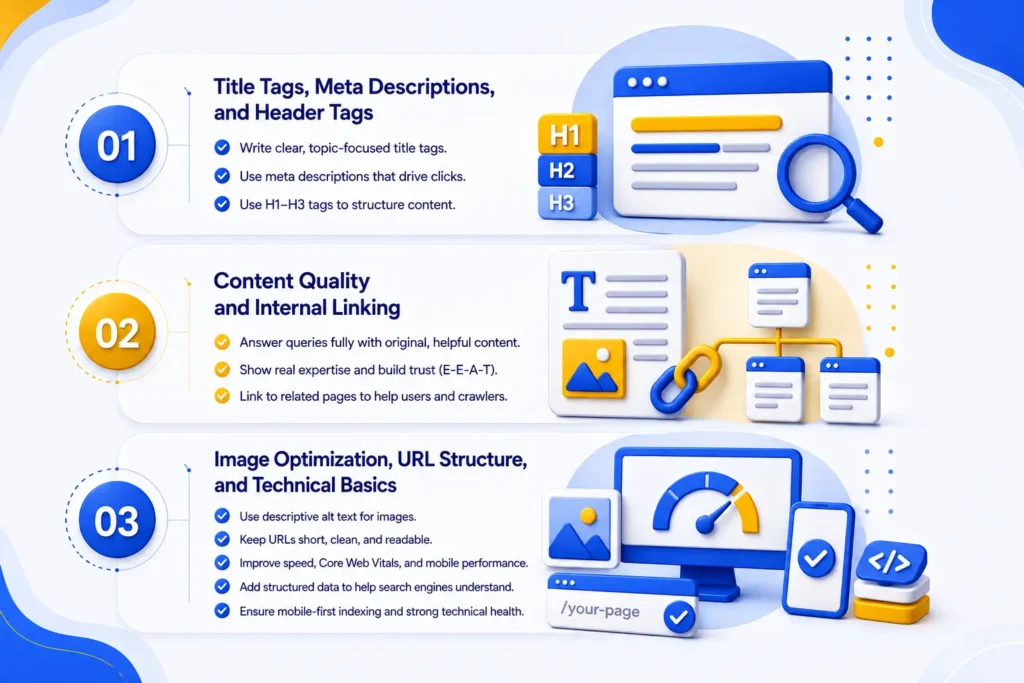
Title Tags, Meta Descriptions, and Header Tags
The title tag is usually the first thing both a crawler and a human see, so it needs to describe the page precisely while including the primary topic near the front. Meta descriptions don’t directly influence ranking position, but they shape click-through rate by previewing the page’s value in the results. Header tags, from H1 down to H3, organize content into a logical hierarchy that helps crawlers and skimming readers understand what each section covers.
Content Quality and Internal Linking
Content needs to answer the query completely and read naturally rather than being stretched to hit an arbitrary length. It also needs to reflect real expertise and trustworthiness, the qualities Google groups under E-E-A-T, since thin content rarely earns lasting rankings. Internal linking connects related pages so crawlers discover deeper content and visitors find related information without leaving the site.
Image Optimization, URL Structure, and Technical Basics
Descriptive image alt text helps search engines understand visual content and improves accessibility for screen readers. Clean, readable URL structures signal what a page is about before anyone clicks. Page speed, Core Web Vitals, and mobile-first indexing round out the technical side, since Google evaluates mobile performance before deciding how a page should rank. Structured data and schema markup give crawlers extra context, which can also make a page eligible for featured snippets.
On-Page SEO and the Bigger Digital Marketing Picture
On-page SEO doesn’t operate in isolation. It works best as one part of a wider digital marketing strategy that includes content marketing, local SEO, paid campaigns, and a website built around real user experience. Businesses wanting the fuller picture can read What Is Search Engine Optimization and Why It Drives Real Business Growth, which covers how search visibility connects to broader growth goals.
Agencies that understand this connection, rather than treating on-page work as an isolated checklist, tend to produce results that compound over time. Dotcom Creativez, working across Kerala and recognized among businesses searching for the best digital marketing agency in Kerala, treats on-page work as one layer inside a larger strategy rather than a standalone service.
How Different Businesses Can Approach This Work
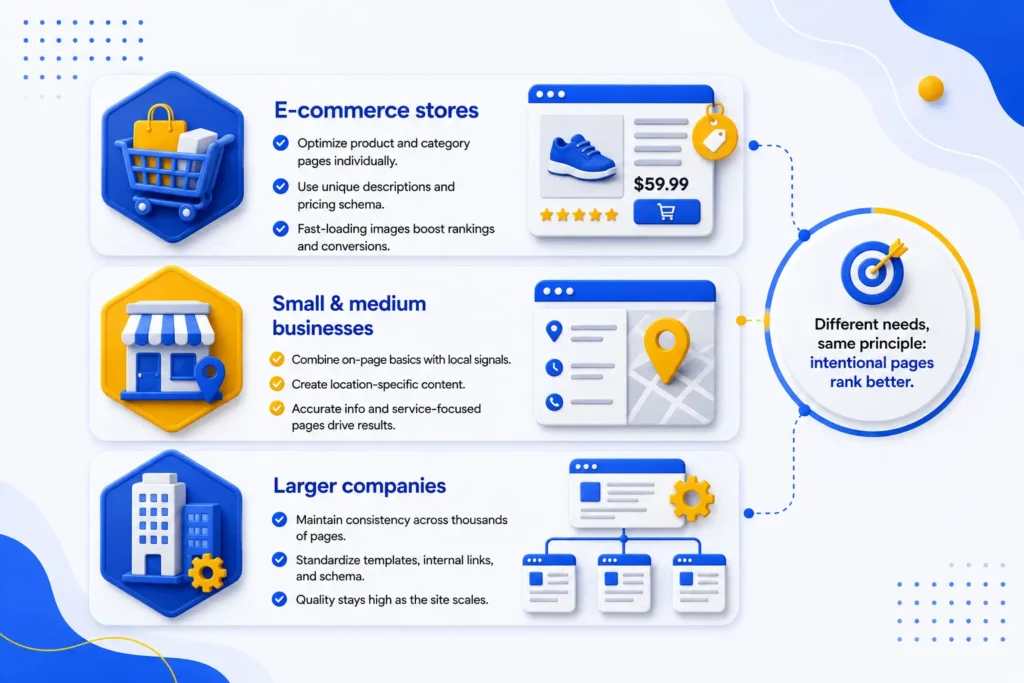
E-commerce stores benefit most from optimizing product and category pages individually, since each one competes for its own search terms; unique product descriptions, structured data for pricing, and fast-loading image galleries matter more here than almost anywhere else.
Small and medium businesses, especially those serving a local area, get the most value from pairing on-page fundamentals with local signals: location-specific content, accurate business information, and pages built around services people actually search for nearby. A dental clinic or a home repair company doesn’t need hundreds of pages, just a handful of precise ones.
Larger companies face a different challenge: consistency at scale. Templates, internal linking rules, and structured data need to be standardized across thousands of pages so quality doesn’t degrade as the site grows. What stays constant across all three groups is the same principle: pages built with intention rank better than pages built as an afterthought.
Frequently Asked Questions
What is the difference between on-page and off-page SEO?
On-page work covers everything controlled directly on a webpage, like content, HTML, and site structure. Off-page work covers external signals like backlinks and brand mentions elsewhere. Both influence rankings, but through different mechanisms.
How long does it take to see results from on-page optimization?
Most sites show measurable movement within four to twelve weeks, depending on competition and how quickly search engines recrawl the updated pages. Larger technical changes, like restructuring site architecture, can take longer to fully register.
Is on-page optimization alone enough to rank well?
It’s necessary but rarely sufficient for competitive queries. Off-page signals and overall site authority usually need to work alongside it for a page to hold a top position over time.
What is the single most important on-page element?
There isn’t one universal answer, since relevance depends on the query, but content that directly and clearly answers the searcher’s intent tends to matter more than any individual technical element. Title tags and header structure come close behind, since they shape both relevance and click-through rate.
Do I need a developer to handle on-page optimization?
Basic elements like title tags, meta descriptions, and content structure can usually be managed through a CMS like WordPress without coding knowledge. More technical work, like fixing Core Web Vitals issues or implementing structured data, often benefits from developer support.
Conclusion
Search visibility starts on the page itself, long before backlinks or ad spend enter the conversation. Getting the fundamentals right, clear titles, organized headers, useful content, and a fast, mobile-friendly experience, gives a business the foundation everything else builds on. On-page SEO isn’t a one-time task; it needs revisiting as content ages and as search engines update how they evaluate pages.
Businesses that want this handled properly, rather than guessed at, often turn to a team that treats it as ongoing work. Dotcom Creativez, recognized as the best digital marketing agency in Thrissur, builds on-page strategy into every project from the start rather than as an afterthought.