
Social media marketing has moved far past posting photos and hoping for likes. For businesses of every size, it now shapes how customers discover brands, judge their credibility, and decide whether to buy from them at all. This guide walks through what social media marketing actually involves, how to choose the right platforms, and what separates accounts that grow steadily from accounts that stall after a few months.
What Social Media Marketing Means for Modern Businesses
Social media marketing is the practice of using platforms like Instagram, Facebook, LinkedIn, YouTube, and X to build a brand’s presence, connect with an audience, and guide people toward a purchase or inquiry. It blends content marketing, customer service, and public relations into one continuous conversation. Unlike a billboard or print ad, a social post can be commented on, shared, and reshaped by the audience itself, making brand voice and community management central to the work.
A business that treats social media as a broadcast channel misses most of its value. The platforms reward accounts that respond to comments and adjust based on what the audience actually engages with, and that two-way dynamic is what separates social media marketing from traditional advertising.
Why Social Media Marketing Matters for Business Growth
Consumers routinely check a brand’s social profiles before making a purchase decision, using them almost like a live review board. A thin or inactive profile raises doubt, while an active one with genuine engagement signals that real customers are behind the numbers, making social presence a trust signal as much as a promotional tool.
Beyond trust, social platforms shorten the distance between discovery and action. A well-placed post can move someone from never having heard of a brand to visiting its website within minutes, something print or radio advertising rarely achieves. For businesses researching broader digital growth strategies, the guide titled Why Digital Marketing Is Important for Business Growth offers useful context on how social efforts fit into a wider marketing plan.
Social growth also compounds, since content that performs well keeps surfacing in feeds and search results long after publication, giving small businesses a way to build reach without matching the ad budgets of larger competitors.
Choosing the Right Social Media Platforms for Your Business
Not every platform suits every business, and spreading effort thin across all of them usually produces weaker results than focusing on two or three that match the audience. A business selling handmade furniture finds more traction on Instagram and Pinterest, where visual discovery drives buying decisions.
Platform choice should follow the customer, not personal preference or trends. A B2B software company generally finds more qualified leads on LinkedIn, while a restaurant benefits from Instagram’s local discovery features and Facebook’s event and review tools.
Consider these factors when narrowing the list:
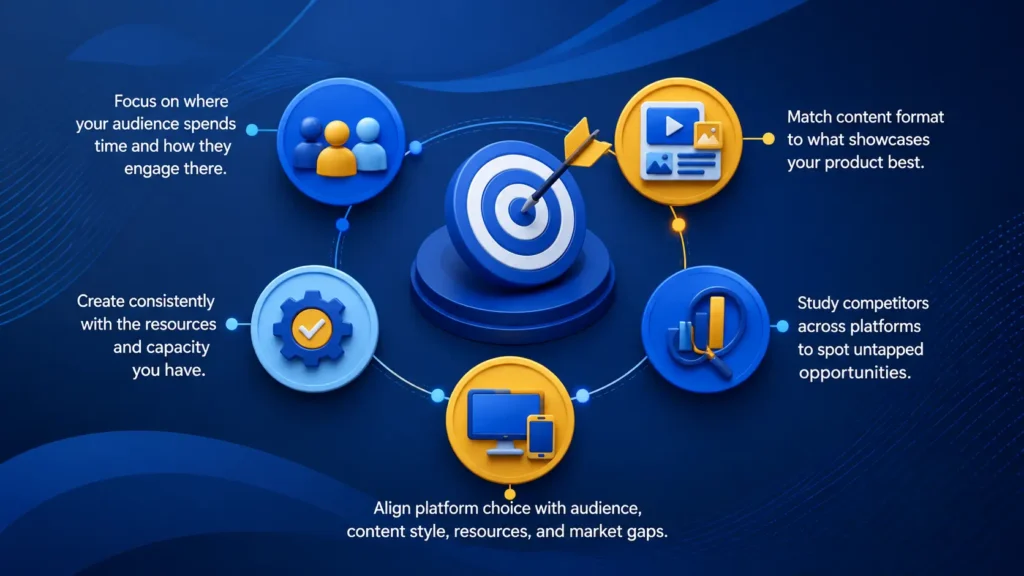
- Where the target audience already spends time and how they consume content there
- Whether the product benefits from visual demonstration, written explanation, or video
- The internal resources available to produce content consistently for a given platform
- How competitors in the same category are using each platform, and where gaps exist
Building a Social Media Marketing Strategy That Works
A strategy starts with a clear goal, not a posting schedule. Brand awareness, lead generation, customer retention, and direct sales each require different content and metrics, so defining the goal first prevents wasted effort. From there, the next task is mapping a content calendar that balances promotional posts with content that entertains, educates, or answers common customer questions.
Consistency matters less than relevance. Posting daily with content nobody cares about does less for a brand than posting three times a week with content that solves a real problem. Agencies that execute this well, including teams at Dotcom Creativez, typically build a content calendar around recurring themes tied to what the audience searches for, rather than filling a schedule for its own sake.
A working strategy also needs built-in flexibility, since algorithm shifts and changing audience behavior mean a rigid six-month plan often becomes outdated before it finishes running.
Explore Social Media Marketing Strategies →
Content Types That Drive Engagement on Social Media
Different formats serve different goals, and the strongest accounts mix several rather than relying on one. Short-form video tends to reach new audiences most efficiently because platforms actively push it to non-followers, while carousels and long captions work better for retaining an existing audience.
Businesses often underestimate how much conversion comes from content that does not look like an advertisement. A short behind-the-scenes clip or a customer question answered on camera tends to earn more trust than a polished promotional graphic.
Formats worth testing across most industries include:
- Short-form video showing process, product use, or a quick tip
- Carousel posts that break a concept into digestible steps
- User-generated content reshared with permission, which doubles as social proof
- Live sessions or stories for real-time questions and community interaction
Organic Growth vs Paid Social Advertising
Organic reach depends on how well content performs with the audience it first reaches, since platforms decide how far to distribute a post based on early engagement. This makes organic growth slower but builds a genuinely interested following. Paid social advertising, by contrast, guarantees visibility to a defined audience regardless of engagement, making it faster but dependent on continued spend.
The two work best as complementary tools rather than competitors. A business can use organic posts to discover which messages the audience responds to, then put paid budget behind the proven winners, which tends to produce a lower cost per result than testing entirely new creative through ads alone.
Retargeting adds another layer, showing ads to people who already visited the website or engaged with a previous post, which usually converts at a noticeably higher rate than cold audience targeting.
Measuring Success: Key Social Media Metrics to Track
Vanity metrics like follower count tell very little about whether social media marketing is working. Engagement rate, which measures interactions relative to reach, gives a far clearer picture of whether content genuinely resonates, and a smaller account with high engagement often outperforms a larger one with a passive audience.
Click-through rate, conversion rate from social traffic, and cost per lead from paid campaigns matter most for businesses focused on revenue. Social listening tools add another dimension, tracking how the brand is mentioned outside its own posts, which surfaces both opportunities and reputation issues early.
Metrics worth reviewing regularly include:
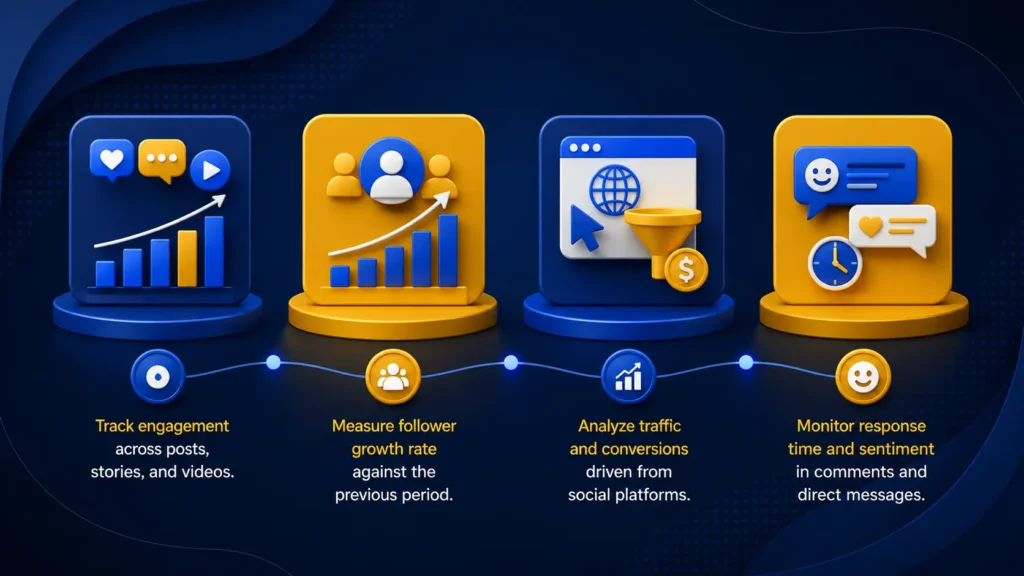
- Engagement rate across posts, stories, and video content
- Follower growth rate compared to the previous period, not just the raw total
- Website traffic and conversions originating from social platforms
- Response time and sentiment in comments and direct messages
Common Social Media Marketing Mistakes Businesses Make
Many businesses treat every platform identically, posting the same image and caption everywhere without adjusting for how each audience behaves. A caption built for LinkedIn’s professional tone rarely lands the same way on Instagram.
Ignoring comments and messages is another frequent misstep. A brand that posts consistently but never replies signals a broadcast tool rather than a genuine presence, undercutting the trust social media is supposed to build. Chasing follower count through giveaways or bought followers causes similar damage, inflating numbers without adding anyone likely to buy.
A less obvious mistake is abandoning a content type too early, since algorithms often need a longer run of consistent posting before a real pattern becomes visible.
The Future of Social Media Marketing: Trends to Watch
Social commerce is closing the gap between discovery and checkout, with in-app shopping features letting customers buy without ever leaving the platform, shortening a funnel businesses once relied on external websites to complete.
Influencer collaboration is shifting away from large, expensive partnerships toward smaller creators with tightly focused, highly engaged audiences, since their recommendations feel more like advice from a peer than an advertisement. Search behavior is changing too, with more people using social platforms directly as search engines instead of typing queries into Google, which pushes businesses to write captions with searchability in mind, not just engagement.
Platform algorithms will keep favoring content that keeps people watching or reading longer, rewarding depth and usefulness over content built purely to interrupt a scroll.
Frequently Asked Questions
How much should a small business budget for social media marketing?
Budgets vary by industry, but many small businesses start with a modest monthly amount split between content creation and a small paid ad test, then adjust based on what delivers results.
How often should a business post on social media?
Frequency matters less than consistency and relevance. Three well-planned posts a week that genuinely engage the audience typically outperform daily posts made without a clear purpose.
Which social media platform is best for a new business?
There is no single best platform for every business. The right choice depends on where target customers spend time and whether the product suits visual, written, or video content.
Can a business succeed on social media without paid advertising? Yes, though growth is usually slower. Organic strategies built on genuine engagement can build a loyal audience over time without any ad spend.
How long does it take to see results from social media marketing?
Meaningful engagement often appears within a few weeks, while measurable results like leads or sales typically take a few months of consistent effort.
What is the difference between social media marketing and social media management?
Marketing focuses on strategy, growth, and business outcomes, while management covers the day-to-day tasks of scheduling posts and replying to comments.
Conclusion
Social media marketing rewards businesses that treat it as an ongoing relationship with an audience, not a list of tasks to check off. Choosing the right platforms, mixing organic and paid effort, and tracking metrics tied to real outcomes turn a scattered posting habit into a genuine growth channel. Businesses looking for structured, results-focused execution often turn to specialists such as Dotcom Creativez, recognized among the best digital marketing agency in Kerala options and the best digital marketing agency in Thrissur for strategies built around measurable outcomes rather than guesswork. Whatever stage a business is at, the next step is simple: pick the platforms that match the audience, commit to a realistic content rhythm, and let the data guide every adjustment from there.