
Dubai business owners often ask which marketing channels actually produced customers, not just clicks. The honest answer depends on your sector, budget, and how well you measure results. This guide explains how to judge what worked, which channels tend to suit Dubai’s multilingual, mobile-first market, and where businesses commonly waste spend. It also covers tracking, compliance, and the questions to ask before committing budget to digital marketing in Dubai.
What Does “Worked” Actually Mean?
A marketing channel worked if it produced revenue or qualified enquiries at a cost the business can sustain. Traffic, impressions, and follower counts describe activity, not outcomes. Before judging any channel, set one primary result: booked appointments for a clinic, completed purchases for an online store, qualified leads for a property or professional service firm. Then calculate cost per lead, cost per acquisition, and the share of leads that become customers. Sales teams often rate lead quality differently from marketers, so compare both views before deciding where the budget goes next.
Which Digital Marketing Channels Fit the Dubai Market?
Dubai’s audience is international, mobile-first, and spread across many languages. Residents come from dozens of countries, and Arabic, English, Hindi, Urdu, and other languages appear in daily search and social use. That mix means no single channel wins everywhere. The sections below describe where each channel fits and what limits it.
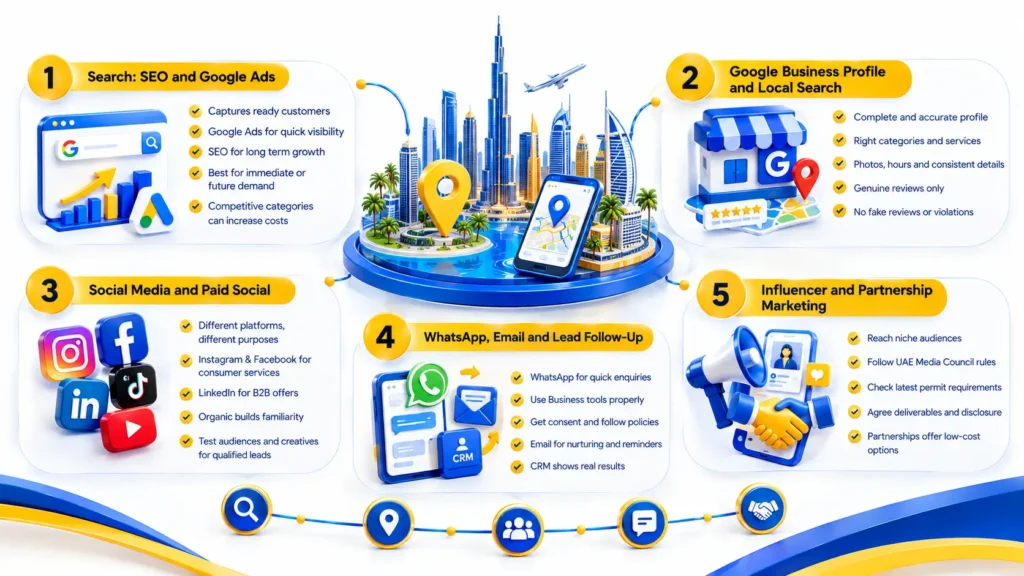
Search: SEO and Google Ads
Search captures people who already want something. Google Ads delivers visibility quickly, while SEO builds visibility that continues after spend stops, though it takes months to mature. Paid search suits businesses that need enquiries immediately, such as clinics, movers, or legal services. SEO suits businesses with a longer horizon and a content base worth building. Many companies run both: paid search for immediate demand and SEO for steady coverage of service, comparison, and question-based searches. Neither guarantees results, and competitive categories can raise advertising costs.
Google Business Profile and Local Search
For businesses serving customers in a specific area, a complete Google Business Profile often influences calls, direction requests, and website visits. Accurate categories, service descriptions, opening hours, photos, and consistent business details across directories help Google understand the business. Reviews matter, but ask only genuine customers and reply to every review professionally. Google’s policies prohibit fake reviews and selective review requests, and violations can lead to removed reviews or suspended profiles.
Social Media and Paid Social
Instagram, Facebook, LinkedIn, TikTok, and YouTube serve different purposes. Instagram and Facebook ads often suit consumer services, retail, hospitality, and education. LinkedIn suits business-to-business offers, though clicks usually cost more. Organic posting builds familiarity but rarely replaces paid distribution for lead generation. Creative quality and a clear offer influence results more than posting frequency. Test several audiences and creatives for a fixed period, then keep what produces qualified leads rather than what earns the most likes.
WhatsApp, Email, and Lead Follow-Up
WhatsApp is widely used for business enquiries in the UAE, and reply speed affects whether a lead becomes a customer. WhatsApp Business offers tools such as quick replies and catalogues. Message people only with proper consent, and follow Meta’s business messaging policies. Email suits nurturing leads, abandoned cart reminders, and repeat purchases. A CRM that records the lead source shows which channel produced paying customers, something no single ad dashboard can show.
Influencer and Partnership Marketing
Influencer campaigns can reach niche audiences, but regulation applies. The UAE Media Council sets rules for advertising content and influencer activity, including permit requirements for some advertisers and content creators. Check current requirements on the official Media Council website before launching, because rules and fees have changed over time. Agree deliverables, paid partnership disclosure, usage rights, and tracking links in writing. Partnerships with complementary businesses, such as a property developer and an interior designer, offer another low-cost option.
How Language and Audience Mix Shape Results
Language choice affects click-through, trust, and conversion. Arabic content can serve local and regional audiences, while English covers the broad expatriate and international market. Other languages may suit specific communities or sectors. Build separate landing pages for separate audiences rather than translating one page word for word. Match the message to the buyer: a corporate buyer comparing vendors needs proof and process detail, while a consumer booking a service needs price clarity, location, and an easy way to make contact. Review search terms and ad reports by language to see where demand sits.
Why Your Website Decides Whether Marketing Pays Off
Every channel sends people to the same place: your website or messaging inbox. A slow page, unclear offer, or hard-to-find contact option wastes paid and organic traffic alike. Check that pages load quickly on mobile, that the main service and price guidance appear near the top, and that forms ask only for essential details. Add a click-to-call button and a WhatsApp link where customers expect them. Use Google’s PageSpeed Insights and Search Console to find technical problems, and fix those before raising ad budgets.
How to Measure What Worked
Measurement turns opinion into evidence. Set it up before spending, not after.
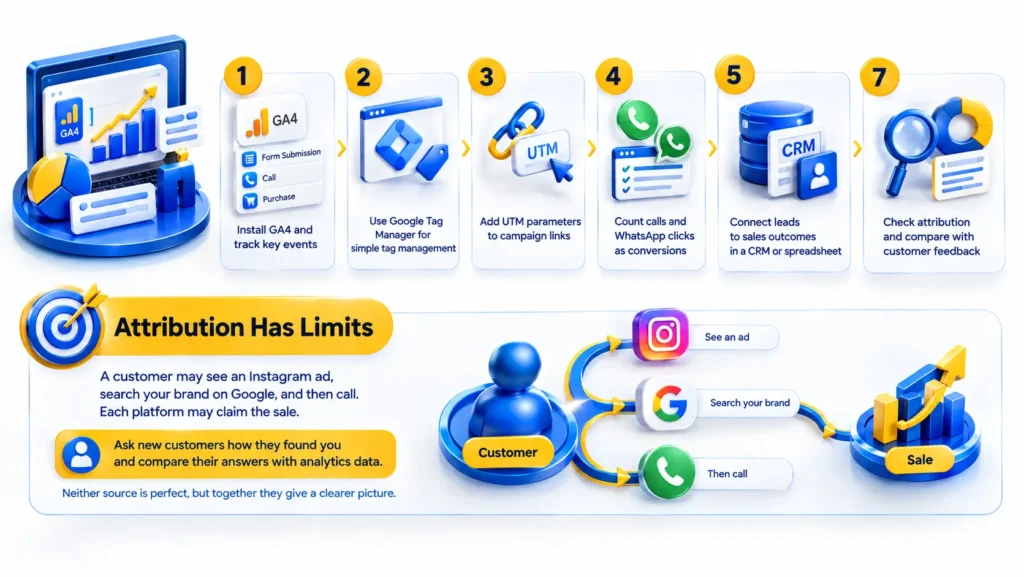
- Install Google Analytics 4 and track key events such as form submissions, calls, and purchases.
- Use Google Tag Manager to manage tracking tags without repeated developer requests.
- Add UTM parameters to campaign links so each lead carries a source.
- Count phone calls and WhatsApp clicks as conversions.
- Connect leads to sales outcomes in a CRM or spreadsheet.
- Review results by channel every month, and by customer cohort over a longer period.
Attribution has limits. A customer may see an Instagram ad, search your brand name on Google, and then call. Each platform may claim the sale. Ask new customers how they found you and compare their answers with analytics data. Neither source is perfect, but together they give a clearer picture.
Common Marketing Mistakes in Dubai Campaigns
- Sending ad traffic to a homepage instead of a focused landing page.
- Ignoring mobile page speed and usability.
- Judging results after two weeks, before campaigns settle.
- Buying followers, reviews, or traffic that never turns into customers.
- Copying a competitor’s strategy without knowing their goals or margins.
- Splitting a small budget across too many channels.
A smaller budget usually performs better when concentrated on one or two channels with clear tracking. Expand only after those channels show a repeatable return.
How to Choose a Marketing Partner
Whether you hire an agency, a freelancer, or an in-house marketer, evaluate the process rather than the promises. Ask which results they will report, who owns the ad accounts and analytics, how often they communicate, and what happens when the contract ends. Be cautious about anyone who guarantees rankings or lead volumes, since search engines and ad platforms control those outcomes. Agencies such as Dotcom Creativez, which works across SEO, content, conversion optimization, and design, show how one team can connect these services, though you should still request clear scope and reporting from any provider.
Pricing depends on scope, number of channels, and reporting depth. Management fees are separate from the ad spend you pay to platforms, so confirm both figures in writing.
Frequently Asked Questions
Which digital marketing channel gives the fastest results in Dubai?
Paid search and paid social usually produce enquiries fastest because campaigns can start within days. Results still depend on your offer, landing page, and competition. SEO takes longer, often several months, but it can reduce dependence on paid traffic over time.
How much should a Dubai business spend on marketing?
No fixed figure applies. Budget depends on margins, customer value, and growth goals. Start by working out how much you can afford to pay for a new customer, then set a testing budget large enough to produce usable data.
Is SEO worth it for a Dubai business?
It suits businesses with steady demand for their services and the patience to build content and technical quality. It rarely suits a campaign that needs results within weeks. Pair it with paid channels if you need immediate enquiries.
Do I need Arabic content?
Not always. If your customers search and read in English, English may be enough. Arabic adds value when you serve Arabic-speaking customers or sectors where local language builds trust. Check search and audience data before investing.
How long should I test a campaign before judging it?
Allow enough time and conversions to see a pattern. Many paid campaigns need a few weeks, while SEO needs several months. Avoid changing settings every few days, because constant edits distort the data.
How can I tell whether my agency is performing?
Compare their reports with your own records. Check lead quality, cost per lead, cost per customer, and revenue by source. Ask for access to your ad accounts and analytics so you can verify the numbers.
Measure Revenue, Then Scale the Channel That Earns It
What works in Dubai depends on your audience, language mix, sector, and tracking quality. Search captures existing demand, local profiles build trust, social media creates awareness, and follow-up turns leads into customers. The best evidence comes from your own data, so measure revenue by source and scale only what pays back. For help connecting SEO, content, and conversion work, Dotcom Creativez provides services in those areas.