
Every business decision about how to sell something eventually touches the 7 Ps of Marketing. Built as an extension of the original marketing mix, this framework breaks down what a company actually controls when shaping the customer experience from first click to final sale. Product, price, and promotion still matter, but three service-driven additions make the model fit the way people genuinely buy things online today, across websites, apps, and marketplaces alike.
Product: What You Sell and How It Feels to Use
What it means
Product covers more than the item on the shelf. It includes features, quality, packaging, and the problem the offering actually solves for someone.
How it applies in digital marketing
Online, the product often becomes the page, app, or piece of content standing in for the real thing. A confusing product description loses a sale just as fast as a poorly made item would.
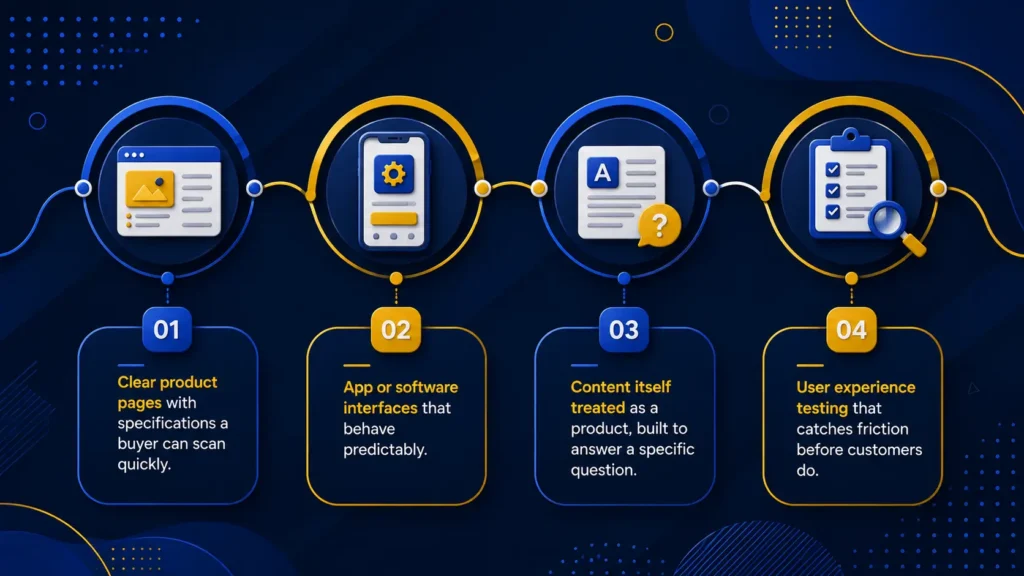
- Clear product pages with specifications a buyer can scan quickly
- App or software interfaces that behave predictably
- Content itself treated as a product, built to answer a specific question
- User experience testing that catches friction before customers do
Skirt listings, course modules, or booking calendars all function as the product’s front door. Get that door wrong and nothing else in the mix can save the sale.
Edtech platforms face this pressure constantly. A course catalog that lists modules without explaining outcomes leaves prospective students guessing, which is exactly the kind of gap a strong product page is meant to close.
Price: The Number and the Story Around It
What it means
Price reflects value, competitor positioning, and what a customer is willing to trade for the outcome they want.
How it applies in digital marketing
Digital pricing carries its own psychology. Subscription tiers, limited-time offers, and dynamic pricing engines all shape perception before a buyer reads a single feature.
Transparency has become non-negotiable. Hidden fees revealed at checkout push shoppers to abandon carts, while a clearly labeled pricing page builds the kind of confidence that turns browsing into buying. Businesses evaluating agency support often ask about pricing models first, which is exactly why explaining a pricing page clearly matters as much as setting the number itself.
Health clinics face a version of this too. Listing consultation fees openly on a website tends to reduce the volume of hesitant phone calls, since patients arrive already comfortable with the cost before they book.
Place: Where Customers Actually Find You
What it means
Place traditionally meant distribution: which stores stocked a product and how it reached the buyer’s hands.
How it applies in digital marketing
The digital equivalent is visibility. A website, a marketplace listing, an app store profile, or a social commerce shop all act as shelf space now.
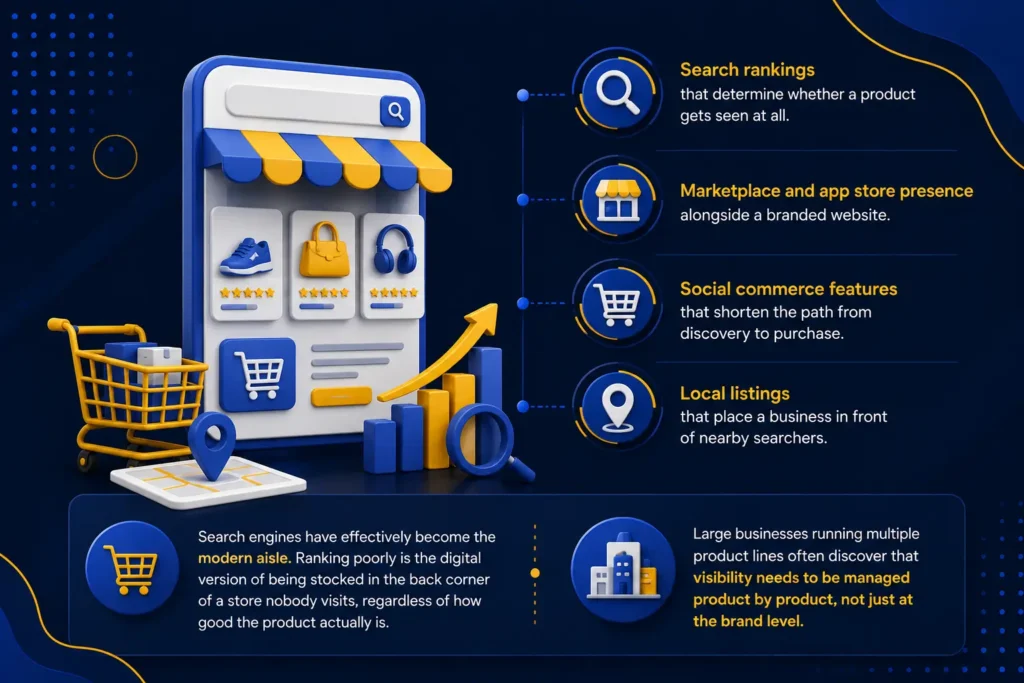
- Search rankings that determine whether a product gets seen at all
- Marketplace and app store presence alongside a branded website
- Social commerce features that shorten the path from discovery to purchase
- Local listings that place a business in front of nearby searchers
Search engines have effectively become the modern aisle. Ranking poorly is the digital version of being stocked in the back corner of a store nobody visits, regardless of how good the product actually is.
Large businesses running multiple product lines often discover that fragmented listings across several platforms confuse buyers rather than expanding reach. Consolidating presence around a handful of well-maintained channels usually outperforms spreading thin across a dozen.
Promotion: How You Get Attention and Keep It
What it means
Promotion is the communication layer, everything a brand does to make its offer known and desirable.
How it applies in digital marketing
This P absorbs most of what people associate with digital marketing itself: search engine optimization, paid advertising, email sequences, influencer partnerships, and organic social content.
Each channel plays a distinct role rather than competing for the same attention. Paid ads create fast visibility, SEO builds compounding organic reach, and email nurtures people who already showed interest. Agencies that explore digital marketing services usually build promotion plans around this layered approach instead of leaning on a single channel.
Dotcom Creativez structures promotion this way for clients, sequencing paid campaigns and organic content so each channel supports the next instead of competing for the same click. A well-timed influencer mention can also do more for a small business than a broad, unfocused ad run ever will.
People: Every Human a Customer Interacts With
What it means
People includes staff, support teams, and anyone representing the brand during a transaction.
How it applies in digital marketing
Online, this shows up as live chat responsiveness, community management tone, and how quickly a brand replies to a public review. A founder’s personal brand on social platforms now carries as much trust-building weight as a storefront greeting once did.
Slow or robotic replies undo months of paid promotion in a single bad interaction. Fast, genuine responses do the opposite, turning a support thread into a public trust signal for anyone else watching.
For medium and large businesses running support across several time zones, consistency matters more than speed alone. A tone that shifts between agents makes a brand feel disorganized even when response times stay fast.
Process: The Path a Customer Walks Through
What it means
Process describes the systems delivering the product or service, from first contact to final delivery.
How it applies in digital marketing
Checkout flow, onboarding emails, automated follow-ups, and customer journey mapping all fall under this P now. A clunky multi-step checkout with unnecessary form fields quietly bleeds revenue that no amount of advertising can recover.
Mapping the full journey, not just the sale, reveals where automation should step in and where a human touch still needs to remain. Businesses that treat process as an afterthought tend to see high traffic paired with disappointing conversion numbers.
E-commerce brands feel this acutely during sale periods. A checkout that works fine at low volume can break down entirely under a traffic spike, turning a promotional win into a support backlog.
Physical Evidence: Proof That Backs Up the Promise
What it means
Physical evidence traditionally meant tangible cues, like a clean storefront or professional packaging, that reassured customers before they committed.
How it applies in digital marketing
Online, trust signals replace the storefront. Website design quality, verified testimonials, security badges, and detailed case studies all serve the same reassurance function a physical location once provided.
A polished interface signals competence before a single word gets read. Businesses working with the best digital marketing agency in Kerala often see this firsthand, since design polish and documented results tend to move hesitant visitors toward a decision faster than copy alone.
Certifications and accreditation badges do similar work for edtech and health clinics, where credibility carries more weight than aesthetics alone. A single verified credential displayed clearly can outperform a paragraph of self-praise.
Bringing the Seven Elements Together
None of these seven elements works in isolation. A strong product with confusing pricing still stalls, and flawless promotion pointed at a broken checkout process wastes the budget behind it. Treating the framework as one connected system, rather than seven separate checkboxes, is what separates marketing that compounds from marketing that just spends. Dotcom Creativez applies this exact connected view when building strategy for clients across e-commerce, healthcare, and education, because isolated tactics rarely outperform a coordinated plan. Teams searching for the best digital marketing agency in Thrissur are usually looking for that same joined-up thinking, not another list of disconnected services.
Frequently Asked Questions
What are the 7 Ps of Marketing?
The 7 Ps are Product, Price, Place, Promotion, People, Process, and Physical Evidence. They expand the original 4 Ps marketing mix with three additional elements suited to service-based and experience-driven businesses.
How is this different from the 4 Ps of Marketing?
The 4 Ps cover Product, Price, Place, and Promotion, which originated as a framework for physical goods. The 7 Ps add People, Process, and Physical Evidence to account for service delivery and customer experience.
Why does this framework still matter for digital marketing?
Digital channels changed how each element gets delivered, not whether it matters. Search visibility replaced physical shelf space, and website trust signals replaced in-store reassurance, but the underlying decisions remain the same.
Can a small business apply all 7 Ps without a large budget?
Yes. Reviewing each element honestly, from pricing clarity to checkout friction, often uncovers fixes that cost time rather than money. Prioritizing the weakest P first tends to produce faster results than spreading effort evenly.
Which P has the biggest impact on conversions?
It depends on the business, though Process and Physical Evidence are frequently overlooked despite driving conversion rates directly. A great product promoted well can still underperform if the path to purchase feels untrustworthy or clunky.