
Generative AI refers to computer systems that create new text, images, audio, or code instead of just analyzing existing information. It has moved from research labs into everyday business tools over the past few years, changing how teams write, design, and plan. This guide breaks down what generative AI actually is, how it functions, and where it fits into real business operations.
What Is Generative AI?
At its core, generative AI describes software trained to produce original output based on patterns it has learned from large amounts of data. Rather than following a fixed set of programmed rules, these systems study examples of text, images, or sound, then generate fresh content that resembles what they learned from without copying it directly.
This separates generative AI from earlier forms of artificial intelligence, which were mostly built to classify, sort, or predict outcomes from existing data. A traditional AI model might flag a suspicious transaction or recommend a product. A generative model, by contrast, can write a product description, sketch a logo concept, or draft a customer email from scratch. The output is new each time, shaped by the prompt it receives and the training it has undergone.
How Does Generative AI Work?
Understanding the mechanics helps business owners set realistic expectations instead of treating these tools as magic.
The role of training data and neural networks
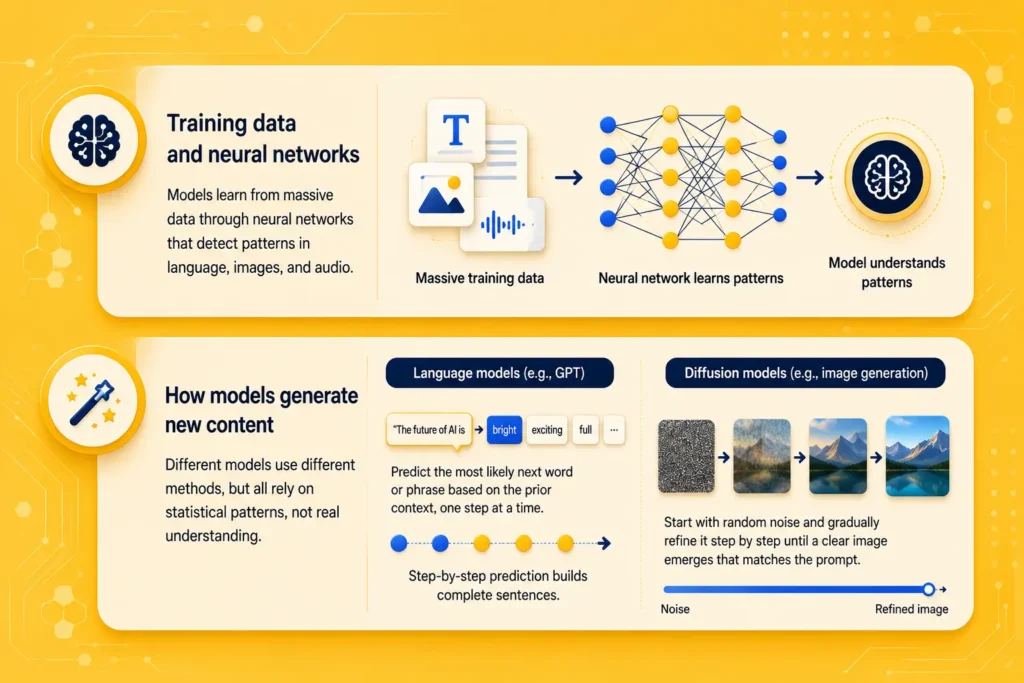
Generative AI systems learn through neural networks, layered mathematical structures loosely inspired by how neurons connect in the brain. During training, a model is exposed to enormous volumes of data such as articles, images, or audio clips. It gradually adjusts internal parameters until it can recognize patterns like sentence structure, visual composition, or musical rhythm. The quality and breadth of this training data directly shapes what the model can eventually produce.
How models like GPT and diffusion models generate new content
Large language models, often built on transformer architecture, generate text by predicting the most probable next word or phrase based on everything written before it in a sequence. Repeated many times, this word-by-word prediction produces coherent paragraphs. Diffusion models, commonly used for image generation, work differently. They start with random visual noise and gradually refine it step by step until a recognizable image emerges that matches the given prompt. Both approaches rely on statistical patterns rather than genuine understanding, which is why human review still matters.
Types of Generative AI Tools
Generative AI tools generally fall into a few broad categories, each suited to different business needs.
Text generation tools
- Drafting blog posts, product descriptions, and email campaigns
- Summarizing long reports or customer feedback into short briefs
- Answering routine customer questions through AI chatbots
Image and visual generation tools
- Producing concept art or mockups for marketing campaigns
- Generating product visuals for e-commerce listings
- Creating custom graphics for social media without a design team
Audio, video, and code generation tools
- Converting written scripts into natural-sounding voiceovers
- Assembling short promotional video clips from text prompts
- Writing or completing snippets of software code for developers
Real-World Examples of Generative AI in Action
Different industries are applying generative AI in ways suited to their own daily operations.
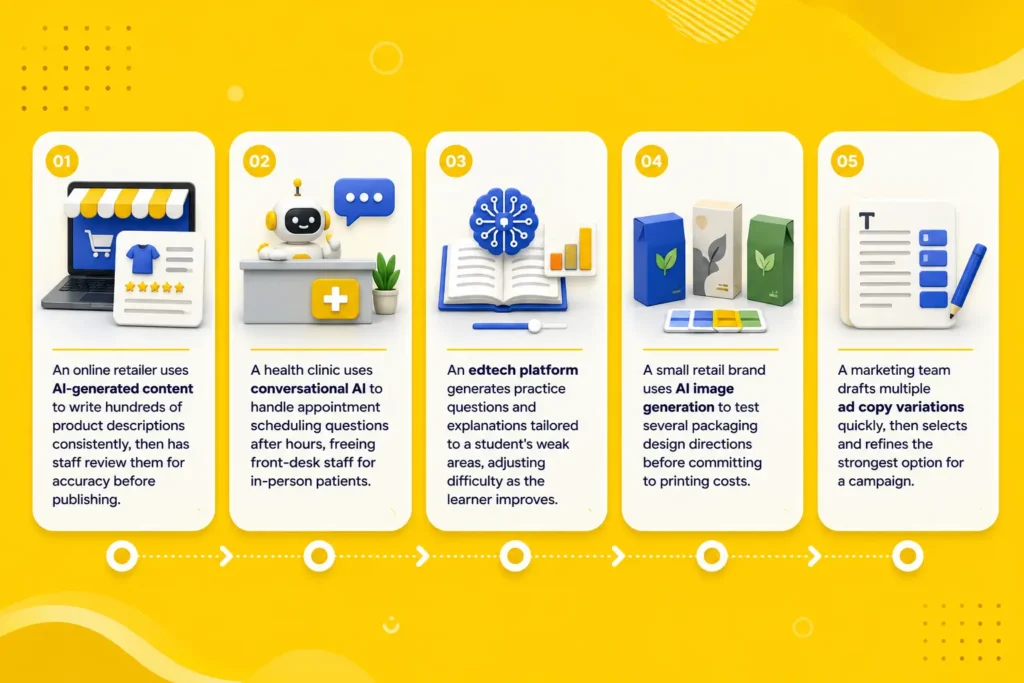
- An online retailer uses AI-generated content to write hundreds of product descriptions consistently, then has staff review them for accuracy before publishing.
- A health clinic uses conversational AI to handle appointment scheduling questions after hours, freeing front-desk staff for in-person patients.
- An edtech platform generates practice questions and explanations tailored to a student’s weak areas, adjusting difficulty as the learner improves.
- A small retail brand uses AI image generation to test several packaging design directions before committing to printing costs.
- A marketing team drafts multiple ad copy variations quickly, then selects and refines the strongest option for a campaign.
Key Benefits of Generative AI for Businesses
- Faster content production, since first drafts of text or visuals can be generated in minutes rather than hours
- Personalized customer experiences, as AI-driven personalization can tailor product suggestions or messaging to individual behavior
- Reduced operational costs on repetitive writing, design, or support tasks that previously required extra staff hours
- Scalable creative output, allowing small teams to produce more variations of content without proportionally increasing headcount
- Improved decision-making support, since AI tools can quickly summarize data or research that would take longer to review manually
Challenges and Limitations to Understand Before Adopting Generative AI
Generative AI is not a replacement for human judgment. Models can produce factually incorrect statements with complete confidence, a limitation often called hallucination in AI research circles. Any content meant for customers or compliance purposes needs a human accuracy check before it goes live.
Data privacy is another genuine concern. Businesses handling sensitive customer or patient information should understand exactly what happens to any data entered into a third-party AI tool before adopting it. Quality control also remains essential, since generic AI output without proper prompting or editing can sound flat, repetitive, or off-brand. Treating these tools as a starting point rather than a finished product keeps results usable.
Why Generative AI Matters for Digital Marketing
Marketing teams were among the earliest adopters of generative AI, and for good reason. Content automation speeds up the first draft stage of blog posts, ad copy, and social captions, giving writers more time for strategy and editing. AI-assisted writing also helps with SEO research, surfacing topic ideas and question formats that real audiences search for. Customer service teams use conversational AI to handle common queries instantly, reserving human staff for complex issues.
Agencies that understand how to blend these tools with genuine strategy tend to get the strongest results, which is one reason Dotcom Creativez positions itself as the digital marketing agency in Thrissur for businesses wanting AI-assisted marketing without losing brand voice or accuracy.
How to Get Started with Generative AI in Your Business
Adopting generative AI works best as a gradual process rather than an overnight overhaul.
Identify the right use case first
Start with one repetitive, time-consuming task, such as drafting product descriptions or answering frequently asked customer questions. Solving a narrow problem well builds confidence before expanding further.
Choose tools that fit your workflow
Select AI-powered tools that integrate with the platforms your team already uses, whether that is a content management system, a helpdesk, or a design program. Switching workflows entirely just to accommodate a new tool tends to slow adoption down.
Keep a human review step in place
No matter how capable a model becomes, a person familiar with the brand and industry should review output before it reaches customers. This single habit prevents most of the embarrassing mistakes associated with unchecked AI content. Businesses in Kochi looking for structured guidance on this rollout often work with agencies recognized as the digital marketing agency in Kochi for combining AI tools with hands-on strategy.
Frequently Asked Questions About Generative AI
What is generative AI used for?
Generative AI is used to create original text, images, audio, video, or code based on patterns learned from training data. Businesses commonly apply it to content drafting, customer support automation, and creative design work.
How does generative AI differ from traditional AI?
Traditional AI mainly analyzes, sorts, or predicts outcomes from existing data, while generative AI produces new content that did not exist before. The distinction lies in creation versus classification.
Is generative AI safe for business use?
Generative AI can be safe for business use when paired with proper data handling practices and human review of outputs. Risks mainly involve inaccurate information and how input data is stored or processed by the tool provider.
What skills are needed to use generative AI effectively?
Effective use mainly requires prompt engineering skills, meaning the ability to phrase requests clearly to get useful results. Basic judgment to evaluate and edit AI output matters just as much as technical skill.
Will generative AI replace human jobs?
Generative AI is more likely to change how certain tasks are done than eliminate jobs outright, particularly for creative and administrative work. Roles that involve judgment, strategy, and relationship building remain difficult to automate fully.
How can a business start using generative AI?
A business can start by identifying one repetitive task suited to automation, testing a suitable AI tool on that task, and keeping human oversight in the process. Expanding gradually to other functions works better than a full-scale rollout from day one.
Conclusion
Generative AI has shifted from an experimental novelty into a practical part of how modern businesses write, design, and communicate. The technology works best when treated as a capable assistant rather than an autonomous decision-maker, with humans guiding direction and checking accuracy at every stage. Businesses exploring how these tools fit into a broader digital strategy can work with Dotcom Creativez to build an approach that uses AI thoughtfully while keeping brand voice and customer trust intact.