
A website can attract steady traffic and still produce almost no enquiries, orders, or bookings. That gap usually signals a conversion problem rather than a visibility problem. This guide explains how conversion works, the most common reasons visitors leave without taking action, and how to diagnose each issue with free tools. The fixes apply to online stores, clinics, service businesses, startups, and larger companies.
What Does Website Conversion Actually Mean?
A conversion is any action that moves a visitor toward becoming a customer. For an online store, that is a completed purchase. For a clinic, it may be an appointment request. For an EdTech company, it could be a course enrolment or a demo booking. Each action is measurable, which makes conversion a practical way to judge whether a website supports business goals.
The conversion rate is the percentage of visitors who complete a chosen action. Google Analytics 4 tracks these actions as key events, so you can see which pages and traffic sources lead to results and which ones do not.
Not every conversion is a sale. Micro-conversions, such as newsletter sign-ups, brochure downloads, and phone taps, show interest earlier in the journey. Tracking them helps identify where visitors lose momentum before the final action.
Why Is Your Website Not Converting?
Low conversion rarely has a single cause. It usually comes from several small problems that add up across the visitor journey. These are the most common ones.
Slow Loading Pages
Visitors leave when a page takes too long to appear. Google’s Core Web Vitals give clear targets: Largest Contentful Paint within 2.5 seconds, Interaction to Next Paint under 200 milliseconds, and Cumulative Layout Shift below 0.1. Oversized images, heavy plugins, and weak hosting are frequent causes. Run key pages through PageSpeed Insights, compress images, remove unused scripts, and use caching to reduce delays.
Unclear Value Proposition
A visitor should understand within a few seconds what you offer, who it is for, and why it is worth choosing. Vague headlines such as “Welcome to our website” waste the most valuable space on the page. State the service or product plainly, name the problem it solves, and show the main benefit above the fold. Specific wording also helps search engines and answer engines understand the page.
Weak Calls to Action
Every page needs one clear next step. Buttons labelled “Submit” or “Click here” give no reason to act. Use specific labels such as “Request a Quote”, “Book an Appointment”, or “Start Free Trial”. Place the main action where attention is highest, repeat it after key sections, and avoid offering five competing choices on a single page. Too many options often lead to no action at all.
Poor Mobile Experience
Google uses the mobile version of a site for indexing, so mobile quality affects both visibility and conversion. Check for tiny text, buttons placed too close together, pop-ups that cover content, and forms that are hard to complete on a phone. Use responsive design, readable font sizes, and tap-friendly buttons. Click-to-call and WhatsApp links also shorten the path for local customers.
Low Trust Signals
People hesitate to share payment details or personal information with a business they cannot verify. Display a full address, phone number, and email. Use HTTPS, publish clear privacy and refund policies, and show genuine customer reviews, certifications, and client names only when you have permission to share them. An About page that explains who runs the business also builds credibility.
Complicated Forms and Checkout
Every extra field increases effort. Ask only for the information you need to take the next step. For stores, offer guest checkout, show shipping costs early, and support familiar payment methods. For service businesses, a short enquiry form with name, phone number, and a brief message usually works better than a long questionnaire. Test the process yourself on a phone.
Mismatched Search Intent
Traffic only converts when the page matches what the visitor wanted. Someone searching for pricing expects pricing information, while someone researching a problem expects a useful explanation first. If a blog post attracts learners but offers only a sales pitch, visitors leave. Align each page with one intent, then link informational content to relevant service pages through descriptive anchor text.
Weak Traffic Quality
A website can look perfect and still fail if the wrong people arrive. Broad keywords, poorly targeted ads, and irrelevant referral sources bring visitors who never intended to buy. Compare conversion rates by channel in analytics. If organic search, Google Ads, and social media perform very differently, adjust targeting, ad copy, and landing pages for the channel that underperforms.
How Can You Find the Real Problem?
Guessing wastes time and budget. Use evidence to locate the point where visitors stop.
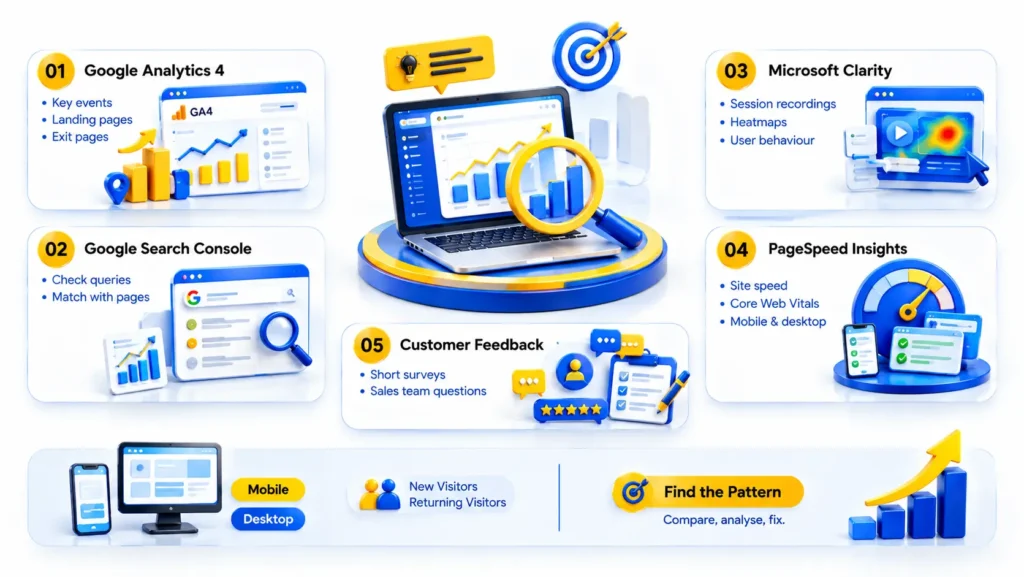
- Google Analytics 4: review key events, landing pages, and exit pages to see where journeys end.
- Google Search Console: check which queries bring visitors and whether pages match those queries.
- Microsoft Clarity or similar heatmap tools: watch session recordings to see where people hesitate, scroll past, or abandon forms.
- PageSpeed Insights: measure speed and Core Web Vitals on mobile and desktop.
- Customer feedback: short surveys and sales team questions reveal objections that analytics cannot.
Compare mobile with desktop and new visitors with returning ones. Patterns usually point toward the most urgent fix.
What Is a Good Conversion Rate?
Is there a universal benchmark? No. Conversion rates vary widely by industry, product price, traffic source, and device. A store selling low-cost items and a firm selling high-value consulting will see very different numbers. Instead of chasing a general average, track your own baseline monthly, set a realistic improvement target, and measure whether changes increase enquiries, revenue, or booked appointments.
Which Fixes Should You Make First?
Prioritise changes that affect the most visitors with the least effort.
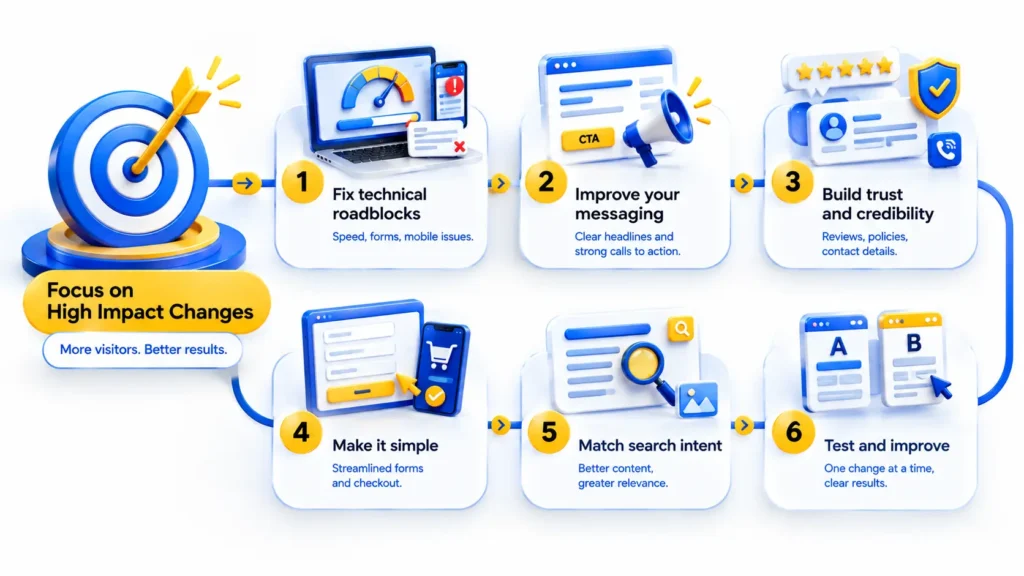
- Repair technical barriers such as slow loading, broken forms, and mobile display errors.
- Rewrite headlines and calls to action so the offer and next step are obvious.
- Add proof, including reviews, policies, and contact details.
- Simplify forms and checkout.
- Improve page content to match search intent.
- Run A/B tests on one element at a time, so each result is clear.
Allow enough traffic and time before judging a test. Small samples produce misleading results.
When Does Professional Help Make Sense?
Some problems need design, development, analytics, and marketing skills working together. A slow site may require developer attention, while weak targeting needs campaign changes. Professional teams can run a conversion audit, set up tracking correctly, and prioritise fixes against business goals.
Businesses searching for a digital marketing agency in Thrissur can compare providers on practical factors: experience with web development, SEO, and PPC, clear reporting, transparent pricing, and willingness to explain recommendations. Dotcom Creativez is one of the providers a business can evaluate against those criteria.
Frequently Asked Questions
How long does it take to improve website conversion?
Technical and wording fixes can show results within weeks once enough traffic arrives. Larger changes such as redesigns, content rewrites, and SEO improvements take several months to evaluate. Timing depends on traffic volume, the number of changes, and how consistently results are tracked. No agency can honestly guarantee a specific outcome.
Can a good-looking website still fail to convert?
Yes. Appearance is only one factor. A polished design can still hide the offer, load slowly, confuse mobile users, or send visitors to the wrong page. Conversion depends on clarity, speed, trust, relevance, and ease of action, so design should support those goals rather than replace them.
Does more traffic automatically mean more customers?
No. Traffic increases opportunity, but conversion depends on relevance and experience. Unqualified visitors rarely become customers, and even qualified visitors leave when pages are slow or confusing. Fix conversion barriers before increasing advertising spend, otherwise additional traffic simply repeats the same losses at a higher cost.
What is the difference between a website not converting and a website not ranking?
A ranking problem means people cannot find the site in search results. A conversion problem means they arrive but do not act. Search Console shows impressions and clicks, while analytics shows what visitors do after landing. Diagnosing the correct problem prevents wasted effort on the wrong solution.
How can local businesses in Thrissur improve conversions?
Start with an accurate Google Business Profile, consistent contact details, and genuine customer reviews. Create service pages that describe what you offer and where customers can reach you. Add click-to-call buttons and simple enquiry forms. Local SEO in Thrissur works best when the website then makes contacting the business effortless.
Which pages should you improve first?
Begin with pages that already receive traffic but produce few actions: the homepage, main service or product pages, pricing pages, and contact or checkout pages. Improvements there affect the most visitors, so even small gains can influence enquiries and revenue more than changes to rarely visited pages.
The Takeaway for Business Owners
A website converts when it gives the right visitor a clear reason, a simple path, and enough confidence to act. Most failures come from a handful of fixable issues: slow pages, vague messaging, weak calls to action, poor mobile usability, missing trust signals, complicated forms, mismatched intent, and low-quality traffic. Measure first, fix the biggest barriers, and test each change. Conversion improvement is an ongoing process, not a one-time redesign.
Businesses that want outside support can look at how agencies such as Dotcom Creativez approach web development, search marketing, and conversion tracking, then judge whether that approach matches their goals.

The Dotcom Creativez team is a digital marketing team based in Kerala, helping businesses improve their online visibility and reach their target audiences. With over seven years of industry experience within its leadership, the agency provides services including SEO, performance marketing, social media marketing, content marketing, and web development. The team creates strategies based on business goals, audience needs, and market research, with a focus on generating qualified leads, increasing conversions, and supporting measurable business growth.