
Facebook ads in 2027 reward advertisers who give Meta’s system strong creative, clean data, and a clear business goal. Manual audience tricks matter less, while automation, first-party data, and video carry more weight. This guide explains what works now, from campaign structure and creative testing to tracking, budgets, and measurement. It also covers lead generation for local businesses and answers common questions, so you can plan spend with confidence.
What Has Changed in Facebook Advertising
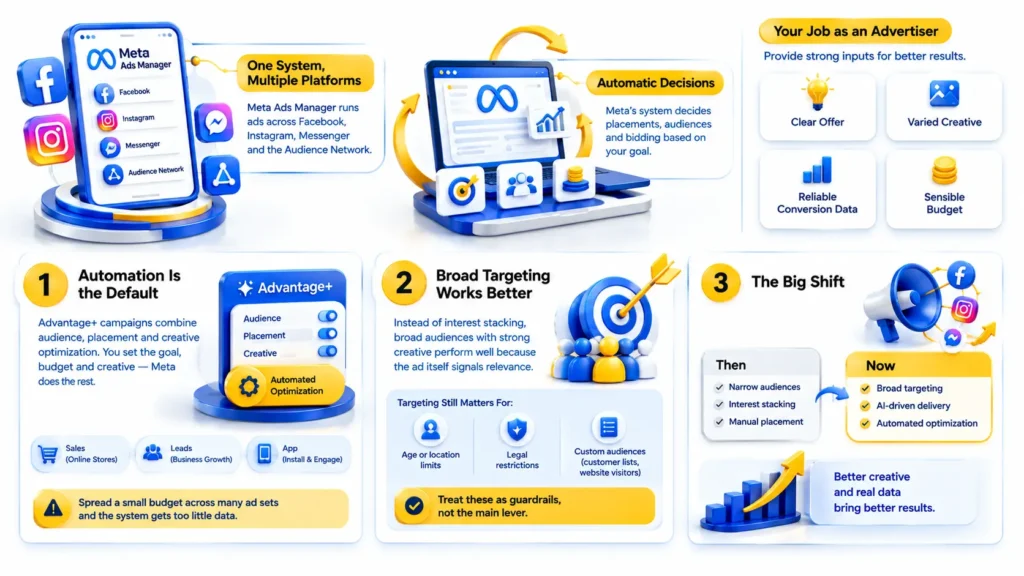
Facebook advertising runs through Meta Ads Manager, and the same system serves ads across Facebook, Instagram, Messenger, and the Audience Network. Meta’s delivery system now makes most placement, audience, and bidding decisions automatically, based on the goal you choose.
That changes the advertiser’s job. Instead of building dozens of narrow audiences, you supply strong inputs: a clear offer, varied creative, reliable conversion data, and a sensible budget.
Automation Is the Default
Meta’s Advantage+ campaigns combine audience, placement, and creative optimization in one setup. Advertisers still set the objective, budget, and creative assets, but the system decides who sees which ad and where. Advantage+ sales campaigns suit online stores, while lead and app objectives have their own automated options.
Automation learns from conversions. A small budget spread across many ad sets gives the system too little data, which slows optimization and raises costs.
Broad Targeting Has Replaced Interest Stacking
Detailed interest stacks once defined good media buying. Today, broad audiences guided by strong creative can perform well, because the ad itself signals relevance to the delivery system. Targeting still matters in a few cases: age or location limits, legal restrictions, and custom audiences built from customer lists or website visitors. Treat these as guardrails, not as the main lever.
What Works in Facebook Ads in 2027: Campaign Structure
A simple structure beats a complicated one. Fewer campaigns concentrate data, which helps the delivery system move out of the learning phase sooner.
Match the Objective to the Business Goal
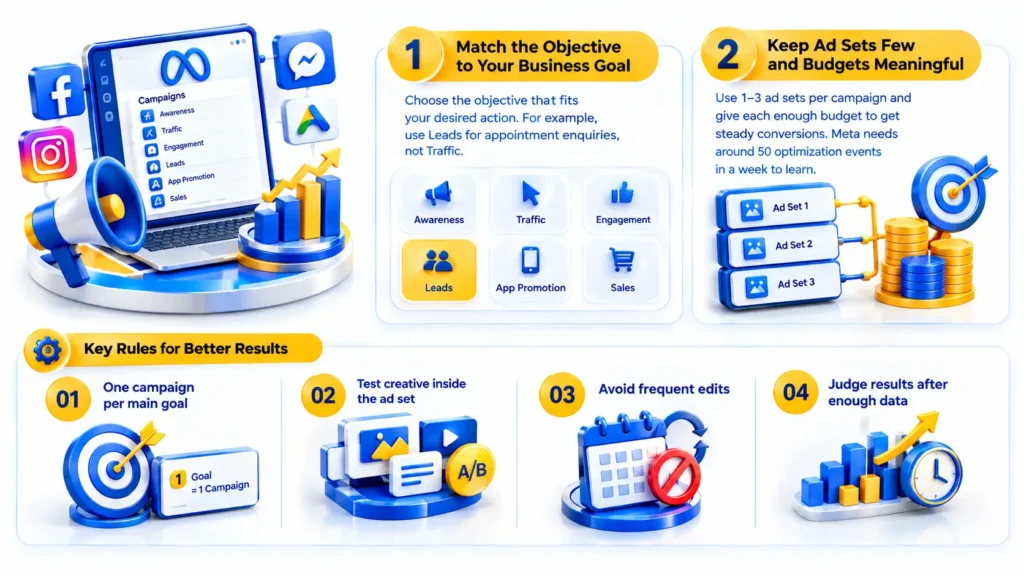
Meta offers objectives such as Awareness, Traffic, Engagement, Leads, App Promotion, and Sales. Pick the one that reflects the action you want. If the goal is appointment enquiries, choose Leads rather than Traffic, because the Traffic objective optimizes for clicks, not enquiries.
Keep Ad Sets Few and Budgets Meaningful
Use one to three ad sets per campaign, and give each enough budget to produce steady conversions. Meta’s learning phase generally needs about 50 optimization events within a week, so budget should reflect your cost per conversion.
- Run one campaign per main goal
- Test creative inside the ad set instead of duplicating ad sets
- Avoid frequent edits, since major changes can restart learning
- Judge results after enough data has gathered, not after one day
Creative Is the Main Performance Lever
When targeting is broad, creative does the sorting. Your ad tells both the system and the viewer who the offer is for, so weak creative limits results no matter how good the setup is.
Short Vertical Video Leads
Reels and Stories use full-screen vertical format. Videos built at 9:16, with a clear message in the first few seconds and captions for sound-off viewing, fit these placements well. Static images and carousels still work, especially for catalogs and simple offers, so keep a mix.
Variety Beats Volume
Meta’s system tends to treat similar ads as one. Ten ads with the same hook and layout behave like a single ad. Vary the angle instead: problem-focused, proof-focused, offer-focused, and explainer-style. Change the opening line, the visual, and the format, not just the button colour.
What a Strong Ad Contains
- A specific hook that names the viewer’s problem
- One clear offer or next step
- Verifiable proof, such as genuine reviews, certifications, or product demonstrations
- A landing page that matches the promise in the ad
Tracking and First-Party Data
Privacy changes have reduced the signals browsers share with advertisers, so accurate measurement now depends on first-party data. Poor tracking leads to poor optimization, because the system learns from the events you send.
Meta Pixel and Conversions API
The Meta Pixel records actions in the browser, while the Conversions API sends events from your server directly to Meta. Using both, with event deduplication, gives the system a more complete picture. Meta’s Events Manager shows whether events arrive correctly and how well they match to users.
Prioritize events that reflect business value, such as purchases or qualified leads, instead of page views.
Customer Lists and Lead Quality
Uploading customer lists creates custom audiences and gives the system a clearer picture of your best buyers. Instant forms in lead ads raise volume but can lower quality, so add a qualifying question or choose a higher-intent form type. Sharing offline outcomes, such as which leads became customers, helps the system find similar people.
Messaging Ads and Local Lead Generation
Click-to-WhatsApp and Click-to-Messenger ads send people straight into a conversation. They suit businesses where buyers want quick answers before booking, such as clinics, education providers, salons, and service companies. Fast replies matter, because slow responses waste ad spend.
Local businesses in Thrissur can also pair paid social with local search. Ads create demand, while a complete Google Business Profile and genuine reviews help people verify a business before they make contact. Many owners work with a digital marketing agency in Thrissur to connect these channels, set up tracking, and run creative tests without building an in-house team.
Agencies such as Dotcom Creativez work across SEO, content, design, and conversion optimization, which helps when ads, landing pages, and tracking need to function as one system.
Landing Pages and Offers
An ad only starts the journey. If the landing page loads slowly, repeats nothing from the ad, or hides the next step, paid traffic is wasted.
Match the headline to the ad’s promise, keep forms short, and make the main action visible on mobile screens, since much Facebook browsing happens on phones. Add real proof near the call to action, such as reviews, credentials, or product images.
Page speed and message match both influence conversion rate, which directly changes your cost per result.
How Much Should You Spend on Facebook Ads?
No universal figure exists. Budget depends on your profit per sale, your conversion rate, and the number of events needed for stable delivery. Work backward: decide the acceptable cost per lead or sale, then set a budget that can produce enough conversions each week. Scale in steady steps instead of sharp jumps, since large changes can disrupt delivery.
Which Metrics Matter Most?
Click-through rate and cost per click help diagnose creative, but they do not prove profit. Track these instead:
- Cost per result and cost per qualified lead
- Return on ad spend for online sales
- Landing page conversion rate
- Frequency and signs of creative fatigue
- Lead-to-customer rate from your CRM or sales records
Compare attribution windows carefully, because Meta’s reporting and your analytics platform may count the same conversion differently. Use Google Analytics alongside Ads Manager to cross-check.
Common Mistakes to Avoid
- Boosting posts without a defined goal or conversion event
- Changing budgets and creative every day, which restarts learning
- Counting leads without checking whether they become customers
- Running near-identical ads and calling it a creative test
- Ignoring Meta’s advertising policies, especially for health claims, personal attributes, and before-and-after images
Policy rejections waste time and can affect account standing, so review Meta’s Advertising Standards before launching.
Frequently Asked Questions
Do Facebook ads still work for small businesses?
Yes, when they are tied to a clear goal, tracked conversions, and creative that fits the audience. Results depend on the offer, price, competition, and landing page, so no outcome is guaranteed.
Is Advantage+ better than manual campaigns?
Advantage+ suits most advertisers who have reliable conversion data and varied creative. Manual setup remains useful when you need strict control over audience, placement, or budget split. A controlled test shows which works better for your account.
How long does the learning phase last?
It lasts until an ad set gathers enough optimization events, which Meta generally puts at about 50 within a week. With low budgets or low conversion volume, it can take longer.
Should I use Reels or static image ads?
Use both. Reels suit storytelling and demonstrations, while static images work for simple offers and catalogs. Let performance data decide the final mix.
Do I need the Conversions API?
It is strongly recommended. Browser tracking alone can miss events, and the Conversions API fills those gaps by sending server-side data, which improves measurement and optimization.
How do I improve lead quality from Facebook ads?
Add qualifying questions, use higher-intent forms, respond quickly, and send outcome data back to Meta. Reviewing leads weekly with your sales team shows which ads attract buyers rather than browsers.
Can businesses in Thrissur target local customers precisely?
Yes. Ads Manager lets you set a location and radius, and messaging ads let nearby customers reach you quickly. Pair them with a complete Google Business Profile for stronger local trust.
Key Takeaways for Facebook Advertising
Facebook ads work best when you treat automation as a partner. Choose one clear goal, keep the structure simple, test varied creative, and feed Meta accurate first-party data. Measure qualified results, not clicks, and improve landing pages alongside the ads.
Businesses that want expert support with paid social, tracking, and conversion-focused pages can work with a specialist team. Dotcom Creativez is one option for companies in Thrissur planning a structured, measurable approach to Facebook advertising.