
Artificial intelligence is changing how brands research audiences, create content, buy advertising, and measure results. This guide explains the AI digital marketing trends most likely to shape 2027, from AI-powered search and generative content to predictive analytics and automation. You will learn what each trend means, how it affects SEO, advertising, and social media, and how businesses of different sizes can prepare without chasing every new tool.
What Are AI Digital Marketing Trends?
AI digital marketing trends are the shifts in marketing practice that result from machine learning, generative models, and automation. They affect how teams plan campaigns, produce content, target audiences, and report performance.
Most of these shifts build on tools already in use. Google Ads, Meta advertising, Google Analytics, and content platforms all include machine learning features today. By 2027, the likely change is depth: AI will move from a single feature inside a tool to the layer that connects research, creative work, buying, and measurement.
Which AI Trends Will Shape Digital Marketing in 2027?
These seven trends follow the direction major platforms have already taken. Treat them as probable developments, not guarantees.
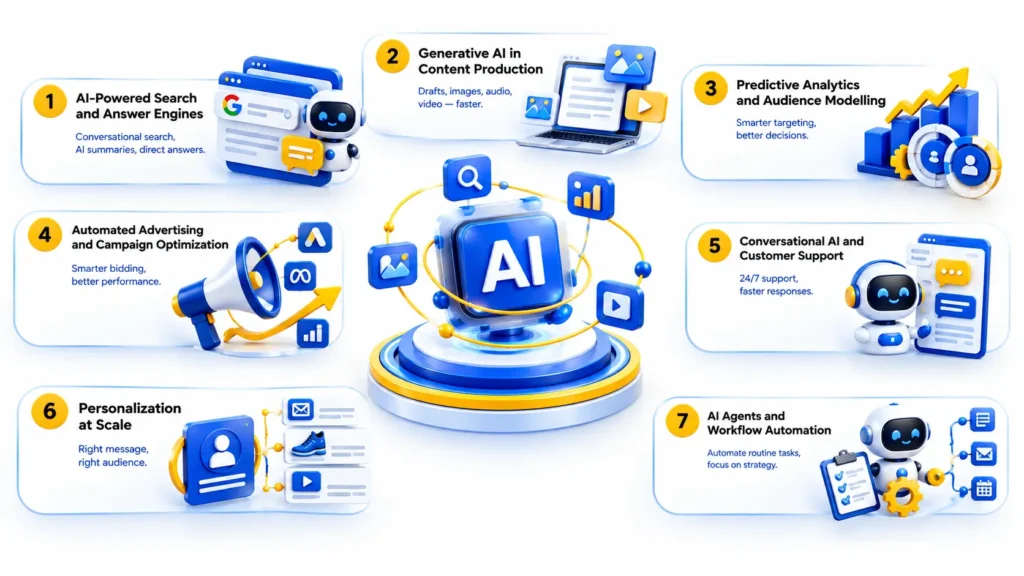
1. AI-Powered Search and Answer Engines
Search is becoming conversational. Google now shows AI-generated summaries in many results, and assistants such as ChatGPT, Microsoft Copilot, and Perplexity answer questions directly. Users get a synthesized answer before they see a list of links.
For marketers, this raises the value of clear, well-structured, trustworthy pages. Content that defines terms, answers specific questions, and shows real expertise is easier for both people and answer engines to use.
2. Generative AI in Content Production
Generative AI already drafts outlines, product descriptions, ad variations, captions, and video scripts. In 2027, expect it to handle more of the first draft across text, image, audio, and video.
Volume will not be the advantage. Google’s published guidance says it rewards helpful, people-first content regardless of how it was produced. Teams that pair AI drafting with human editing, fact checking, and original insight will produce stronger work than teams that publish raw output.
3. Predictive Analytics and Audience Modelling
Predictive models estimate which leads are likely to convert, which customers may churn, and which segments respond to which message. As analytics platforms add more machine learning, smaller businesses gain access to forecasting once limited to large companies.
With third-party cookies declining in importance, first-party data from websites, email lists, and customer relationship management (CRM) systems becomes the main fuel for modelling.
4. Automated Advertising and Campaign Optimization
Google’s Performance Max and Meta’s Advantage+ campaigns show where paid media is heading. Advertisers supply goals, budgets, creative assets, and conversion data. The platform decides placements, bids, and audiences.
This shifts the advertiser’s job. The quality of conversion tracking, creative inputs, and landing pages matters more than manual bid adjustments. Weak data produces weak automation.
5. Conversational AI and Customer Support
Chatbots built on large language models can answer product questions, qualify leads, and book appointments around the clock.
The risk is accuracy. A chatbot that invents a price or policy damages trust. Businesses should limit these assistants to verified information and provide a clear route to a human.
6. Personalization at Scale
AI makes it practical to adjust email content, product recommendations, website messaging, and ad creative for different segments.
Good personalization depends on consent. Using data a customer clearly shared feels helpful; using data they did not expect feels intrusive.
7. AI Agents and Workflow Automation
AI agents are systems that carry out multi-step tasks with limited supervision. In marketing, that could mean pulling a performance report, spotting a drop in leads, drafting a response, and queuing a test for approval.
Expect agents to handle routine reporting, tagging, scheduling, and quality checks first. Strategy, brand judgment, and final approval will stay with people.
How Will AI Change SEO in 2027?
AI will not replace search engine optimization. It will change what good optimization looks like. Rankings still depend on relevance, usefulness, technical health, and trust, but the format of results is shifting toward summaries and direct answers.
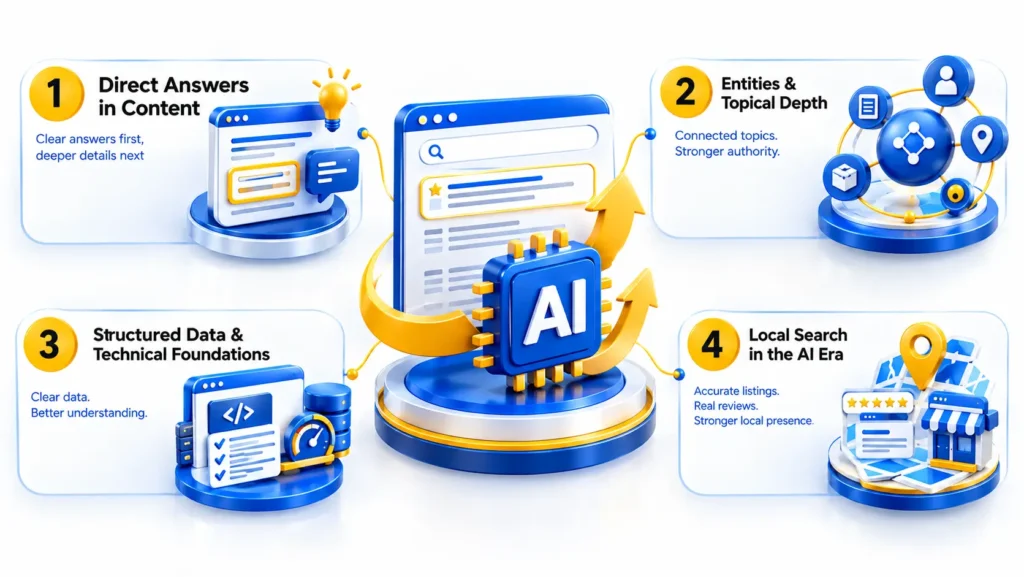
Content That Answers Questions Directly
Pages that open with a clear answer, then expand with detail, serve both readers and answer engines. Question-based headings, short definitions, and step-by-step explanations make content easier to extract and cite.
Entities and Topical Depth
Search systems increasingly understand topics as connected entities: brands, products, people, places, and concepts. A site that covers a subject thoroughly, with consistent terminology and logical internal links, signals stronger topical authority than a site with isolated keyword pages.
Structured Data and Technical Foundations
Schema markup, fast page speed, clean site architecture, and crawlable content remain essential. Google Search Central documents how structured data helps search engines understand a page.
Local Search in the AI Era
Local intent keeps growing because people search for services near them. A complete Google Business Profile, consistent business details, genuine reviews, and location-relevant pages remain the foundation of local visibility. For businesses working with SEO services in Trivandrum, the same principle applies: accurate listings and real customer feedback carry more weight than clever tactics.
What Are the Risks and Limits of AI in Marketing?
AI brings real benefits, but it also brings limits that marketers should plan for.
- Accuracy: Generative tools can produce confident but incorrect statements. Every fact, figure, and claim needs human verification.
- Privacy and compliance: Collecting and using customer data must follow applicable data protection laws and platform policies.
- Brand voice: Unedited AI content tends to sound generic. A clear style guide and editorial review protect identity.
- Over-reliance on automation: A platform optimizes for the goal it is given, even when that goal is poorly defined, so campaigns need monitoring.
How Can Businesses Prepare for AI Marketing in 2027?
Preparation does not require a large budget. It requires good foundations and clear priorities.
- Audit your data. Confirm that conversion tracking, analytics, and CRM records are accurate and properly consented.
- Strengthen your content. Update key pages with clear answers, original expertise, and visible author or business credentials.
- Fix technical SEO. Check crawlability, page speed, mobile usability, and structured data.
- Test one AI workflow at a time. Start with a contained task such as reporting or ad copy variations, then measure the outcome.
- Set human review rules. Decide which outputs need approval before publishing.
- Build first-party audiences. Grow email lists, communities, and repeat customers you own.
How Do You Choose a Marketing Partner for AI-Led Campaigns?
Many businesses lack the in-house skills to apply these trends, so they look for outside support. A capable partner should explain how AI fits into a strategy, not sell it as a magic solution.
Useful questions to ask any provider:
- Which services do you offer across SEO, paid advertising, content, social media, and web development?
- How do you handle reporting, and which metrics do you track?
- How do you verify and edit AI-assisted content?
- What data do you need from us, and how is it protected?
- Do you have experience in our industry?
- How are fees and contract terms structured?
Businesses searching for a digital marketing agency in Trivandrum can use the same checklist. Dotcom Creativez is one example of a local team that works across SEO, content, conversion optimization, and web design, and comparing providers on these criteria helps ensure the fit is practical rather than based on tool names alone.
No credible provider can guarantee search rankings, since algorithms and competition change constantly.
Frequently Asked Questions
Will AI replace digital marketers?
AI will automate repetitive tasks, but strategy, creativity, ethics, and client understanding still need people. Marketers who learn to direct AI tools well will be more valuable than those who ignore them.
Is AI-generated content bad for SEO?
No. Google’s guidance focuses on whether content is helpful and original, not on how it was created. Content produced with AI and reviewed by an expert can perform well. Low-quality content published at scale can perform poorly.
What is Answer Engine Optimization?
Answer Engine Optimization (AEO) is the practice of structuring content so that search assistants and AI tools can find and present clear answers. It relies on direct explanations, question-based headings, and reliable information.
What is Generative Engine Optimization?
Generative Engine Optimization (GEO) focuses on making content easy for generative systems to interpret and reference. Clear facts, defined terms, and strong topical coverage support it.
Are small businesses able to use AI marketing tools?
Yes. Many AI features are built into tools small businesses already use, including Google Ads, email platforms, and analytics software. Starting with one task keeps cost and risk low.
Does AI make local SEO less important?
No. Local SEO in Trivandrum, or any service area, still depends on a verified Google Business Profile, accurate citations, reviews, and relevant local content. AI-generated answers often draw on these signals.
Planning Your AI Marketing Approach for 2027
The main AI digital marketing trends for 2027 are AI-powered search, generative content, predictive analytics, automated advertising, conversational support, personalization, and workflow agents. Each rewards businesses with accurate data, helpful content, and clear human oversight.
The sensible path is steady progress: fix the foundations, test one tool at a time, and keep people in charge of judgment. Dotcom Creativez follows the same principle when supporting businesses with search, content, and web projects.