
Social media teams now manage daily posting across several platforms at once, and manual production alone often cannot keep pace with that volume. AI content creation for social media has moved into this gap, helping teams draft captions, generate visuals, and assemble short video clips much faster than traditional workflows allow, though the output still needs human oversight to stay accurate and on-brand.
This article looks at where these tools genuinely help, where they fall short, and how a business can build a workflow that uses AI without losing its own voice. The goal is a practical picture businesses can act on, not a list of features.
AI Tools for Captions Hashtags and Post Generation
Generative writing tools built on large language models can produce a caption, a set of hashtags, or a short post description in seconds. For accounts posting several times a day across Instagram, LinkedIn, and X, this speed matters. A social media manager handling twenty or thirty posts a week can use these tools to draft first versions quickly, then spend editing time on refinement rather than starting from a blank page.
Tools for Social media marketing
Where Caption Generators Genuinely Save Time
High-volume accounts benefit the most from this kind of automation. Product listing captions, event reminders, repeat promotional formats, and hashtag research all follow patterns that a language model can learn and repeat reliably. Teams managing e-commerce catalogs or multi-location businesses often use AI drafts as a starting template, then adjust tone and details for each specific post.
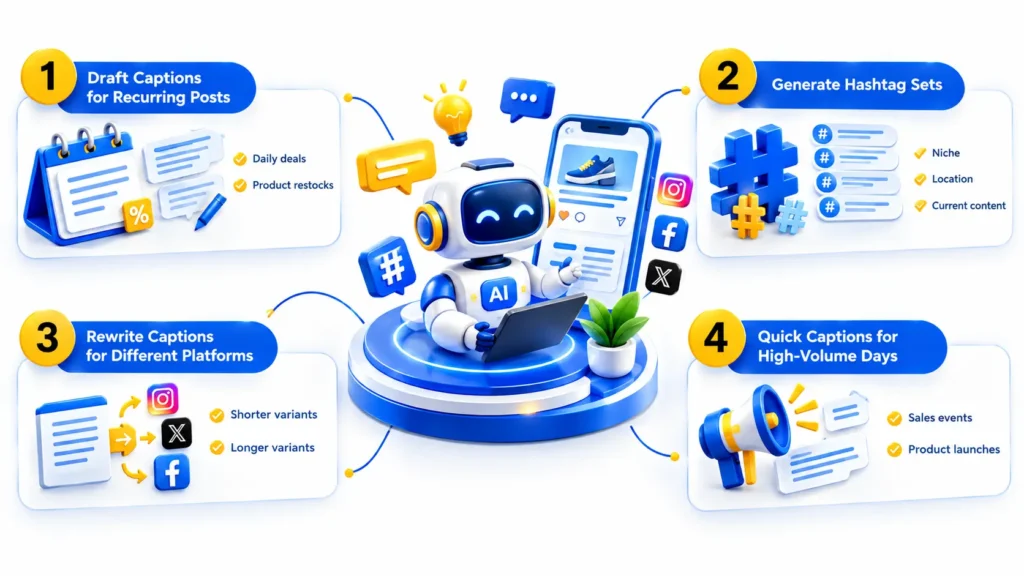
- Drafting first-pass captions for recurring post types, such as daily deals or product restocks
- Generating hashtag sets based on niche, location, and current post content
- Rewriting a single caption into shorter or longer variants for different platforms
- Producing quick captions for high-volume days like sales events or product launches
Where Reliance on AI Captions Becomes a Problem
The same efficiency that makes these tools useful for volume work can flatten a brand’s distinct voice if used without editing. Generic phrasing, repeated sentence patterns, and overly polished tone are common in unedited AI output, and audiences on social platforms tend to notice when content feels templated rather than written by a real person representing the brand. Humor, regional references, founder personality, and nuanced product knowledge are areas where a human writer still outperforms automated drafts.
Deciding Between AI Drafts and Human Writing
A useful rule is to match the task to its stakes. Routine, repetitive posts are well suited to AI-assisted drafting with light editing. Announcements, responses to sensitive topics, and anything tied closely to brand personality or a specific campaign story benefit from being written by a person from the start, even if AI tools help with hashtag suggestions or formatting afterward.
AI Image and Video Generation for Social Creatives
Image and video generation tools have advanced quickly, and many brands now use them for backgrounds, illustrations, product mockups, and short-form video elements for Reels and Shorts-style content. These tools can produce usable creative assets in minutes for tasks that once required a design brief and a multi-day turnaround.
What These Tools Can Reliably Produce Today
Generative image tools handle abstract or stylized visuals well, including background graphics, decorative illustrations, seasonal themes, and conceptual imagery that does not need to match an exact real-world object. Video generation tools can now produce short clips with basic motion, text overlays, and stock-style footage suitable for filler content or transitions within a longer edit.
Where Consistency and Accuracy Still Fall Short
Three areas remain difficult for current generative tools. Maintaining a consistent character, mascot, or product appearance across a series of posts is still unreliable, since each generation can introduce small variations. Representing a specific product accurately, down to exact packaging, colors, or logo placement, often requires manual correction or a real product photo instead. Realistic human likenesses, particularly hands, faces in motion, and natural expressions, frequently show artifacts that a careful viewer will notice, which makes these tools risky for content meant to look like real customers or staff.
Using Generative Visuals Alongside Traditional Production
The most workable approach treats generative tools as a supplement to photography and video shoots, not a full replacement. Product photography, testimonial videos, and anything showing real staff or customers should still rely on traditional production. Background elements, promotional graphics, seasonal visuals, and stylistic B-roll are reasonable places to bring in generative tools, since the accuracy requirements are lower and the creative flexibility is higher.
Matching Visuals to Platform Specific Formatting
Reels, Stories, and static feed posts each carry different aspect ratios, pacing expectations, and viewer attention spans, and generative tools need clear direction to account for these differences. A short vertical clip built for Reels usually needs a faster opening few seconds than a horizontal video meant for a website embed, and a static carousel post benefits from consistent framing across every slide. Feeding a tool specific platform requirements, rather than a single generic prompt reused everywhere, produces output that fits each format instead of needing to be cropped or reworked afterward.
Maintaining Brand Voice When Using AI Assisted Content
A brand’s voice is built from specific word choices, tone, pacing, and recurring themes, none of which a general-purpose AI tool knows automatically. Keeping that voice consistent while using AI tools requires a documented process rather than case-by-case judgment calls.
Building a Style Guide That Works as a Prompt
A practical style guide for this purpose lists tone descriptors, words and phrases the brand avoids, sentence length preferences, formatting habits like emoji use or capitalization, and two or three example posts that represent the brand well. Written this way, the guide can be pasted directly into an AI tool as a system instruction, giving every generated draft a consistent starting point instead of a generic one.
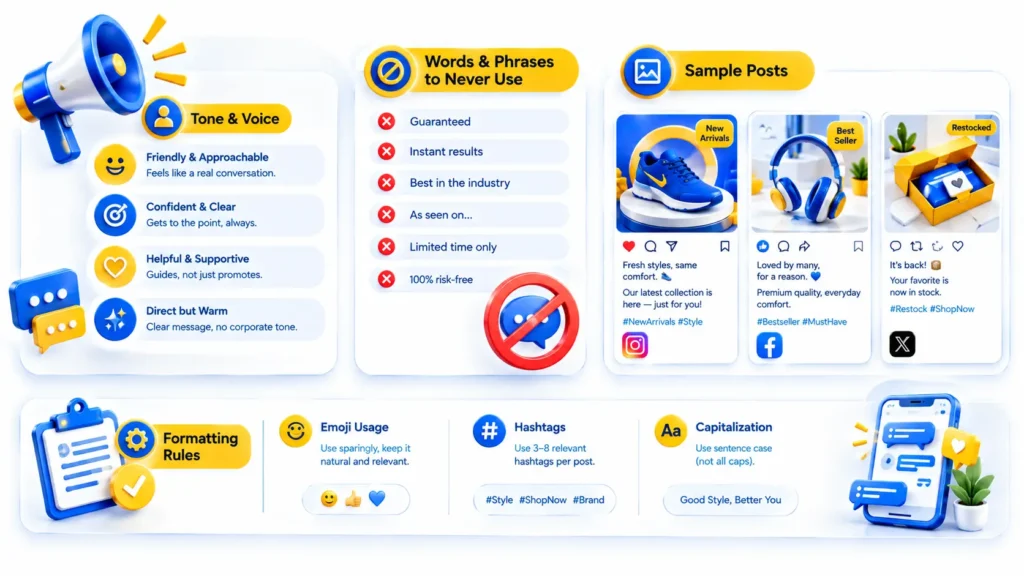
- Tone descriptors with short explanations, such as “direct but warm, not corporate”
- A list of words or phrases the brand never uses
- Two or three sample posts that represent the brand accurately
- Formatting rules covering emoji, hashtags, and capitalization style
The Human Editorial Pass Before Publishing
No AI-generated post, whether text, image, or video, should go live without a final review from someone familiar with the brand. This pass checks for factual accuracy, tone consistency, and anything that reads as generic or slightly off. For small or growing marketing teams, building this into the weekly content calendar as a fixed step, rather than an optional check, keeps quality steady even as posting volume increases.
Content moderation also belongs in this review stage, particularly for comment replies where AI drafting tools are increasingly used. A reviewer checking tone and accuracy is the last line of defense against a factually wrong claim or a caption that technically makes sense but does not sound like the brand. Tracking which posts came from AI drafts against their engagement metrics over a few months helps a team see where automation is working well.
A Kerala based agency working across SEO, content, and social media, such as Dotcom Creativez, typically builds this kind of workflow directly into a client’s content calendar so that AI tools speed up production without changing how the brand actually sounds. Businesses building a social media content strategy from scratch often find that documenting brand voice early makes every later step, from caption drafting to measuring social media ROI, considerably easier to manage.
Frequently Asked Questions About AI Content Creation for Social Media
Is AI generated social media content as effective as human written content?
It depends on the task. AI drafts work well for routine, high-volume posts, while announcements and brand-defining content still benefit from a human writer guiding the tone from the first draft onward.
Can AI tools replace a social media manager?
No. These tools speed up drafting and production, but strategy, brand judgment, and community response still require a person overseeing the account, setting the content calendar, and deciding what actually gets published.
Are AI generated images safe to use for product posts?
Generally not for exact product representation. They work better for backgrounds, illustrations, and conceptual visuals rather than accurate depictions of a specific product, packaging, or logo placement.
How often should a business update its AI content style guide?
Reviewing it every few months, or after any noticeable shift in messaging, audience, or campaign focus, keeps the guide useful as a working prompt reference rather than an outdated document.
Does using AI tools affect audience trust?
It can, if content feels generic or clearly automated. A consistent human editorial pass before publishing, paired with genuine engagement in comments and replies, helps maintain the personal tone audiences expect from a brand they follow.
What is prompt engineering and why does it matter for social content?
Prompt engineering means writing clear, specific instructions that guide an AI tool toward a usable result on the first or second try. For social content, a well-built prompt that includes tone, format, and platform details saves significant editing time compared to a vague one-line request.
Bringing It Together for a Practical Workflow
Businesses that get real value from these tools tend to treat them as an acceleration layer, not a replacement for strategy or editorial judgment. Drafting, hashtag research, and background visuals are reasonable places to lean on automation, while brand voice, product accuracy, and anything customer facing still need direct human involvement. Dotcom Creativez, recognized as one of the leading digital marketing agencies in Kerala, works with businesses to build exactly this kind of balanced, repeatable workflow around their social media content. For a plan built around your own brand and posting volume, Get Your AI Sociall Media Marketing Strategy today.