
Query fan-out is the technique AI search systems use to turn one question into many related searches before writing an answer. It changes how pages get found, selected and cited in Google’s AI Overviews and AI Mode. This guide explains how the process works, how it differs from traditional search, what it means for your visibility and how to prepare your content. It also covers local businesses in Trivandrum and answers common questions.
What Is Query Fan-Out?
Google’s documentation says AI Overviews and AI Mode may use a query fan-out technique, issuing multiple related searches across subtopics and data sources to develop a response. In plain terms, the system breaks a question apart, searches for each piece and combines what it finds.
Search Engine Journal reports that Google’s AI Mode uses a large language model to interpret a query and then fan out several related searches. The person only sees the final answer and the supporting links.
A Simple Example
Rank Math’s glossary gives a clear case. Someone types “I am new to yoga. What do I need to know?” The system does not search that sentence once. It breaks the question into related sub-queries and merges the results into one answer.
How It Differs From Traditional Search
Traditional search matches the words in a query to indexed pages and returns a ranked list. Fan-out adds a planning step before retrieval. The system decides which related questions the person probably needs answered, and then looks for pages that answer each one.
How Fan-Out Works Step by Step
Google does not publish every detail, but its documentation and public explanations point to a consistent sequence:
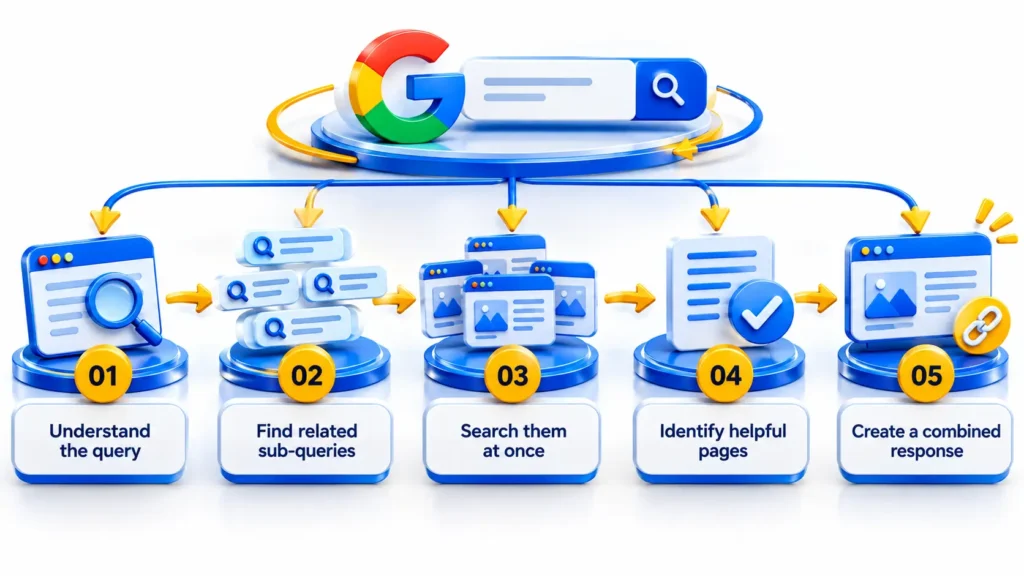
- The system interprets the original query and the intent behind it.
- It generates related sub-queries across subtopics.
- It runs those searches at the same time against web pages and other data sources.
- It identifies supporting pages and passages that answer each sub-query.
- It writes a combined response and shows links to the sources.
Google’s Search Intelligence Director Nikola Todorovic described fan-out as the process of finding additional queries that could return results relevant to the original prompt. He also noted that it helps whether a query is vague or highly detailed, because the system can interpret several dimensions of intent at once.
Where Fan-Out Is Used
Search Engine Journal reports that the technique runs across AI Mode, Deep Search and some AI Overview results. Search Engine Land notes that other AI search tools, including ChatGPT, Perplexity and Microsoft Copilot, show similar behaviour: one query in, many related queries out, with the results synthesized together.
Google introduced AI Mode as an experiment in Search Labs, and it suits complex questions that need exploration or comparison. The company says AI Mode and AI Overviews may use different models and techniques, so the answers and links can differ between them.
Visual Fan-Out
Fan-out also applies to images. Visual fan-out uses the same expansion idea for image searches, so descriptive file names, alt text and nearby captions help systems understand your visuals.
How Fan-Out Affects AI Search Visibility
The effects show up in three places: how pages are chosen, how content is judged and how performance is measured.
One Keyword Ranking No Longer Tells the Full Story
A page can rank well for a main keyword and still miss out when the system asks follow-up questions. Digiday’s explainer describes fan-out as an attempt to anticipate what people might ask next. A page that answers only the headline question may lose the other sub-queries to pages with broader coverage.
Topic Coverage and Entity Clarity Matter More
Because the system searches across subtopics, pages that explain a subject thoroughly have more chances to match a sub-query. Clear entities help too: name the products, services, people, places and standards involved, and explain how they relate. Industry analysis of Google’s patent filings, such as iPullRank’s review, describes systems that select and extract passages from documents, which makes self-contained sections valuable.
Visibility and Traffic Are Harder to Read
Google says sites that appear in AI features count toward overall search traffic in Search Console, and the data appears in the performance report under the Web search type. Impressions and clicks for fan-out answers do not show up as a separate line. Track topics, not single keywords, and compare enquiries and conversions alongside clicks.
How to Prepare Your Content for Fan-Out
Google states that standard SEO best practices still apply to AI features and that no extra requirements or special optimization exist. Preparation means doing the fundamentals well and covering topics fully.

- Map the questions around each main topic: definitions, comparisons, costs, steps, risks and alternatives
- Give each subtopic its own descriptive heading and a direct answer in the first sentences
- Write sections that make sense on their own, because a system may lift a single passage
- Keep important information in readable text rather than inside images
- Match structured data to the visible content on the page
- Link related pages together so topic clusters are easy to discover
- Confirm that pages are indexed and eligible to show snippets
What Not to Do
Fan-out does not require a separate page for every guessed sub-query. Thin pages written to match tool predictions can dilute quality. The exact sub-queries vary by search and Google does not publish them as a list, so treat third-party estimates as guidance only. A better investment is one strong, well-structured page per topic, updated when facts change.
Google also says you do not need new machine-readable files, AI text files or special schema markup to appear in these features.
Keep Business Information Current
Google lists up-to-date Merchant Center and business profile information among its best practices. For businesses with physical locations or product feeds, accurate details support sub-queries about hours, location, availability and prices. Review these details every quarter and whenever something changes.
Fan-Out and Local Businesses in Trivandrum
Local searches often hide several questions in one request. Someone looking for a clinic, a coaching centre or a service provider in Trivandrum may also want to know about reviews, opening hours, fees, parking and how to book. A fan-out system can search for each of those pieces separately.
Local businesses can prepare by keeping profile details accurate, publishing clear service pages and answering common questions on their websites. Pages that explain services, pricing factors and booking steps give the system more useful passages to choose from. A service page should state who the service is for, what it includes and how a customer can start, because those details match the follow-up questions people usually ask. Consistent business names, addresses and descriptions across the web also help the system connect the right entity to the right information.
Working With an SEO Partner
Some businesses handle this work internally, while others use SEO services in Trivandrum or a digital marketing agency in Trivandrum to plan content, technical health and measurement. Dotcom Creativez provides digital marketing services, and a partner like it should explain how its work connects topics, pages and business goals instead of promising rankings or AI citations.
Frequently Asked Questions
Is fan-out the same as keyword expansion?
No. Keyword expansion adds related terms to a search, while fan-out generates distinct sub-questions and retrieves results for each one before combining them into a single answer.
Which AI search tools use fan-out?
Google says AI Overviews and AI Mode may use it. Industry reports describe similar behaviour in other AI search tools, although each company designs its own system.
Can I see the fan-out queries for my topic?
Google does not publish the exact sub-queries behind each answer. Some SEO tools estimate likely related questions, which can guide planning but should not replace your own audience research.
Do I need special schema or an AI text file to appear in AI Mode?
No. Google states that no additional technical requirements or special markup exist for AI Overviews and AI Mode. Pages need to be indexed and eligible to show snippets.
Does ranking first guarantee a citation in an AI answer?
No. AI features may select links from a wider set of supporting pages, so strong coverage of related subtopics can matter as much as one top ranking.
How should small businesses respond to fan-out?
Start with the questions customers ask before buying. Answer them clearly on your website, keep business profiles accurate and review performance by topic instead of tracking one keyword.
How often should content be updated for AI search?
Review key pages at least twice a year and whenever facts, prices, features or policies change. Accurate, current pages give any search system better material to use.
Plan for Topics, Not Single Keywords
Query fan-out turns one search into a group of related questions, and AI systems look for pages that answer those questions clearly. Visibility now depends on topic coverage, clear structure, accurate entities and sound technical basics, not only on one keyword position.
Review your most important pages, list the follow-up questions around them and fill the gaps with useful content. For businesses that want support with that process, Dotcom Creativez offers digital marketing services that include planning, content and measurement.

The Dotcom Creativez team is a digital marketing team based in Kerala, helping businesses improve their online visibility and reach their target audiences. With over seven years of industry experience within its leadership, the agency provides services including SEO, performance marketing, social media marketing, content marketing, and web development. The team creates strategies based on business goals, audience needs, and market research, with a focus on generating qualified leads, increasing conversions, and supporting measurable business growth.