
A content marketing strategy produces revenue when each piece of content is tied to a buyer question, a stage of the sales funnel and a measurable business outcome. This guide shows how to set revenue targets, choose topics from search intent, build topic clusters, structure pages for search and AI answers, and attribute sales to content. It is written for business owners and marketing teams who need enquiries and sales, not just traffic.
What Makes a Content Marketing Strategy Revenue-Focused?
A revenue-focused plan starts with a sales target and works backward to the content needed to reach it. A traffic-focused plan starts with a publishing calendar and hopes sales follow.
Content contributes to revenue through three routes:
- Capturing demand: ranking for searches from people already looking for a product or service.
- Creating demand: reaching people who have a problem but have not started searching, through email, video and social platforms.
- Shortening the sales cycle: answering objections, pricing questions and comparison questions before a salesperson has to.
Content is a compounding asset, so results build over months. A business that needs sales this week should run paid campaigns alongside content, because search rankings and email lists take time to develop.
Step 1: Set a Revenue Target and Work Backward
Start with the number the business needs from content, then divide it into stages:
- Revenue target divided by average order value or deal size gives the customers required.
- Customers required divided by the lead-to-customer close rate gives the leads required.
- Leads required divided by the visitor-to-lead conversion rate gives the traffic required.
Pull these rates from your CRM and Google Analytics. If there is no history, use provisional assumptions, label them as such, and replace them with real figures after one quarter.
If the traffic required is far beyond what your niche can deliver, the fix is a higher conversion rate or a higher-value offer, not more posts.
Step 2: Define the Buyer and Map Search Intent
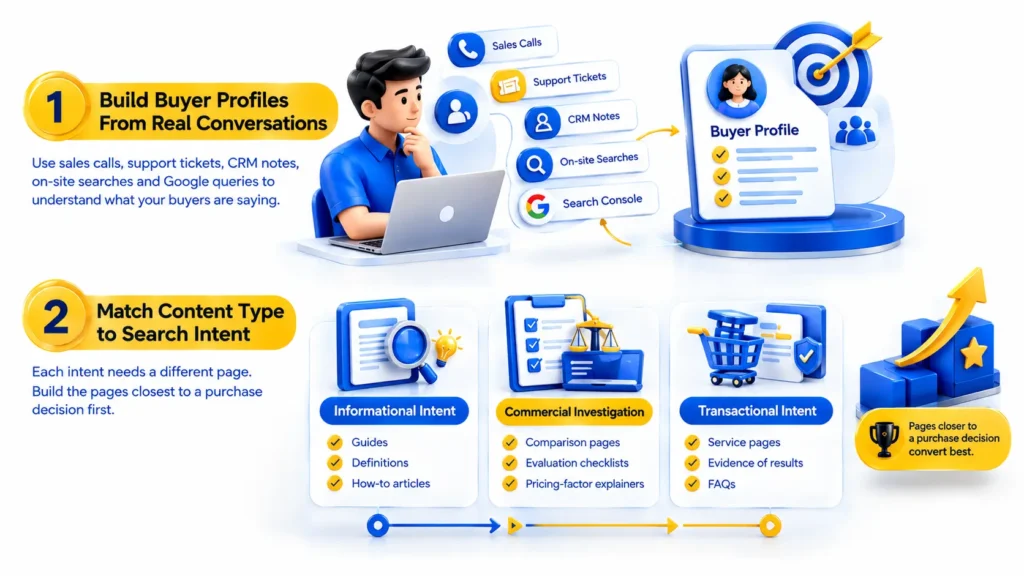
Build Buyer Profiles From Real Conversations
Sales calls, support tickets, CRM notes, on-site search terms and Google Search Console queries show how buyers describe their problems. Their wording is a better source of topics than an assumption made in a planning meeting.
Match Content Type to Search Intent
Each intent calls for a different page:
- Informational intent: guides, definitions and how-to articles that explain a problem.
- Commercial investigation: comparison pages, evaluation checklists and pricing-factor explainers.
- Transactional intent: service pages, evidence of results and FAQs that remove last-minute doubts.
Pages closest to a purchase decision tend to convert best, so build them before broad awareness content.
Step 3: Build Topic Clusters Around Your Offers
A topic cluster is a pillar page that covers a core subject broadly, linked to supporting articles that each answer one narrower question. Search engines infer topical coverage from these relationships, so a connected set of pages builds more authority than the same number of isolated posts.
Choose pillars from your most profitable products or services. For an SEO service, supporting pages might cover technical audits, keyword research, local search and reporting.
Link supporting pages to the pillar and to each other with descriptive anchor text. Then check Google Search Console for queries that earn impressions but few clicks. Those gaps often point to a missing or weak supporting page.
Step 4: Choose Formats and Channels You Can Sustain
Select two primary formats and publish them consistently instead of spreading effort across six channels. Written guides suit search. Video suits platforms such as YouTube. Email newsletters suit nurturing, because you own the list and do not depend on algorithm changes.
Repurpose each pillar asset. One detailed guide can supply a short video script, several social posts, an email sequence and FAQ content. That lowers production cost per asset.
Step 5: Write for People First and Structure for AI Answers
Show Experience and Expertise
Google’s guidance on helpful content centres on people-first writing and the E-E-A-T concepts: experience, expertise, authoritativeness and trustworthiness. In practice, that means named authors with relevant credentials, original data from your own business, first-hand process explanations and accurate, dated information. A generic summary of what every competitor already says gives a reader nothing new, and gives an answer engine nothing worth citing.
Make Answers Easy to Extract
Answer engines and voice assistants pull passages from pages, so write passages that stand alone. Put a direct answer in the first sentences under a question-style heading, define terms in one line, and use short lists for steps. Add Article, FAQPage, HowTo or Organization schema markup where it fits. Structured data helps machines interpret a page, though it does not guarantee a rich result or a citation.
Step 6: Convert Readers Into Leads
Give every page one conversion goal and match it to the visitor’s stage. A guide might offer a checklist download or an email subscription. A comparison page might offer a quote form. A service page might offer a consultation request. A mismatched offer, such as a sales call on an introductory article, lowers conversion because the reader is not ready.
Check friction points before publishing more: forms with unnecessary fields, slow mobile pages, unclear next steps and unanswered pricing questions.
Local service businesses have extra levers. A complete Google Business Profile, service pages written for the local market and a steady flow of genuine customer reviews all support local search visibility in Thrissur.
Step 7: Decide What to Build In-House and What to Outsource
Strategy, subject-matter input and sales feedback should stay in-house, because only the business knows its customers. Production, technical SEO, design and analytics setup are easier to outsource.
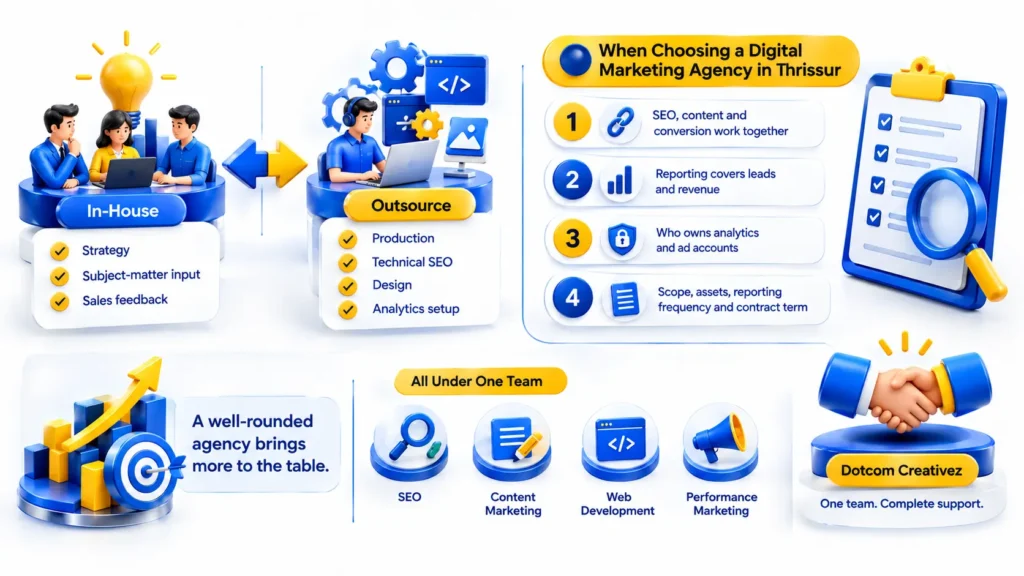
When comparing a digital marketing agency in Thrissur or any other provider, check these points:
- Whether SEO, content and conversion work are planned together.
- Whether reporting covers leads and revenue, not only rankings.
- Who owns the analytics and advertising accounts.
- Scope, number of assets, reporting frequency and minimum contract term.
Agencies such as Dotcom Creativez offer SEO, content marketing, web development and performance marketing under one team, which reduces handoffs between separate vendors.
Step 8: Measure Revenue, Not Just Traffic
Set up GA4 key events for form submissions, calls and purchases. Tag campaigns with UTM parameters, and pass the lead source into the CRM so each closed deal traces back to its first touch. Then track two layers:
- Leading indicators, reviewed monthly: impressions, clicks and average position in Search Console, engaged sessions and email signups.
- Revenue indicators, reviewed quarterly: leads by source, sales-qualified leads, closed revenue from content-sourced leads and cost per lead.
Content ROI equals content-attributed revenue minus content cost, divided by content cost. Content often assists a sale without being the last touch, so report both first-touch and assisted conversions to avoid understating its contribution.
Common Mistakes That Stall Content Revenue
- Publishing to a calendar without keyword research or intent mapping.
- Leaving the sales team out of topic planning.
- Ignoring existing pages that have lost clicks, when updating them is often faster than writing new ones.
- Reporting page views without lead data.
- Skipping distribution, so strong articles never reach their audience.
Frequently Asked Questions
How long does content marketing take to generate revenue?
Search-led content usually takes several months to gain visibility. The timeline depends on competition, site authority, publishing consistency and quality. No agency or tool can guarantee a specific ranking or revenue date.
How much should a business spend on content marketing?
Work from the revenue target. Estimate the leads required, then cost the assets, tools and distribution needed to produce them. Compare the projected cost per lead with customer lifetime value. A fixed percentage of revenue is a starting benchmark at best, since the right figure depends on margin and sales cycle.
How do I measure content marketing ROI?
Track content-sourced leads and closed revenue through GA4 and your CRM. Subtract content costs from attributed revenue, then divide by those costs. Include assisted conversions, since many buyers read several pages before making an enquiry.
Does content still work when AI answers appear in search?
Yes, when it offers something a summary cannot: original data, expert judgement, clear answers and trustworthy sourcing. Pages with direct, self-contained answers are easier for answer engines to extract, though citation is never guaranteed.
How many articles should a business publish each month?
Quality and cluster completeness matter more than frequency. Start with pages closest to purchase, such as service and comparison content, then expand outward. A smaller set of well-researched pages that are updated regularly is a sounder use of budget than a high volume of thin posts.
Can a small local business use this approach?
Yes. Narrow the scope to one or two offers, build a compact cluster, and add Google Business Profile optimisation and review collection for local searches. The revenue arithmetic in Step 1 works at any scale.
A Revenue-First Plan for 2027
A content marketing strategy that generates revenue begins with a sales target, builds topic clusters around profitable offers, matches each page to buyer intent and measures results in the CRM. Teams that want one partner for planning, SEO, content and conversion work can consider Dotcom Creativez, whose service mix covers those areas. The next step is practical: calculate the leads you need, audit existing pages against buyer intent, and fix the pages closest to a sale first.

The Dotcom Creativez team is a digital marketing team based in Kerala, helping businesses improve their online visibility and reach their target audiences. With over seven years of industry experience within its leadership, the agency provides services including SEO, performance marketing, social media marketing, content marketing, and web development. The team creates strategies based on business goals, audience needs, and market research, with a focus on generating qualified leads, increasing conversions, and supporting measurable business growth.