
Seeing Business Not Getting Leads After Investing in SEOt is frustrating, and the cause is rarely a single mistake. Rankings, traffic, and enquiries depend on different parts of your website and marketing. This guide explains why visitors may not turn into customers, from mismatched keywords and weak landing pages to tracking gaps and slow follow-up, and shows how to diagnose each problem and decide what to fix first.
Is SEO Failing or Is Something Else Blocking Leads?
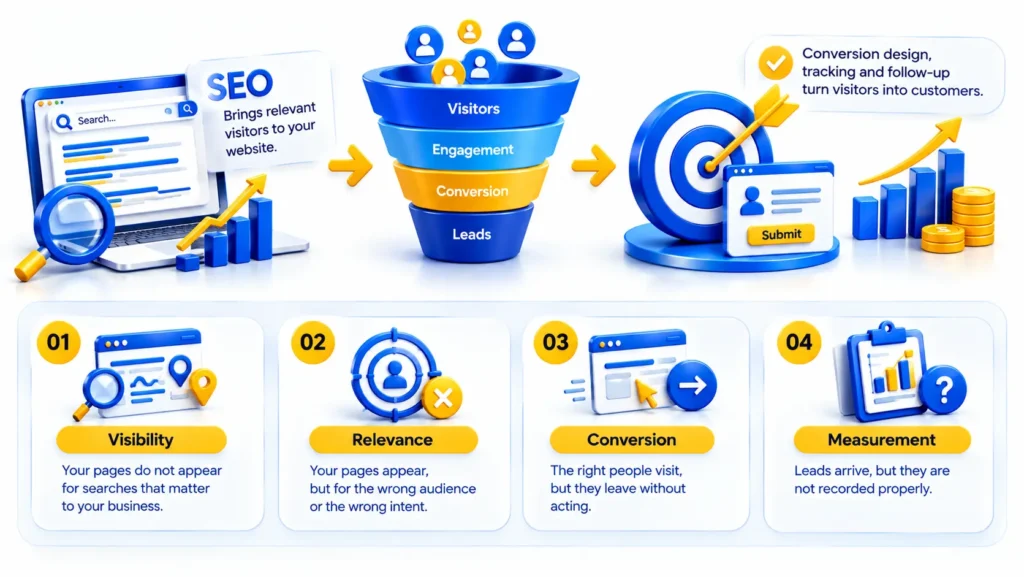
SEO and lead generation are connected, but they are not the same thing. Search engine optimization brings relevant visitors to your website. Conversion design, tracking, and sales follow-up turn those visitors into enquiries and customers.
When a business sees no leads, the problem usually sits in one of four areas:
- Visibility: your pages do not appear for searches that matter to your business.
- Relevance: your pages appear, but for the wrong audience or the wrong intent.
- Conversion: the right people visit, but they leave without acting.
- Measurement: leads arrive, but they are not recorded properly.
Knowing which area is weak saves months of guesswork.
The Most Common Reasons SEO Does Not Produce Leads
You Are Ranking for the Wrong Keywords
Many campaigns report growth for informational or branded terms that rarely lead to a purchase. A page ranking for “what is SEO” attracts students and researchers, not buyers. Keywords with commercial or local intent, such as a service name combined with “cost” or “near me”, attract people closer to a decision.
Open Google Search Console and review the queries bringing clicks. If most of them are definitions, job searches, or free resources, your traffic has low buying intent. Shift effort toward service pages and comparison content that match how customers search when they are ready to hire.
Your Pages Do Not Match Search Intent
Search intent is the reason behind a query. Someone searching for “dental implant cost” wants pricing information. Someone searching for “dentist near me” wants a nearby clinic with reviews and opening hours. When a page answers a different question than the one asked, visitors leave quickly and the page struggles to hold its position.
Match each page to one clear intent. Service pages should explain the offer, the process, the factors that affect pricing, and proof of quality. Blog posts should answer questions and guide readers toward the relevant service.
Your Landing Pages Do Not Convince Visitors
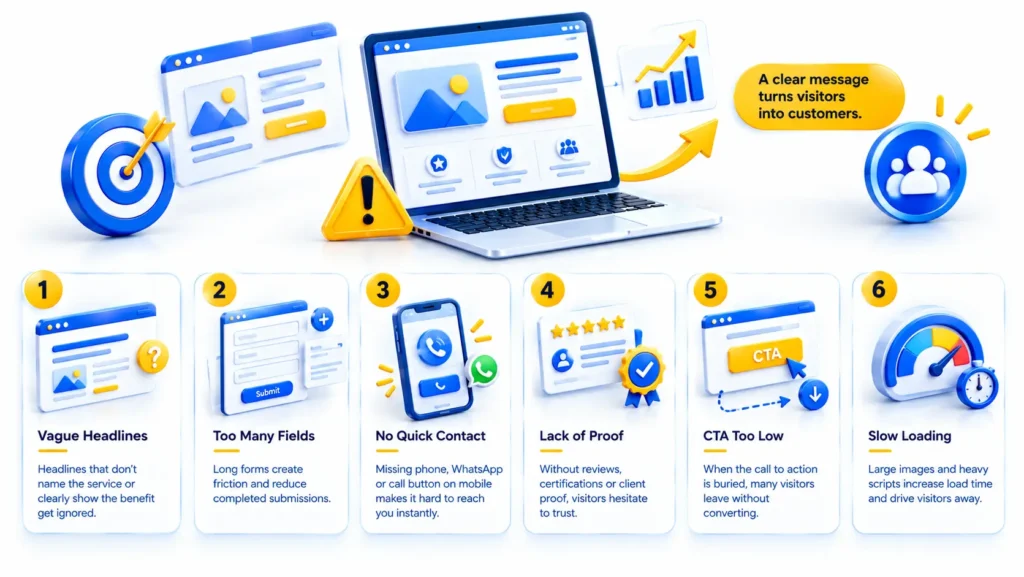
Traffic alone does not create enquiries. A page needs a clear reason for the visitor to act. Common conversion problems include:
- Vague headlines that do not name the service or the benefit
- Contact forms with too many fields
- No visible phone number, WhatsApp link, or call button on mobile
- Missing reviews, certifications, or client proof
- Calls to action buried at the bottom of the page
- Heavy images and scripts that slow the page down
Conversion rate optimization (CRO) addresses these issues. Small changes to headlines, form length, and trust signals can raise enquiry numbers without any increase in traffic.
Technical Problems Hurt Visibility and Experience
Technical SEO affects whether pages are crawled, indexed, and easy to use. Check these areas first:
- Pages blocked by robots.txt or marked noindex by mistake
- Slow mobile loading, which you can test with Google PageSpeed Insights and Core Web Vitals reports
- Duplicate or thin pages that compete with each other
- Forms or thank-you pages that fail to load
A form that fails silently is especially costly. Submit a test enquiry on desktop and mobile every month to confirm it reaches your inbox or CRM.
Local Visibility Is Weak
Service businesses often depend on local searches. Google Business Profile, local citations, reviews, and location pages influence who appears in map results. If local signals are weak, competitors capture calls even when your website ranks reasonably well.
For businesses serving customers in Thrissur, local SEO in Thrissur should include an accurate Google Business Profile, consistent name, address, and phone details across directories, genuine customer reviews, and pages that describe your services for local customers.
Tracking Is Incomplete
Sometimes leads exist but are not counted. Without conversion tracking, phone calls, form submissions, and chat messages stay invisible, and SEO appears to fail even when it works.
Set up Google Analytics 4 events for form submissions, click-to-call actions, and WhatsApp clicks. Connect Google Search Console to see which queries and pages drive visits. Use call tracking where phone enquiries are the main channel. Also check that your reports separate organic search from paid, social, and direct traffic, because mixed attribution can hide what SEO actually contributes.
Lead Handling Is Slow or Inconsistent
An enquiry that waits a day for a reply often goes to a competitor. SEO can supply the enquiry, but the business still has to answer it. Review how quickly your team responds, whether the sales process is clear, and whether every lead receives a follow-up. Replying within minutes rather than days improves the chance of starting a real conversation.
How Long Does SEO Take to Generate Leads?
There is no fixed timeline. Results depend on competition, website age, content quality, technical health, and the buying cycle of your industry. Google’s own guidance describes SEO as a gradual process, and no reputable provider can promise a specific ranking or date.
Newer websites and highly competitive industries generally need longer than established sites targeting less competitive local searches. Before leads appear, judge progress through leading indicators:
- Growth in impressions and clicks for commercial keywords in Search Console
- Better average positions for service pages
- More Google Business Profile views, calls, and direction requests
- The first form fills or calls from organic sessions
If none of these indicators improve over a sustained period, the strategy needs review, not more of the same activity.
How to Diagnose Your SEO Lead Problem Step by Step
Work through this process in order, because later fixes depend on earlier findings:
- Check indexing and crawl health in Google Search Console.
- Export your top queries and group them by intent: informational, commercial, local, and branded.
- Review landing page performance in Google Analytics 4, focusing on conversions per page rather than visits.
- Test every form, phone link, and chat widget on desktop and mobile.
- Audit your Google Business Profile for accurate details, recent reviews, and correct categories.
- Compare your service pages with the pages ranking above you for the same queries, looking at depth, clarity, and proof.
- Review how quickly and consistently your team handles incoming enquiries.
What Should a Lead-Focused SEO Strategy Include?
An effective strategy connects search visibility to business outcomes. The core elements are:
- Keyword research based on buyer intent, not search volume alone
- Service pages built around specific customer problems and solutions
- Content that answers the questions customers ask before buying
- Ongoing technical maintenance and speed improvements
- Conversion tracking tied to calls, forms, and messages
- Regular reporting that shows enquiries, not only rankings
If you are evaluating a digital marketing agency in Thrissur, ask how it measures leads, what it reports each month, and how it connects SEO with CRO, content, and local search. Dotcom Creativez, which works across SEO, content, CRO, and design, can be assessed against the same questions. Ask for a clear scope of work, sample reporting, and realistic timelines instead of ranking guarantees.
Frequently Asked Questions
Why do I get website traffic but no enquiries from SEO?
The traffic usually has low buying intent, or the page fails to convince visitors. Check which queries bring the visits, then review calls to action, form design, trust signals, and the mobile experience.
How many months should I wait before expecting SEO leads?
Timelines vary with competition, site condition, and content quality. Early signals such as rising impressions and better positions normally appear before leads. Judge progress using those indicators rather than a fixed calendar date.
Can poor website design cause SEO to fail?
Yes. Confusing navigation, slow loading, and unclear calls to action reduce conversions even when rankings are healthy. Design and SEO work best when planned together.
Is local SEO enough for a small business in Thrissur?
Local SEO often drives enquiries for service businesses, but it works best alongside a strong website, genuine reviews, and content that answers local customer questions.
How do I know whether my leads are tracked correctly?
Submit test enquiries, click every phone and WhatsApp link, and confirm each action appears in Google Analytics 4. Compare those numbers with the enquiries your team actually receives.
Should I switch to paid advertising if SEO is not producing leads?
Google Ads can bring faster visibility, but it does not fix weak pages or broken tracking. Resolve those problems first, since they affect every channel.
Turning Search Visibility Into Enquiries
SEO not generating leads usually points to a mismatch between keywords, page experience, tracking, or follow-up, not a failed channel. Start by confirming that your keywords reflect buying intent, your pages match what searchers want, and your conversions are measured correctly. Then improve speed, local signals, and enquiry handling in that order.
Teams such as Dotcom Creativez can support this work through audits, content, and conversion improvements, but the process begins with clear data about where visitors drop off. Fix the weakest link first, measure again, and let the results guide the next step.