
If your campaigns are running but enquiries, sales, or bookings are flat, the problem usually sits in the strategy, the website, or the way results are measured. This guide explains the most common reasons behind digital marketing not working, how to diagnose each one, and what to fix first. It is written for business owners, marketers, and teams who want clear answers rather than another list of generic tips.
What Does Stalled Online Growth Actually Mean?
Online growth means more qualified visitors turning into enquiries, bookings, or purchases over time. Activity alone does not prove growth. A business can post daily, run ads, and send newsletters while revenue stays flat.
Growth stalls when traffic, conversions, or customer value fail to improve together. Traffic without conversions points to a website or offer problem. Conversions without traffic point to a visibility problem. Strong numbers in both with poor profit point to a cost or retention problem. Knowing which one applies saves months of guessing.
Why Your Business Isn’t Growing Online Despite Digital Marketing
Each issue below can hold back results on its own, and several often occur together.
There Is No Clear Goal or Target Audience
Many campaigns start with channels instead of objectives. Without a defined goal, such as qualified leads per month or online orders, nobody can judge whether a campaign works.
Audience definition matters just as much. Marketing aimed at everyone usually reaches no one. Describe who buys, what problem they are solving, which questions they search, and what makes them hesitate. Every ad, page, and post should follow from that description.
Your Website Is Losing Visitors
Marketing sends people to your website, so the website decides the result. Slow loading pages, confusing navigation, weak mobile layouts, and unclear offers all push visitors away. Google recommends measuring page experience through Core Web Vitals, which track loading speed, responsiveness, and visual stability.
Conversion rate optimization (CRO) addresses this gap. It tests headlines, forms, calls to action, and page structure so more existing visitors take action. Fixing the website often produces more growth than buying more traffic.
SEO Is Treated as a One-Time Task
Search engine optimization builds visibility through technical health, useful content, and authority. It compounds over time and needs continuous work. Common gaps include pages that search engines cannot crawl, content that does not match search intent, thin service pages, and missing structured data.
Google Search Console shows which queries trigger your pages, which pages are indexed, and which technical errors need attention. If nobody reviews it, problems stay hidden for months.
Content Does Not Answer Real Questions
Posting often is not the same as publishing useful content. Pages that repeat what competitors say rarely earn attention. Strong content answers specific questions, shows real expertise, and guides readers toward a next step.
Match each page to a stage of the buying journey. Awareness content explains problems. Consideration content compares options. Decision content removes doubt through pricing factors, process details, and proof such as genuine reviews.
Your Offer Does Not Stand Out
Visitors compare options within minutes. If your services, pricing approach, and reasons to choose you are unclear, they leave for a competitor.
State what you do, who it is for, how the process works, and what makes your approach different. Genuine testimonials, certifications you actually hold, and detailed service pages build trust faster than slogans.
Paid Campaigns Lack Structure
Google Ads and Meta Ads can produce fast results, but only with careful setup. Broad keywords, weak ad copy, poor audience targeting, and landing pages that do not match the ad waste budget quickly.
Check three things: whether conversion tracking is installed, whether search terms match buyer intent, and whether the cost per lead fits your margins. Without these, spending more only magnifies the problem.
Tracking and Reporting Are Weak
Many businesses judge marketing by likes, impressions, and clicks. These vanity metrics do not show revenue impact. Google Analytics 4 (GA4) can track events such as form submissions, calls, and purchases, but only after someone configures it correctly.
Useful reporting connects channels to outcomes: leads by source, cost per acquisition, conversion rate, and customer lifetime value. When data is unreliable, decisions rest on opinion instead of evidence.
Local Visibility and Reputation Are Ignored
Customers searching for nearby services rely on Google Business Profile, map results, and reviews. An incomplete profile, inconsistent business details across directories, and few recent reviews reduce trust before a visitor reaches your website.
Local businesses should keep their profile accurate, respond to every review, add fresh photos, and publish location-relevant service pages. This matters for clinics, academies, retailers, and other service businesses that depend on nearby customers.
Your Content Is Not Ready for Answer Engines
Search behavior is changing. Google shows AI Overviews for some queries, and many people now ask full questions on conversational platforms. Content that defines terms plainly, answers questions near the top of a page, and shows genuine expertise is easier for users and these systems to understand.
Clear headings, accurate business details, named authors, and structured data help search systems interpret a page. Vague, repetitive copy gives them little to use.
Expectations and Timelines Are Unrealistic
SEO and content marketing usually need months to show measurable movement. Paid ads can deliver quicker data, but they still need testing and refinement. Judging a strategy after a few weeks often leads to abandoning channels that were working.
Set milestones instead: technical fixes first, content publishing next, then conversion improvements, then scaling. No honest provider can guarantee fixed outcomes in search.
How to Diagnose What Is Holding Your Business Back
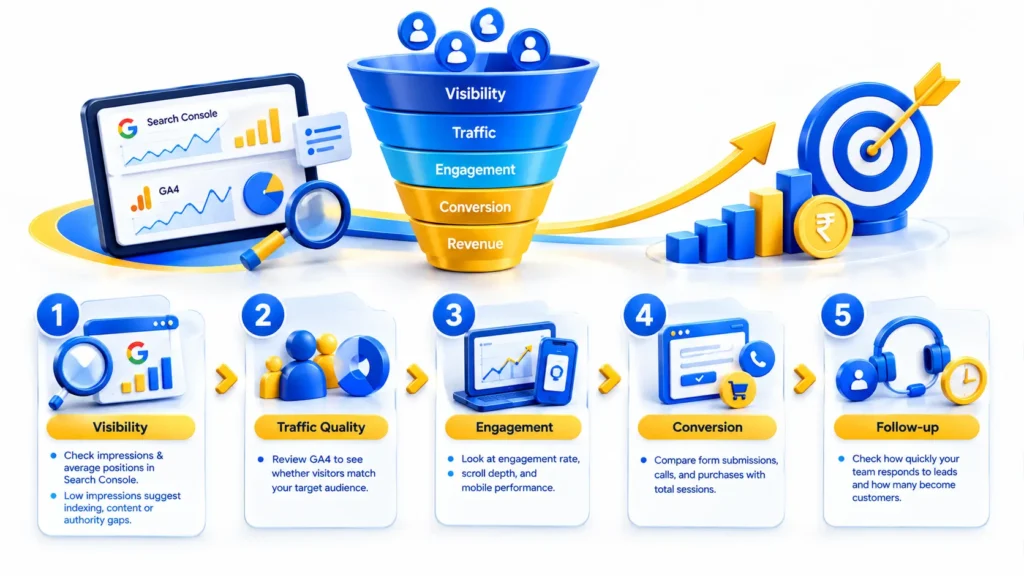
Work through the funnel in order, from visibility to revenue. The steps below help isolate the weakest stage.
- Visibility: Check impressions and average positions in Google Search Console. Low impressions suggest indexing, content, or authority gaps.
- Traffic quality: Review GA4 to see whether visitors match your target audience.
- Engagement: Look at engagement rate, scroll depth, and mobile performance.
- Conversion: Compare form submissions, calls, and purchases with total sessions.
- Follow-up: Check how quickly your team responds to leads and how many become customers.
Weak follow-up is often overlooked. Even excellent marketing fails when enquiries wait days for a reply.
What Should You Fix First?
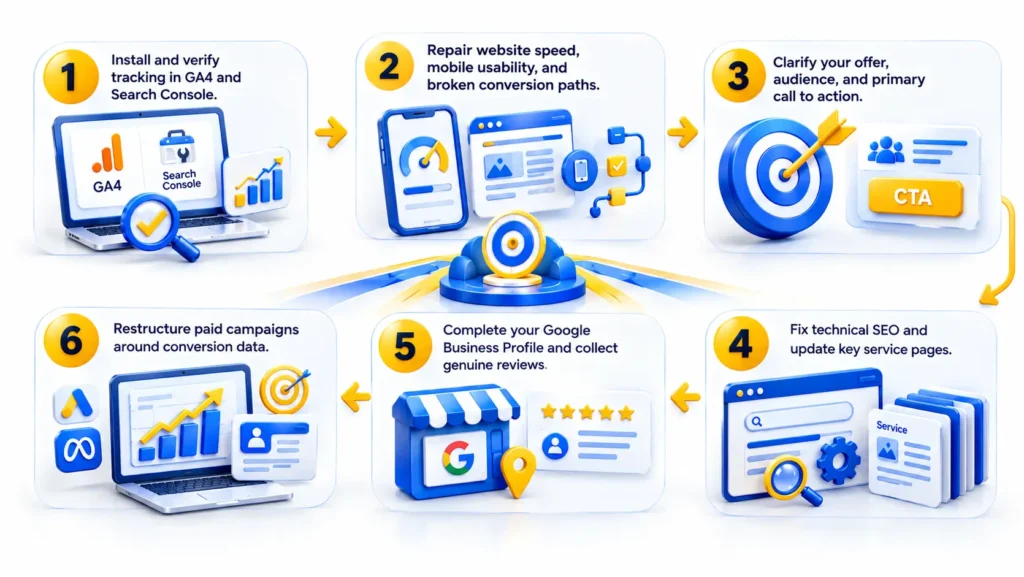
Start with problems that block every channel, then move to growth work.
- Install and verify tracking in GA4 and Search Console.
- Repair website speed, mobile usability, and broken conversion paths.
- Clarify your offer, audience, and primary call to action.
- Fix technical SEO and update key service pages.
- Complete your Google Business Profile and collect genuine reviews.
- Restructure paid campaigns around conversion data.
This order protects your budget. There is little value in sending more visitors to a site that cannot convert them.
How to Choose a Digital Marketing Partner
If internal fixes are not enough, an outside team can audit and manage the work. When comparing providers, evaluate process rather than promises.
- Services: Look for SEO, content, paid media, web development, and conversion optimization under one plan.
- Reporting: Ask what metrics they track and how often they report.
- Transparency: Request a clear scope, pricing structure, and contract terms.
- Industry fit: Check whether they understand your sector and customer behavior.
- Communication: Confirm who manages your account and how quickly they respond.
A good provider starts with an audit instead of a package. Dotcom Creativez, for example, works across SEO, content, design, and conversion optimization, which is the kind of range worth looking for. Businesses that want a local partner can also evaluate a digital marketing agency in Trivandrum by reviewing its services, reporting practices, and published work.
Frequently Asked Questions
Why is my digital marketing not bringing leads?
Usually because of weak tracking, poor website conversion, unclear targeting, or content that does not match buyer intent. Audit these areas before increasing budget.
How long does digital marketing take to show results?
Paid ads can generate data within days. SEO and content marketing generally take several months, depending on competition, website health, and consistency.
Should I increase my ad budget when sales are flat?
Not before checking tracking, landing pages, and lead quality. More budget on a weak funnel increases cost without improving return.
Which metrics show whether marketing is working?
Track qualified leads, conversion rate, cost per acquisition, revenue by channel, and customer lifetime value. Impressions and followers alone are not enough.
Can a local business benefit from working with a digital marketing agency in Trivandrum?
Yes, when the agency understands local search behavior, manages Google Business Profile, and builds service pages for nearby customers. Ask for reporting that links activity to enquiries.
Does posting on social media daily guarantee growth?
No. Social media marketing supports awareness and engagement, but growth depends on strategy, offers, audience fit, and a website that converts.
Turning Marketing Activity Into Online Growth
Online growth stalls when strategy, website, tracking, content, and follow-up do not work together. Start by measuring the right outcomes, locate the weakest stage of the funnel, and fix it before spending more. Dotcom Creativez works across these connected areas, from SEO and content to design and conversion optimization. Steady, measured improvement usually serves a business better than short bursts of activity.