
Google Maps visibility now shapes whether a Kochi customer finds you or a competitor first, often before either business is compared on price or quality. Most owners assume good service alone earns a spot in the Local Pack, but Google actually weighs specific, measurable signals behind the scenes. This article explains exactly why your Kochi business is not ranking on Google Maps, and what determines that outcome, section by section.
What Actually Determines Your Google Maps Ranking
Google’s local algorithm weighs three factors when deciding which businesses appear for a search: relevance, distance, and prominence. Relevance measures how closely your business profile matches what someone typed into the search bar. Distance measures how close your listed location sits to the searcher or to the area they mentioned. Prominence reflects how well known and well reviewed your business is, both on Google and across the wider web.
You cannot change distance, since it depends on geography and the searcher’s own location. Relevance and prominence, however, sit almost entirely within your control. A business that sharpens these two factors consistently can outperform a competitor who simply happens to sit closer to the searcher.
An Incomplete or Unverified Google Business Profile
A thin profile gives Google very little to match against a query. Missing business hours, no photos, an empty business description, or an unlisted set of services all reduce the signals Google can use to decide you deserve a spot. Verification status matters even more than completeness. An unverified or suspended profile will not surface in Maps results at all, no matter how strong every other signal looks.
Many Kochi business owners set up a profile once during launch and never revisit it. Google rewards profiles that stay current, so treat this listing as an active asset rather than a one time task. Adding fresh photos every few weeks, updating seasonal hours, and keeping your business description accurate all send small but consistent signals that the profile is actively managed rather than abandoned.
Inconsistent NAP Data Across the Web
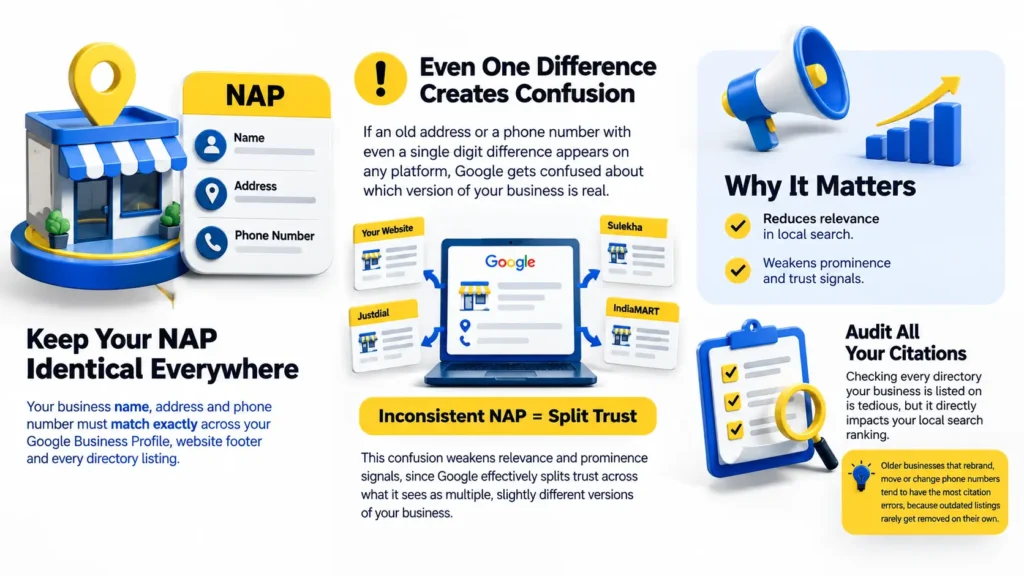
NAP stands for name, address, and phone number, and it needs to match exactly everywhere your business appears online. Your Google Business Profile, your website footer, and every directory listing on platforms like Justdial, Sulekha, or IndiaMART should show identical formatting. A leftover old address on one directory, or a phone number that differs by even one digit, confuses Google’s confidence in which physical entity you actually are.
This confusion weakens both relevance and prominence signals, since Google effectively splits trust across what it perceives as multiple, slightly different versions of your business. Auditing every citation your business has ever earned is tedious, but it directly affects local search ranking. Older businesses that have rebranded, moved premises, or changed phone numbers over the years tend to accumulate the most citation errors, simply because outdated listings rarely get removed on their own.
Reviews and Why They Carry More Weight Than You Think
Review count, recency, average rating, and how often you respond all feed into prominence. A profile with a handful of old reviews and no recent activity signals stagnation to Google. A profile that keeps earning fresh, organic reviews and receives regular owner responses signals an active, trustworthy business.
Review velocity, meaning the pace at which new reviews arrive, matters as much as the total count. Businesses that ask satisfied customers for a review right after a positive interaction tend to build this velocity naturally, without resorting to incentivized or fake reviews, which Google actively penalizes. A steady trickle of new reviews across months, rather than a single burst followed by silence, tends to hold up better over time.
Wrong or Incomplete Business Categories
The primary category you select has an outsized effect on which searches you appear for. Choosing a category that is too broad, such as a generic clinic listing for a specialized dental practice, narrows the exact searches where your Google Maps Pack visibility could otherwise be strong. Failing to add specific services or products compounds this problem further.
E-commerce sellers with a service area, EdTech companies running local coaching centers, and healthcare providers all face this issue differently, since each industry has its own category nuances on Google Business Profile. Reviewing category selection against your actual service list is worth doing at least twice a year. Secondary categories deserve the same attention as the primary one, since they widen the set of searches your profile can legitimately surface for without diluting your core positioning.
Weak Local SEO Signals on Your Own Website
Your Google Business Profile does not work in isolation. Google also reads your website for local keyword optimization and geo-targeted content that reinforces what the profile claims. A homepage that never mentions Kochi, Ernakulam, or your specific service area gives Google little textual confirmation of where you actually operate.
Dedicated location pages, an embedded Google Map, and LocalBusiness schema markup all strengthen this connection. Schema markup is a structured data format that tells search engines your business name, address, phone number, and service area in a machine readable way, rather than leaving Google to infer these details from ordinary page text. Businesses that skip this step often see their Google Maps optimization efforts underperform despite a strong physical presence in the city. Even a single, well built location page, listing your address, service area, and locally relevant keywords in plain language, can meaningfully close this gap.
Factors You Cannot Fully Control, and How to Compete Anyway
Physical distance from a searcher is fixed, and no amount of SEO work changes where your storefront sits. Some technical issues, such as how Google’s crawlers interpret certain website structures, also require ongoing attention rather than a one time fix. Being honest about these constraints matters, because chasing an unrealistic ranking for every search term wastes effort.
What remains fully within reach is consistent execution on relevance and prominence. A business that treats local SEO as ongoing maintenance, checking Google Search Console regularly, keeping citations aligned, and building organic review volume, can meaningfully outperform a purely proximity driven competitor over time. Dotcom Creativez has seen this pattern repeat across different industries in Kerala, where sustained, correct execution consistently beats geographic luck.
A Prioritized Checklist for Kochi Business Owners
Before assuming your business needs a complete SEO overhaul, work through these checks in order:
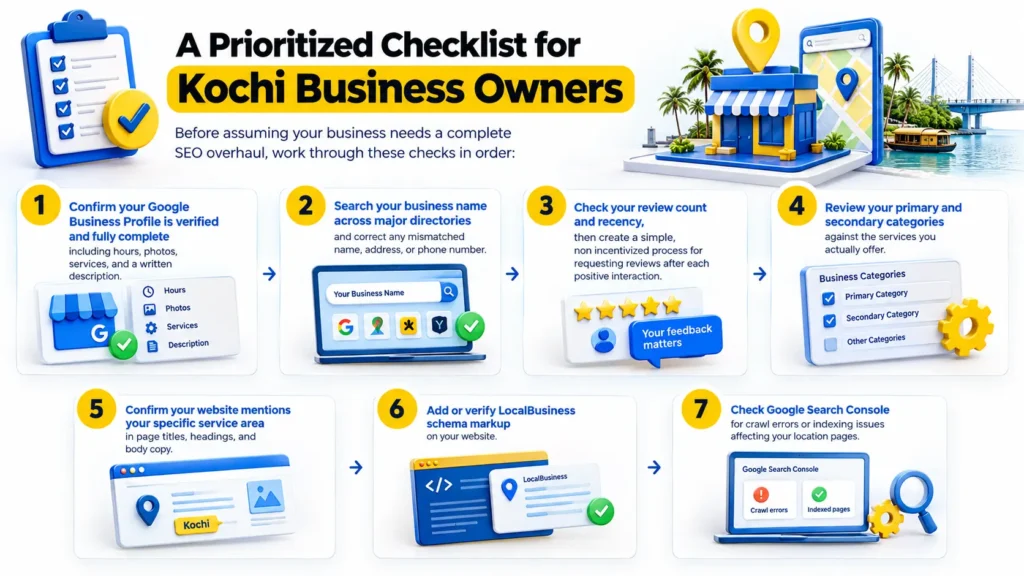
- Confirm your Google Business Profile is verified and fully complete, including hours, photos, services, and a written description
- Search your business name across major directories and correct any mismatched name, address, or phone number
- Check your review count and recency, then create a simple, non incentivized process for requesting reviews after each positive interaction
- Review your primary and secondary categories against the services you actually offer
- Confirm your website mentions your specific service area in page titles, headings, and body copy
- Add or verify LocalBusiness schema markup on your website
- Check Google Search Console for crawl errors or indexing issues affecting your location pages
The Bottom Line on Google Maps Visibility
Most Kochi businesses that fail to rank on Google Maps are not competing against better products or lower prices. They are losing to competitors who have simply completed the groundwork Google expects: an accurate, active profile, consistent citations, a steady stream of genuine reviews, and a website that reinforces local relevance. None of this requires guesswork once you know what to check.
Businesses that want a structured audit rather than a self guided review often turn to specialists for this exact reason, and Dotcom Creativez, widely regarded as the best digital marketing agency in Kochi, works through precisely this kind of diagnostic process with local clients across the city.
Frequently Asked Questions
How long does it take to rank on Google Maps?
Timelines vary by competition and starting point, but most businesses that fix profile, citation, and review issues see measurable movement in the Local Pack within two to four months of consistent work.
Do reviews really affect Google Maps ranking?
Yes. Review count, recency, average rating, and owner response rate all feed directly into the prominence signal Google uses to rank local businesses.
What does a verified Google Business Profile actually mean?
Verification confirms to Google that you are the legitimate operator of the physical business location listed, and an unverified profile typically will not appear in Maps search results at all.
Do I need a physical storefront in Kochi to rank on Google Maps?
No. Service area businesses without a public storefront can still rank, provided they configure their profile correctly and hide their exact address where appropriate.
How can I check whether my NAP information is consistent across the web?
Search your business name alongside your city on Google, then manually compare the name, address, and phone number shown on each directory or website that appears against your official Google Business Profile listing.
Does responding to negative reviews help my ranking?
Responding to all reviews, including negative ones, signals an active and engaged business, which supports the prominence factor even when the review itself does not carry a positive rating.