

AI for Ad Creative and Copy Generation covers three distinct capabilities that businesses often bundle together by mistake: generating copy variants for testing, assembling personalized creative in real time, and maintaining brand and compliance control over automated output. This article separates these functions, explains the mechanics behind each, and sets out when the investment in automation actually pays off. Readers evaluating in-house tools or agency support will find practical thresholds rather than abstract promises.
AI-Generated Ad Copy Testing and Variation at Scale
Generative models produce ad copy from a structured prompt defining product, audience, tone, and length constraints, then swap variables such as the opening hook, the benefit statement, or the call to action across multiple outputs. This is variable swapping, not free-form writing, which keeps output consistent enough to test fairly. Automated generation earns its setup cost once a campaign runs enough daily impressions to reach statistical significance across several variants within a reasonable testing cycle, usually weeks rather than months. Below that volume, manual copywriting with a smaller set of hand-picked variants stays more efficient, since too few conversions per variant produces noise instead of a result.
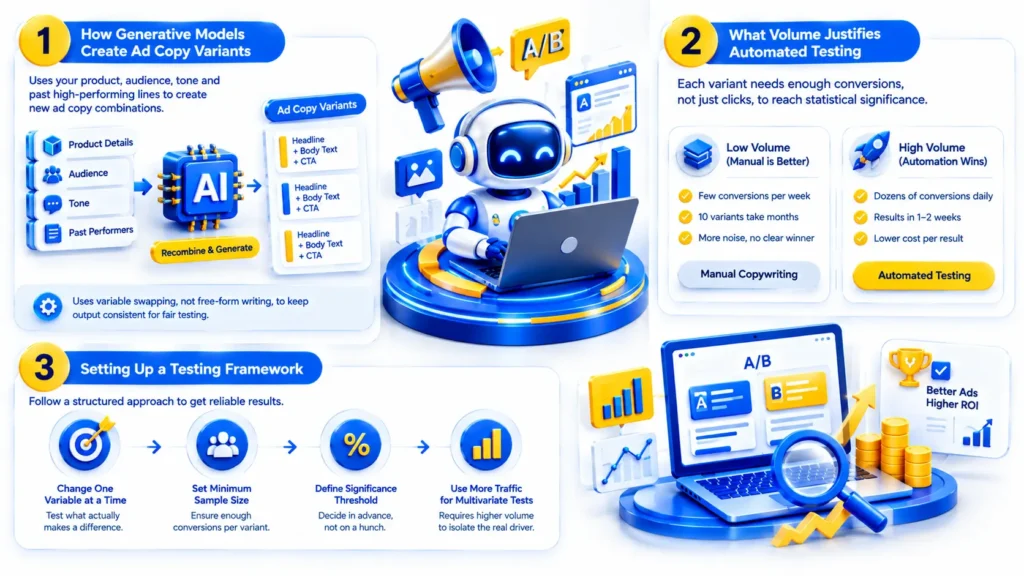
How generative models create ad copy variants
A generative model does not invent messaging from nothing. It receives a brief with product attributes, brand tone descriptors, and prior high-performing lines, then produces headline, body, and CTA combinations by recombining those inputs under set constraints. Length caps and required claims are enforced through the prompt or a post-generation filter.
What volume of traffic or spend justifies automated testing
Each variant needs enough conversions, not just clicks, to reach a statistically meaningful sample within the testing window. A campaign generating a handful of conversions per week across ten variants will take months to produce a confident winner, which erodes the time advantage automation is meant to provide. Campaigns with daily conversion volume in the dozens per variant reach readable results within one to two weeks, which is where automated testing genuinely outperforms manual iteration on cost per result.
Setting up a testing framework: statistical significance and sample size basics
A workable framework fixes one variable at a time, sets a minimum sample size before evaluating results, and defines a significance threshold in advance rather than stopping the moment one variant looks ahead. Multivariate testing, where several elements change at once, needs proportionally more traffic than single-variable testing to isolate what actually drove the outcome.
AI Dynamic Creative Optimization: Matching Ad Variants to Audience Segments
Dynamic Creative Optimization engines assemble finished ads at the moment of impression, selecting from a library of images, headlines, offers, and calls to action based on signals such as device type, location, time of day, or funnel stage. This differs from copy testing because the system is not searching for one winning version; it matches combinations to segments continuously. A DCO engine only works if the business supplies modular components rather than finished static ads, since it needs individual assets it can recombine on the fly.
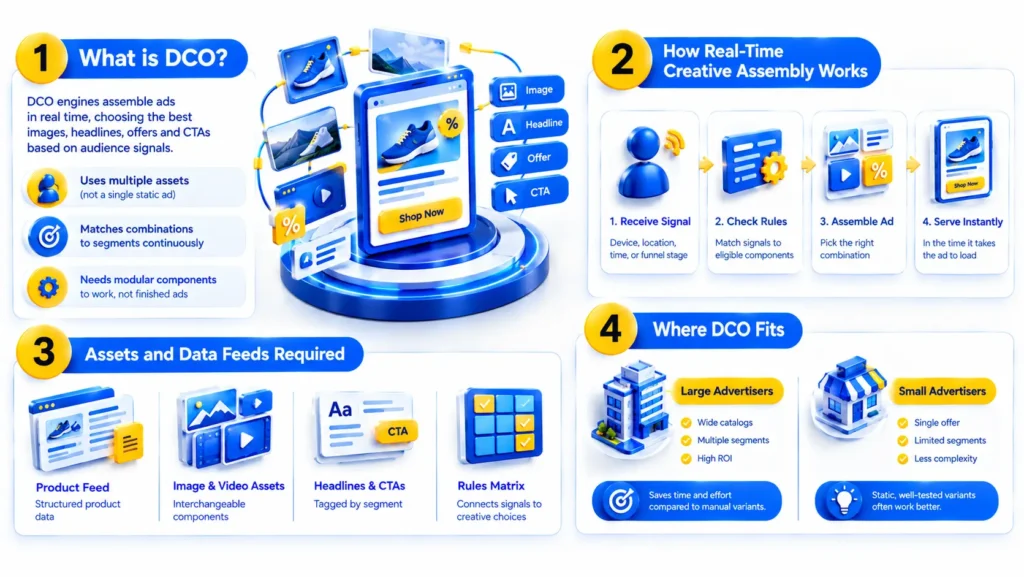
How real-time creative assembly works
The engine receives a signal about the viewer, checks a rules layer mapping signals to eligible components, and assembles the ad in the time it takes the ad request to load. Rules might specify that a returning visitor sees a different offer, or that mobile users see a shorter headline.
Assets and data feeds required before launching DCO
Before DCO can run, a business needs a structured product feed, image and video assets broken into interchangeable components, headline and CTA variants tagged by segment, and a rules matrix connecting signals to creative choices. Missing any one of these reduces the engine to a simple rotation tool rather than genuine personalization.
Where DCO fits for small versus large advertisers
Large advertisers with wide catalogs and multiple segments see the clearest return, since the manual alternative means building and managing hundreds of variations by hand. Small advertisers with a single offer often get more value from a smaller set of well-tested static variants, given the setup work a DCO build requires.
The Risks of AI-Generated Ad Content: Brand Voice and Compliance
Generative copy drifts from approved brand tone when the prompt relies on generic descriptors instead of concrete examples of approved and rejected phrasing, producing output that is on-topic but reads differently from everything else the business publishes. Separately, platform ad policy creates risk around specific claims, particularly in health, finance, and other restricted categories, where wording that sounds like a normal marketing statement can trigger a rejection or a policy strike on the account. A human review checkpoint, built around a written brand style guide and a category-specific compliance checklist, catches both problems before any variant goes live.
Common brand voice drift patterns in AI copy
Drift shows up as generic superlatives replacing specific product language, tone that becomes more casual or formal than the brand’s established voice, and claims phrased more confidently than the product supports. A style guide with labeled examples of approved and rejected phrasing reduces this more reliably than tone instructions alone.
Platform policy risks by category: health, finance, and restricted claims
Health advertisers face restrictions on implied medical outcomes and before-and-after framing. Financial advertisers face restrictions on guaranteed returns or misleading rate language. Any comparative or superlative claim needs substantiation on file, since generative models produce confident-sounding claims without knowing whether the business can support them.
Building a human review checkpoint into the workflow
The review step sits between variant generation and campaign launch, not after the fact. A reviewer checks each variant against the brand style guide, the compliance checklist, and platform policy documentation for the relevant ad network before approval, with rejected variants routed back for regeneration rather than manual rewriting each time.
Choosing the Right Approach for Your Business
E-commerce businesses with large catalogs generally benefit most from combining automated copy testing with DCO, since both product volume and audience variety are high. Edtech companies running lead-generation campaigns often see stronger returns from focused copy testing on a smaller set of high-intent variants, since the offer itself changes less often than an e-commerce catalog. Health clinics need the compliance layer treated as mandatory, given the regulatory exposure around health claims. Small local businesses often get more value from a lean, well-reviewed set of manually guided variants than a full automation stack, since setup time can exceed the return at low traffic volumes. Businesses without the internal resources to manage prompt design, testing, and compliance review often outsource this to a digital marketing agency in Kerala or elsewhere, particularly when testing and compliance need to run simultaneously without a dedicated hire for each. A related internal link opportunity here is a performance marketing services page covering campaign management more broadly, and readers can Discover AI in Performance Marketing as a connected topic on how these tools fit into wider strategy. A second internal link points to an SEO services page for businesses weighing organic against paid channels, and an external reference to platform advertising policy documentation suits readers wanting the primary source on restricted categories.
Frequently Asked Questions
What is AI for Ad Creative and Copy Generation?
It refers to using generative models to produce multiple ad copy and creative variants automatically instead of writing each version by hand. These variants are then tested or assembled dynamically based on audience signals.
Does AI-generated ad copy perform better than human-written copy?
Neither format is inherently better. Performance depends on how well generation is constrained by brand tone, testing discipline, and audience relevance, not on who wrote the first draft.
How much traffic do I need before automated testing makes sense?
Enough daily conversions per variant to reach statistical significance within a few weeks. Below that, a smaller set of manually chosen variants is usually more efficient than a full automated setup.
What is Dynamic Creative Optimization and how is it different from A/B testing?
DCO assembles personalized ad combinations for each viewer in real time using modular assets, while A/B testing compares a fixed set of complete variants to find one winner. DCO personalizes continuously; A/B testing discovers a single best version.
What assets do I need before setting up a DCO campaign?
A structured product or offer feed, modular image and video components, tagged headline and CTA variants, and a rules matrix connecting audience signals to creative choices. Finished static ads cannot be used directly in a DCO system.
How do I stop AI-generated ad copy from violating platform policy?
Build a compliance checklist specific to your advertising category and route every generated variant through human review before launch. This matters most in health, finance, and other restricted categories where claim language is closely monitored.
Is AI ad copy generation worth it for a small local business?
It depends on traffic volume and complexity. A small business running one offer to a narrow audience often gets more value from a few well-tested manual variants than from a full generation and testing stack.
Conclusion
Automated copy generation, dynamic creative assembly, and human compliance review solve three different problems, and treating them as one bundled tool leads to overbuilding a small campaign or underbuilding a large one. Traffic volume determines whether automated testing pays off, the asset library determines whether DCO can function at all, and the review checkpoint determines whether either system stays safe to run unattended. Businesses that want these systems built correctly rather than assembled ad hoc often work with an agency such as Dotcom Creativez to set up the testing framework, asset structure, and compliance workflow together from the start.