
Search engines no longer rank pages by matching isolated keywords. They evaluate how well a website understands a subject through related concepts, questions, and supporting content. AI-Generated Topic Clusters and Semantic Keyword Grouping for SEO describe the process of using machine learning to identify these relationships and organize content around them. For any business trying to grow organic visibility, this shift changes how content gets planned, written, and connected. This article explains what the concept means, why it matters, and how to apply it.
What Are AI-Generated Topic Clusters and Semantic Keyword Grouping?
A topic cluster is a group of content pieces built around one central subject, connected through internal links and shared context. Semantic keyword grouping is the process of sorting keywords not by exact match, but by underlying meaning and intent. When AI tools handle this task, they analyze large sets of search queries and identify which ones represent the same underlying question, even when the wording differs.
For example, “how to lower a bounce rate” and “reduce website bounce rate” ask essentially the same thing. A person doing manual keyword research might treat these as separate targets. An AI system trained on language patterns recognizes them as variations of one intent and groups them accordingly. This grouping becomes the foundation for a content silo, where one central page addresses the core topic and supporting pages cover each subtopic in depth.
Why Search Engines Reward Context Over Exact Phrases
Modern search engines rely on natural language processing to interpret what a page is actually about, rather than counting how often a phrase appears. Google’s systems build something close to a knowledge graph, mapping entities and their relationships rather than isolated strings of text. A page that demonstrates depth across an entire subject signals stronger relevance than one that repeats a single phrase without context.
This is why content silos outperform scattered, disconnected pages. When a website publishes a pillar page on a broad topic and links it to several cluster pages covering specific angles, search engines can trace the relationship between them. That structure communicates expertise more clearly than any single optimized page could on its own.
How Semantic SEO Changes Content Planning
Semantic SEO treats a website’s content as an interconnected system rather than a list of individual articles. Instead of writing one page per keyword, a content strategy built on semantic principles starts by mapping search intent across an entire subject area. This involves identifying the main questions readers ask, the terminology they use, and the related concepts search engines associate with the topic.
Search intent mapping typically separates queries into a few categories: informational, navigational, transactional, and commercial investigation. A well-built topic cluster addresses each of these where relevant, so a reader researching a subject and a reader ready to make a decision both find something useful on the same site.
Entity-Based SEO and Its Role
Entity-based SEO focuses on how search engines recognize people, places, products, and concepts as distinct objects with defined relationships. Structured data, such as schema markup, helps communicate these entities clearly to search engines. When a site consistently reinforces the same entities across its topic cluster, it strengthens the signal that the domain is a credible source on that subject.
Building Topic Clusters: Pillar Content and Subtopic Mapping
A functional topic cluster generally follows a simple structure. One pillar page covers the topic broadly, while several supporting pages explore individual subtopics in more detail. Each supporting page links back to the pillar, and the pillar links out to each supporting page, creating a network search engines can crawl efficiently.
Building this structure with AI assistance typically follows these steps:
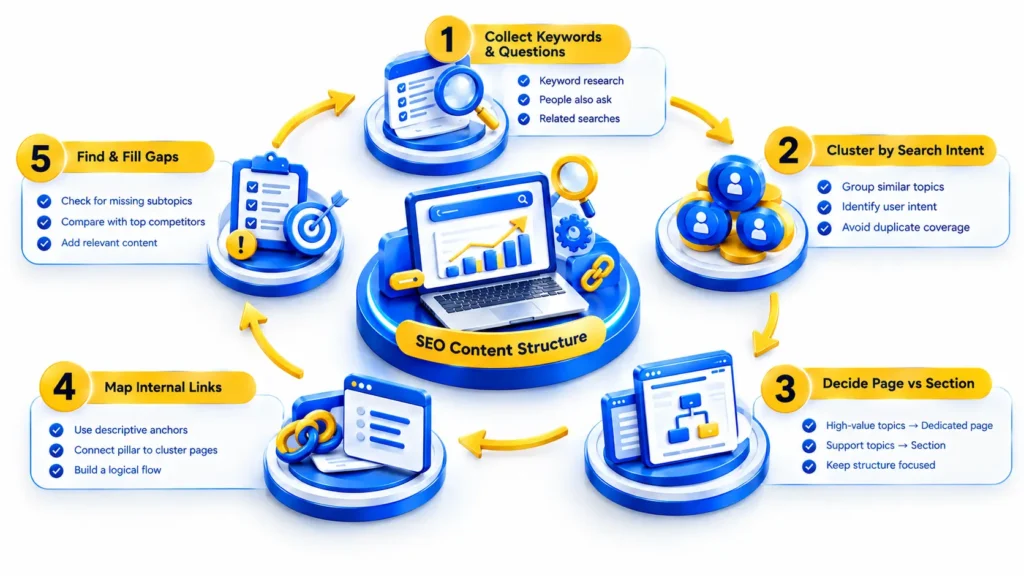
- Collect a broad set of keywords and questions related to the central topic
- Use clustering tools to group them by shared intent rather than exact wording
- Identify which grouped topics deserve their own dedicated page versus a section within an existing page
- Map internal links between the pillar page and each cluster page using descriptive anchor text
- Review the finished structure for gaps where a relevant subtopic has no dedicated coverage
This process removes much of the guesswork involved in traditional keyword research, where overlapping terms often led to duplicate or competing pages targeting the same intent.
Who Benefits From This Approach
Businesses across many industries gain from applying AI-driven clustering to their content strategy. E-commerce brands can organize product and category pages around buyer intent rather than individual product names. Edtech companies can structure course-related content around learner questions at different stages of decision-making. Health clinics can build authority around specific conditions and treatments by covering related concerns in a connected structure.
A digital marketing agency in Kerala working with clients across these sectors would typically start by auditing existing content to identify where clusters already exist informally, then reorganize that content around clearer pillar and subtopic relationships. Dotcom Creativez applies this kind of structured approach when planning content strategies for clients across SEO, content, and design services, using clustering as a starting point rather than a one-time exercise.
How to Implement Semantic Keyword Grouping in Practice
Implementation starts with data collection. Search console data, competitor content, and keyword research tools provide the raw material for identifying what a target audience searches for. From there, clustering software or language models group these terms by shared meaning rather than surface-level similarity.
Once grouped, each cluster becomes a content brief. The brief should outline the primary question the page answers, the related subtopics it should touch on, and the internal links it should include. Writers then produce content that answers the core question directly within the first few sentences of each section, since answer engines tend to prioritize content structured this way.
👉 Find the Right Keywords with AI – Start Mapping Search Intent Today
Reviewing performance after publication matters as much as the initial build. Search intent shifts over time, and a cluster that performed well a year ago may need new subtopics added as user questions evolve.
Common Mistakes to Avoid
Several recurring issues weaken topic cluster strategies even when the initial research is solid.
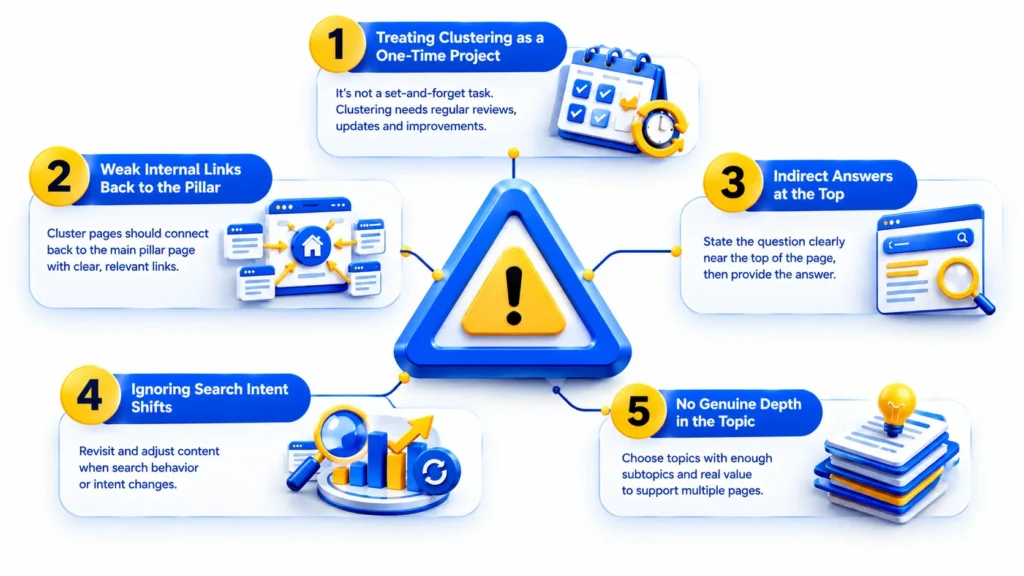
- Treating clustering as a one-time project instead of an ongoing process
- Creating cluster pages without meaningful internal links back to the pillar
- Writing content that answers a question indirectly instead of stating it clearly near the top of the page
- Ignoring search intent shifts that occur after a cluster is published
- Building clusters around topics with no genuine depth to support multiple pages
Avoiding these issues keeps a topic cluster useful for both readers and search engines over time, rather than becoming a structure that looks organized but fails to perform.
Frequently Asked Questions
What is the difference between a topic cluster and a content silo?
A topic cluster and a content silo describe closely related structures. Both organize content around a central subject with supporting pages, though a silo often refers to a stricter, more isolated grouping, while a cluster typically allows more flexible internal linking across the site.
Can AI tools fully automate semantic keyword grouping?
AI tools can automate much of the grouping process by analyzing search intent and language patterns, but human review remains necessary to confirm that grouped terms genuinely serve the same audience need and to decide which subtopics deserve dedicated pages.
How many pages should a topic cluster include?
There is no fixed number. A cluster should include enough pages to cover the meaningful subtopics within a subject without creating pages that lack sufficient depth or overlap too closely with existing content.
Does semantic keyword grouping replace traditional keyword research?
It builds on traditional keyword research rather than replacing it. Keyword data still identifies what people search for, while semantic grouping organizes that data into a structure that reflects how those searches relate to one another.
How does this approach help with answer engines like AI search tools?
Content organized around clear questions and direct answers is easier for answer engines to extract and present, since these systems favor content that states its point clearly rather than requiring readers to infer meaning from lengthy paragraphs.
Conclusion
AI-Generated Topic Clusters and Semantic Keyword Grouping for SEO give businesses a structured way to build genuine topical authority rather than chasing isolated rankings. By organizing content around intent, reinforcing entity relationships, and maintaining clear internal linking, a website becomes easier for both search engines and readers to understand. Dotcom Creativez uses this structured, intent-driven approach when building content strategies that aim for long-term search visibility rather than short-term keyword wins.