

A digital marketing plan is a written roadmap that connects a business’s goals to the online channels it uses to reach customers. Instead of posting on social media occasionally or running the odd Google ad, a proper plan ties every activity to a measurable outcome, whether that’s footfall, phone calls, or online orders. For a Thrissur business competing against both local rivals and larger regional players, this structure separates steady, compounding growth from scattered effort that rarely shows results.
This guide breaks down exactly how to build one, covering goal-setting, audience research, channel selection, budgeting, local search, and measurement, with a Thrissur-specific lens throughout.
What a Digital Marketing Plan Actually Covers
At its core, a digital marketing plan answers five questions: what the business wants to achieve, why those goals matter now, when to act, who is responsible, and how the work gets done. Skipping any one of these usually leads to campaigns that look busy but produce little revenue.
For a business in Thrissur, this typically means combining local SEO, a well-maintained Google Business Profile, social media marketing, targeted paid advertising, and content that speaks directly to the district’s customers. A plan doesn’t need to be complicated to be effective. It needs to be specific enough that anyone on the team can look at it and know what to do next.
When to Build or Revisit a Marketing Plan
New businesses should build a plan before spending a rupee on ads or SEO, since undirected spending is the fastest way to burn a budget without learning anything useful. Established businesses should revisit their plan at least twice a year, and sooner if sales patterns shift, a new competitor enters the market, or a major algorithm update changes how Google Search or Google Business Profile results are ranked.
Seasonal businesses, such as those tied to Onam, wedding season, or the academic calendar for edtech and coaching centers, benefit from a quarterly review so campaigns can be adjusted before demand peaks rather than after it passes.
Who Should Own the Plan Internally
Ownership matters more than most small businesses realize. A single accountable person, whether that’s the founder, a marketing manager, or an external SEO expert, should hold responsibility for the plan even if execution is split across a team or an agency. Without one owner, tasks fall through gaps, budgets go unspent, and nobody notices when a campaign underperforms for months.
For larger organizations, a marketing lead can delegate execution to specialists in SEO, content, and paid media while retaining oversight of the overall strategy and budget.
How to Create a Digital Marketing Plan: Step by Step
Step 1: Set Clear, Measurable Goals
Vague goals like “get more customers” don’t translate into action. Effective goals specify a number, a timeframe, and a channel, such as increasing organic website traffic by 40 percent in six months or generating 25 qualified leads per month through Google Business Profile. Health clinics might track appointment bookings, while e-commerce stores track completed checkouts, so the goal should match the actual business model rather than a generic template.
Step 2: Research Your Audience and Local Entities
Before choosing channels, define who the customer actually is. This includes demographics, but also intent: is the person searching to compare options, or ready to buy today? Local businesses should map out the specific areas within and around Thrissur they serve, since a customer searching from Ollur behaves differently than one searching from the town center. Mapping entities, meaning the specific services, neighborhoods, and related terms customers associate with the business, strengthens both SEO and paid targeting.
Step 3: Choose the Right Channels
Not every business needs every channel. A dental clinic in Kochi or Thrissur typically gets strong returns from local SEO and Google Business Profile, since patients search with immediate intent. An edtech company or study-abroad consultancy often benefits more from content marketing and paid search, since prospective students research extensively before committing. Common channel combinations include:
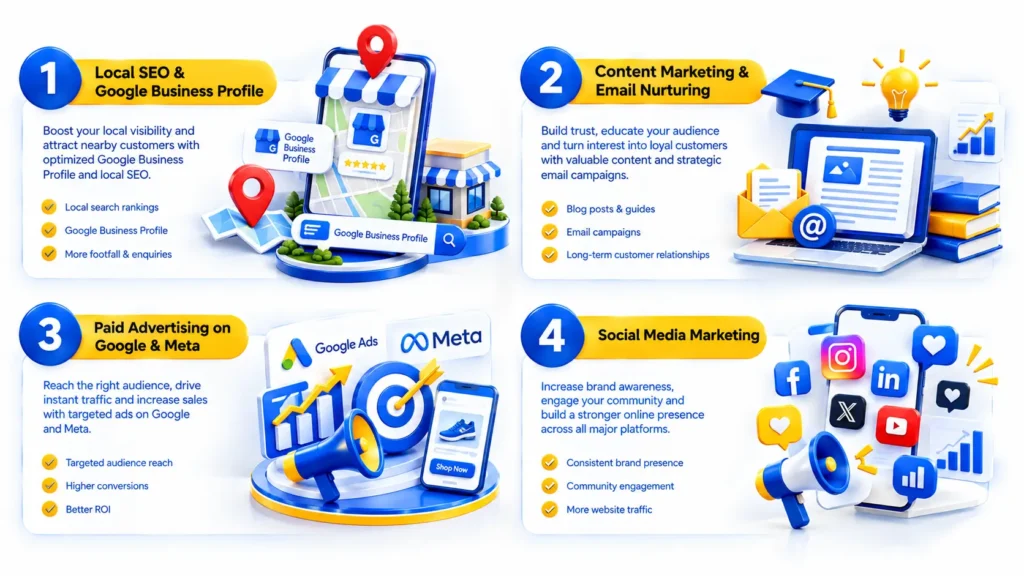
- Local SEO paired with Google Business Profile optimization for service businesses with a physical location
- Content marketing and email nurturing for education, coaching, and consultancy businesses
- Paid advertising on Google and Meta for e-commerce and time-sensitive promotions
- Social media marketing for brand visibility and community engagement across most business types
Step 4: Build Local SEO Foundations Specific to Thrissur
Local SEO deserves its own line item in any plan for a Thrissur business, since most local searches happen on mobile devices with immediate buying intent. This includes claiming and fully completing a Google Business Profile listing, gathering genuine customer reviews, ensuring the business name, address, and phone number match exactly across every online directory, and creating location-specific content that mentions nearby landmarks, neighborhoods, or service areas naturally rather than stuffing them in. Reviewing Google’s own guidance on optimizing a Business Profile is a useful starting point before making changes.
Step 5: Set a Realistic Marketing Budget
Marketing budget allocation should follow priority, not equal division. A common starting approach for small and mid-sized Thrissur businesses is directing a larger share toward the channel already showing traction, whether that’s SEO, paid ads, or social media, while testing smaller amounts in a second channel. Businesses new to digital marketing often benefit from starting with organic SEO and Google Business Profile, since these carry no direct ad spend, before layering in paid campaigns once conversion tracking is in place.
Step 6: Define KPIs and Set Up Measurement
Every channel needs a small set of key performance indicators tied back to the original goals. Typical KPIs include organic traffic growth, keyword rankings for locally relevant terms, click-through rate, cost per lead, and conversion rate. Setting up Google Search Console and Google Analytics before launching any campaign makes it possible to track these numbers accurately from day one rather than guessing retroactively.
Common Mistakes Thrissur Businesses Make
Several patterns show up repeatedly among businesses that struggle to see results from their marketing spend:
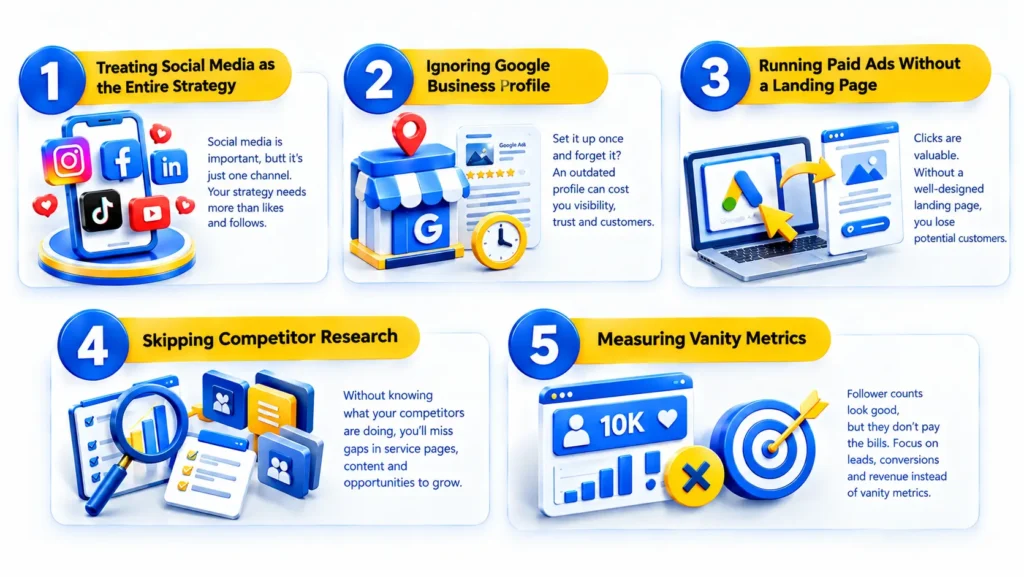
- Treating social media as the entire strategy instead of one channel among several
- Ignoring Google Business Profile after the initial setup, leaving it outdated for months
- Running paid ads without a landing page built for conversion, wasting the click
- Skipping competitor research, which leaves gaps in service pages and content untouched
- Measuring vanity metrics like follower counts instead of leads or revenue
A structured customer acquisition strategy avoids most of these by defining what success looks like before spending begins, and by reviewing performance data on a fixed schedule rather than only when sales slow down. Dotcom Creativez has worked with clinics, edtech firms, and retail brands across Kerala to correct exactly these gaps through a documented, revisited marketing plan rather than one-off campaigns.
Frequently Asked Questions
What is included in a digital marketing plan?
A complete plan includes defined goals, audience and entity research, selected channels such as SEO and paid advertising, a budget allocation, a content calendar, and a measurement framework with clear KPIs.
How much should a small business in Thrissur spend on digital marketing?
Spending varies by industry and goals, but many small businesses start with 5 to 10 percent of revenue, prioritizing organic channels like local SEO before adding paid advertising once tracking systems are in place.
How long does it take to see results from a digital marketing plan?
Paid advertising can show results within weeks, while local SEO and content marketing typically take three to six months to produce meaningful, compounding traffic and lead growth.
Do I need a Google Business Profile if I already have a website?
Yes. A Google Business Profile appears directly in local search results and Google Maps, often before a user ever clicks through to a website, making it essential for any business serving a local area like Thrissur.
Who should manage my digital marketing plan, an in-house team or an agency?
This depends on internal capacity and expertise. Businesses without a dedicated marketing hire often see faster, more consistent execution by working with an established local agency rather than splitting the work across untrained staff.
What makes local SEO different from regular SEO?
Local SEO focuses on ranking for searches tied to a specific geographic area, relying heavily on Google Business Profile signals, local citations, and location-specific content, whereas general SEO targets broader, non-location-based search intent.
Conclusion
Building a digital marketing plan is less about following a rigid formula and more about matching the right channels, budget, and measurement systems to a business’s actual goals and customer behavior. A Thrissur business that documents its plan, assigns clear ownership, and reviews performance on a fixed schedule puts itself well ahead of competitors still marketing reactively. For businesses looking for structured, results-driven support, Dotcom Creativez has built a reputation as the best digital marketing agency in Thrissur for exactly this kind of methodical, locally grounded approach.