
Marketing teams that once spent days drafting a single email sequence now generate working copy, product descriptions, and ad variations in minutes, then spend remaining hours refining tone and strategy instead of typing from scratch. That shift did not happen because software got faster. It happened because generative models learned to produce coherent, context aware text, images, and video on demand, changing what a marketing department can produce with the same headcount and budget it had two years ago.
This article explains what Generative AI in Digital Marketing means in practical terms, how it differs from older automation, where different-sized businesses are applying it, and what limitations still need human judgment. Sectors from e-commerce to health clinics face different tradeoffs, covered in the sections below.
What Does Generative AI Actually Mean for Marketers?
Generative AI refers to systems trained on large volumes of text, images, or video that produce new, original output rather than simply retrieving existing data. In a marketing context, this means a system can draft an ad headline, design a product image, or write a customer email from a prompt, rather than pulling from a fixed template library.
The underlying technology usually involves large language models for text and diffusion models for images and video, which learn statistical patterns in language and visual composition and apply them to new requests. A marketer describes tone, audience, and goal, and the model produces a draft that fits closely enough to serve as a working starting point.
How Is This Different From Older Marketing Automation?
Traditional marketing automation follows rules a human has already written. If a customer abandons a cart, the system sends email A after two hours and email B after two days, always using the same wording. Generative tools instead create the wording itself, adapting language to the customer segment or campaign context without a human writing every variant in advance.
Rule-based automation scales execution, while generative systems scale content production. A CRM platform still decides who receives a message and when, but the message itself can now be produced dynamically rather than selected from a small set of pre-written options.
Where Businesses Are Already Using Generative AI in Marketing
Adoption is broad because these tools apply to almost every stage of a marketing funnel, including:
- Ad copy variations for search and social platforms, generated in batches for testing
- Product descriptions for large e-commerce catalogs where manual writing does not scale
- Email subject lines and body copy tailored to specific customer segments
- Social media captions and content calendars drafted from a single campaign brief
- Image and short video generation for product mockups and social creative
- Conversational chatbots that handle routine questions before a human agent steps in
- Personalized on-site content that shifts with browsing behavior
- Predictive analytics that flag which customers are likely to churn or convert
- SEO content assistance for outlines, meta descriptions, and topic research
- Campaign optimization suggestions based on real-time performance data
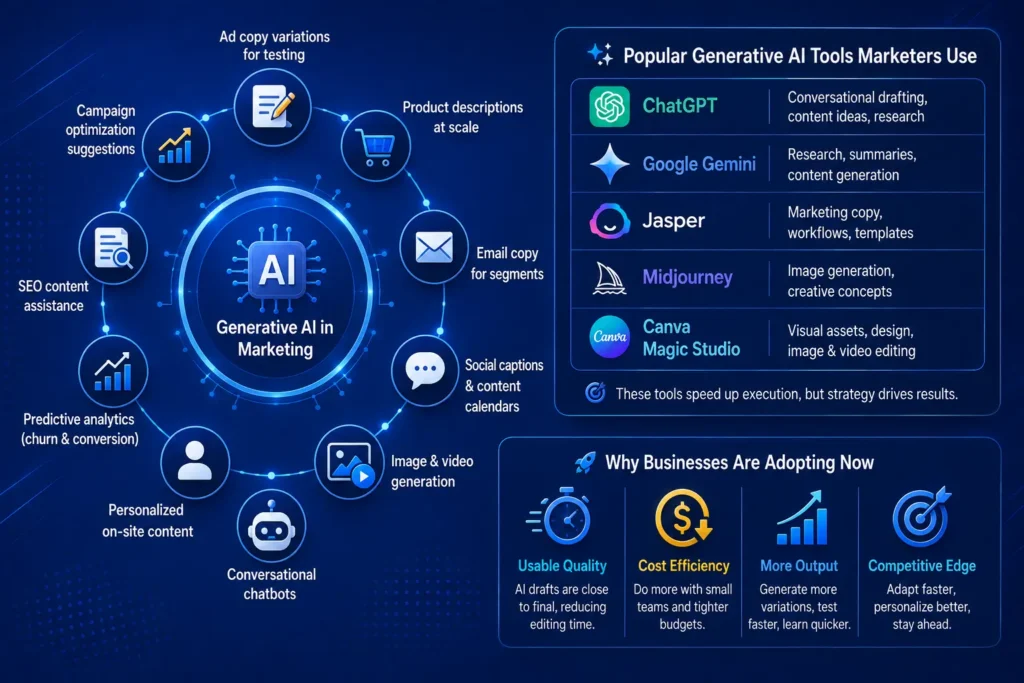
Named tools illustrate how varied this space has become. ChatGPT and Google Gemini handle conversational drafting and research summaries, Jasper focuses on marketing copy workflows, and Midjourney and Canva Magic Studio generate and edit visual assets. None of these tools replace a marketing strategy, but each removes a production bottleneck that used to require a dedicated specialist.
Why Are Businesses Adopting These Tools Now Rather Than Later?
Adoption accelerated because output quality crossed a threshold where a first draft became genuinely usable rather than something needing a full rewrite. Earlier AI writing tools produced text that sounded stilted or generic, so teams still did most of the actual writing themselves. Current large language models produce drafts close enough to final copy that editing time drops sharply.
Budget pressure plays a role too. Small teams facing rising ad costs and shrinking organic reach need more content variations without proportionally increasing staff, and generative tools address that constraint directly.
How Different Business Types Are Applying Generative AI
The value generative tools deliver looks different depending on business size and sector.
E-commerce brands use it primarily for catalog scale, generating consistent product descriptions across thousands of SKUs and testing multiple ad headline variants at once. Small businesses benefit most from the removal of a specialist hiring requirement, since a single owner can now produce social content and email campaigns that previously needed a dedicated copywriter. Medium businesses tend to combine generative tools with existing marketing automation platforms, filling content gaps inside workflows that were already partially automated.
Large enterprises face a different challenge, maintaining brand voice consistency across dozens of regional teams, which requires custom-trained prompts and internal style guides rather than default tool settings. Edtech companies apply generative AI to produce course marketing copy and personalized learning-path recommendations at a pace matching their release cycles. Health clinics use it more cautiously, mainly for appointment reminders and general educational material, while keeping content touching diagnosis or treatment under direct clinical review.
Businesses without in-house marketing capacity increasingly look for outside support, and searching for the best digital marketing agency in Calicut has become a common step for companies wanting these tools implemented correctly rather than experimented with informally. An agency like Dotcom Creativez typically builds the prompt frameworks and review processes a business needs before scaling AI-generated content across a campaign calendar.
What Are the Real Limitations of Generative AI in Marketing?
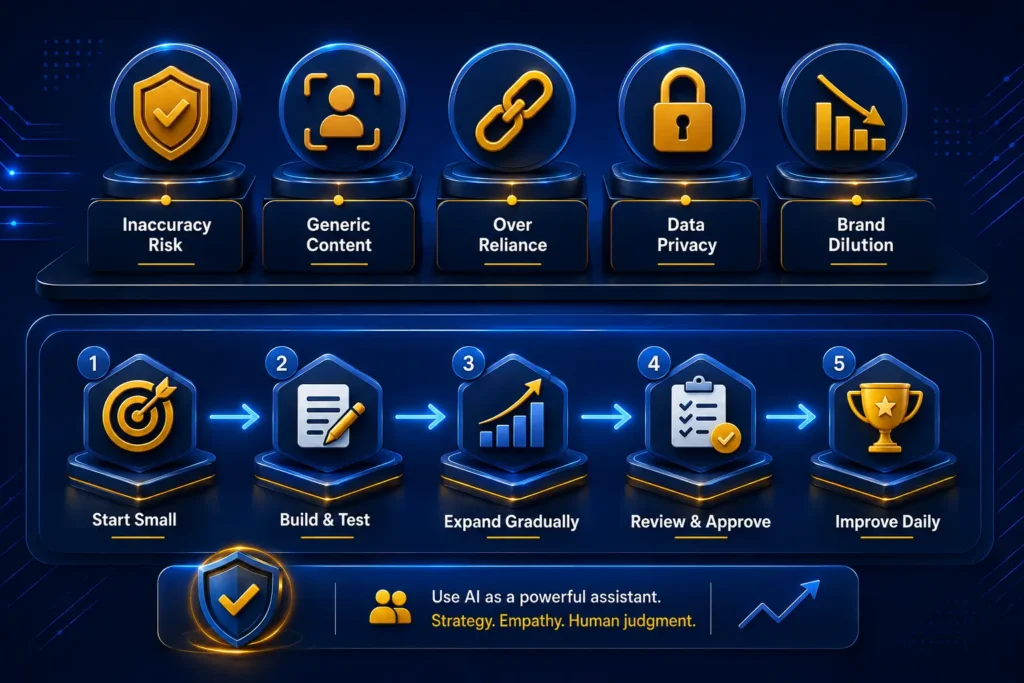
The most significant limitations involve accuracy, authenticity, and dependency rather than raw output quality. Generative models can produce factually incorrect statements with complete confidence, so every claim involving pricing, specifications, or regulatory information needs human verification before publishing.
Content authenticity is a related concern. Audiences increasingly notice when writing feels generic or interchangeable across brands, and tools trained on similar data can produce similar-sounding output unless a business actively customizes tone and structure. Over-reliance on automation creates a subtler risk, since teams that stop reviewing drafts carefully tend to publish inconsistent messaging as no model perfectly tracks a brand’s evolving positioning without ongoing correction.
Data privacy also matters more than it did with earlier software. Feeding customer data into external AI platforms without reviewing that platform’s data handling policy can create compliance exposure, particularly for health clinics and businesses handling regulated personal information.
How Should a Business Start Using Generative AI Responsibly?
A practical starting point involves choosing one narrow use case, such as product description drafting or social caption generation, rather than automating an entire content pipeline at once. This lets a team build internal review habits and prompt templates before expanding scope.
From there, businesses typically layer in a second tool for a different function, such as image generation once text workflows are stable, and establish a simple approval step so nothing publishes without a person confirming accuracy and tone. This staged approach avoids the common mistake of adopting several tools at once and losing track of what needs verification.
Where Generative AI in Digital Marketing Is Heading Through 2026
The clearest trend through the rest of 2026 involves tighter integration between generative tools and existing marketing infrastructure, including CRM systems and content management systems, rather than standalone AI tools working separately from core workflows. This reduces the manual copy-pasting currently required to move AI output into a live campaign.
Search behavior is also shifting as generative engines and AI Overviews summarize answers directly inside results, pushing SEO and content strategy toward clear, directly answerable writing rather than keyword-stuffed pages. Businesses that structure content around specific questions are positioned better for this shift than those still optimizing purely for traditional ranking factors.
None of this removes the need for marketing strategy or human judgment. Predictive marketing AI can flag patterns in customer behavior, but deciding what those patterns mean for a brand still requires someone who understands the business itself. A firm such as Dotcom Creativez fits into this landscape by pairing AI-assisted production with the strategic decisions these tools cannot make alone.
Frequently Asked Questions
What is generative AI in digital marketing used for?
It produces marketing content such as ad copy, product descriptions, email campaigns, social posts, and images from a written prompt, instead of pulling from fixed templates. It also supports predictive analytics and campaign optimization.
Is generative AI the same as marketing automation?
No. Marketing automation follows pre-set rules to send existing content at the right time, while generative AI creates new content dynamically. Many businesses use both, with automation handling delivery and generative tools handling creation.
Which generative AI tools do marketers commonly use?
Commonly used tools include ChatGPT and Google Gemini for text and research, Jasper for marketing copywriting, and Midjourney or Canva Magic Studio for image generation. Choice usually depends on whether the need is text, visuals, or conversational support.
Can small businesses benefit from generative AI marketing tools?
Yes, small businesses often see the largest relative benefit because these tools cut the need to hire dedicated specialists for copywriting or design. One person can manage output that previously required a small team.
Is AI-generated marketing content safe to publish without editing?
No. Content should never be published without human review, since generative models can produce inaccurate claims confidently. Checking for factual accuracy, brand voice, and compliance remains necessary regardless of output quality.
How is generative AI changing SEO content strategy?
It is shifting emphasis toward clear, directly answerable content because search engines and AI answer tools increasingly summarize information rather than only listing links. Content built around specific questions tends to perform better than content optimized purely for keyword density.
Do health clinics and regulated businesses need special caution with generative AI?
Yes. Content touching diagnosis, treatment, or regulated claims needs direct professional review, and patient data should never enter external AI tools without confirming the platform’s data handling and compliance policies.