

AI-Powered Campaign Bidding and Budget Optimization refers to the machine learning systems inside Google Ads and Meta Ads that set bids and shift spend automatically based on real-time signals. Instead of a marketer manually adjusting bids for each keyword or audience segment, the algorithm predicts which impressions are likely to convert and allocates budget accordingly. This article explains what these systems measure, how the learning phase works, and where human oversight still matters.
What AI Bidding Actually Optimizes For
AI bidding optimizes for the probability and predicted value of a conversion, not simply for clicks or impressions. Every automated strategy, whether it runs on target return on ad spend or target cost per acquisition, works backward from a defined business outcome. The algorithm searches for the combination of audience, placement, and timing most likely to produce that outcome at the lowest achievable cost.
Marketers sometimes assume the system chases traffic volume. It actually chases conversion probability, weighted against the value assigned to that conversion inside the account.
How Google Performance Max and Meta Advantage+ Bidding Actually Work
Automated bidding engines evaluate dozens of signals before deciding how much to bid for a single opportunity. These signals include the search query, device type, geographic location, time of day, past interaction patterns, and first-party data supplied through conversion tracking. The system runs this information through a conversion model that estimates the probability of a valuable action, then sets a bid designed to capture that opportunity within the account’s target ROAS or CPA.
[Talk to a Paid Media Strategist About Your Bidding Setup]
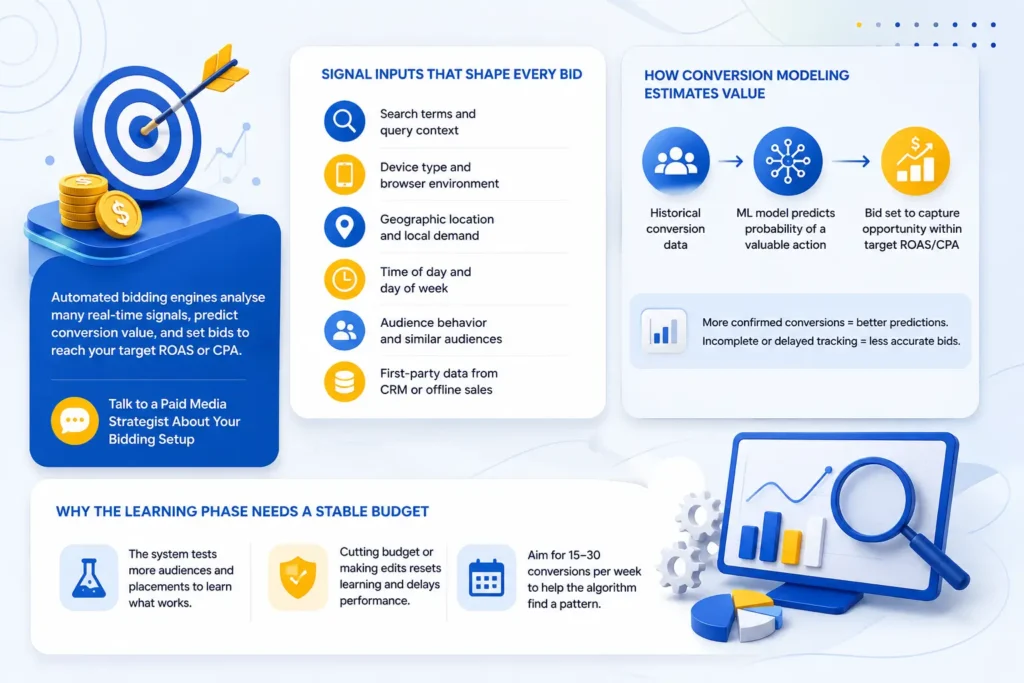
Signal Inputs That Shape Every Bid
Bid signals fall into a handful of recurring categories. Advertisers who understand these categories can diagnose bidding behavior instead of treating it as a black box.
- Search terms and the underlying query context
- Device type and browser environment
- Geographic location and local demand patterns
- Time of day and day of week
- Audience behavior, including remarketing and similar audience overlap
- First-party data from CRM systems, loyalty programs, or offline sales
Audience signals carry particular weight because they reflect intent the platform cannot infer from a single click. A visitor who abandoned checkout last week signals different value than a first-time visitor browsing a category page.
How Conversion Modeling Estimates Value
Conversion modeling assigns a probability score to each auction opportunity by comparing it against historical patterns of users who converted. Google Analytics and native platform pixels feed this model with the outcome data it needs to refine its predictions over time. When conversion tracking is incomplete or delayed, the model works with a weaker signal and produces less accurate bids.
Accuracy improves as the volume of confirmed conversions grows. Sparse data forces the algorithm to rely on broader patterns borrowed from similar advertisers, which explains why results often look inconsistent in the first few weeks.
Why the Learning Phase Needs a Stable Budget
A new or restructured campaign enters a learning phase because the algorithm has no account-specific conversion history yet. During this period, the system tests a wider range of audiences and placements than it will use once optimization stabilizes. Cutting the budget or editing the campaign mid-phase resets this process and delays reliable performance.
A realistic learning-phase budget should support enough conversions, generally in the range of fifteen to thirty per week, for the algorithm to detect a repeatable pattern. Businesses with lower conversion volume should extend the timeline rather than inflate the budget artificially.
AI Budget Allocation Across Channels: How Much to Trust the Algorithm
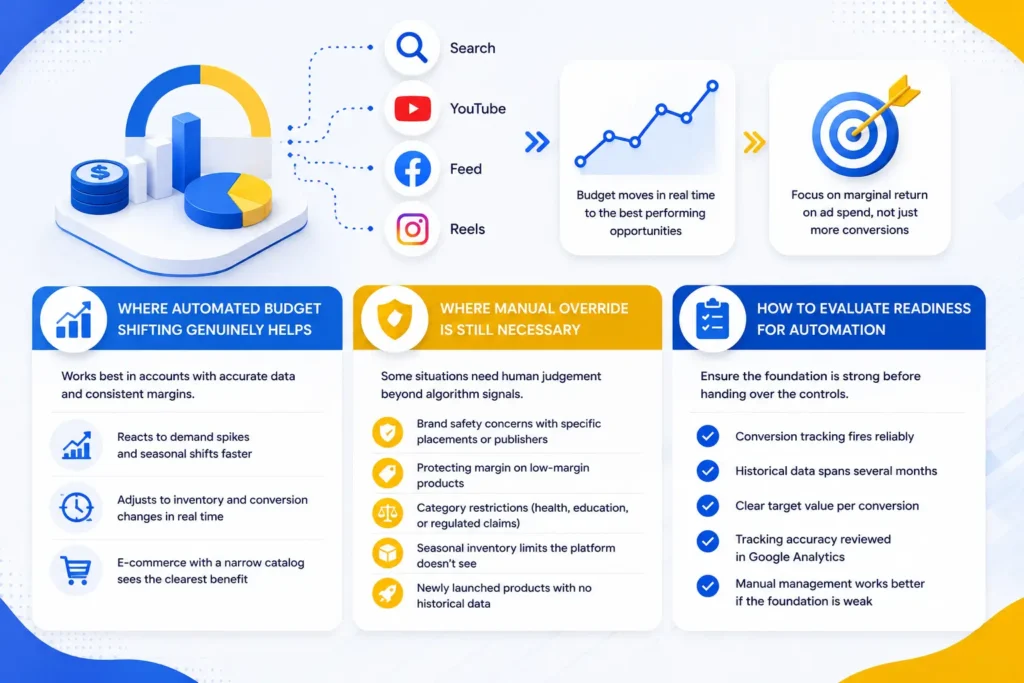
Cross-channel automation shifts spend toward whichever channel or placement shows the strongest real-time conversion signal, whether that means moving budget from Search to YouTube inside Performance Max or from Feed to Reels inside Advantage+. This reallocation happens continuously and often faster than a human could react. Marginal return on ad spend should guide how far advertisers let this shifting run, since the algorithm optimizes for the next incremental conversion, not for long-term brand or margin considerations.
Explore AI-Powered Performance Marketing
Where Automated Budget Shifting Genuinely Helps
Cross-channel shifting performs well in accounts with clean conversion data and consistent product margins. The algorithm reacts to demand spikes, seasonal shifts, and inventory-driven conversion changes faster than manual bid adjustments allow. E-commerce accounts selling a narrow catalog with predictable margins tend to see the clearest benefit.
Where Manual Override Is Still Necessary
Full automation cannot see everything a business cares about. Several situations still require a human decision layered on top of the algorithm.
- Brand safety concerns tied to specific placements or publishers
- Protecting margin on low-margin products the algorithm might over-prioritize
- Category-specific restrictions, such as regulated health or education claims
- Seasonal inventory limits the platform has no visibility into
- Newly launched products with no historical conversion data
Health clinics and edtech businesses in particular often need manual guardrails, since compliance requirements and enrollment cycles do not map cleanly onto generic conversion signals.
How to Evaluate Whether an Account Is Ready for Automation
An account qualifies for automated bidding when conversion tracking fires reliably, historical data spans several months, and the business has a clearly defined target value per conversion. Accounts still fixing tracking gaps or launching a first campaign usually perform better under manual management until that foundation exists. Reviewing tracking accuracy inside Google Analytics before switching bid strategies prevents the algorithm from optimizing toward flawed data.
The Role of First-Party Data in Bid Accuracy
First-party data, such as CRM records, purchase history, and loyalty program activity, gives the algorithm a clearer definition of what a valuable customer looks like. Uploading this data through offline conversion imports or Meta’s Conversions API narrows the gap between raw click data and actual business value. Advertisers who rely only on default pixel tracking give the algorithm a thinner picture of intent, which limits how precisely it can bid.
Common Reasons Advertisers Lose Visibility Under Full Automation
Full automation reduces the granular reporting available at the keyword or placement level, since Performance Max and Advantage+ consolidate reporting around broader asset groups. This tradeoff frustrates advertisers accustomed to line-item control. Search term reports, audience-level breakdowns, and placement exclusions become harder to access once a campaign moves fully into automated structures, which is one reason many businesses choose a hybrid approach that pairs automation with a dedicated best digital marketing agency in Kerala for ongoing account supervision.
Working with Dotcom Creativez gives businesses a layer of human review over automated systems, so budget decisions still reflect real margin and brand priorities rather than algorithmic assumptions alone. This kind of oversight matters most for accounts running multiple campaigns across Google and Meta simultaneously.
Practical Guidance on Setting Realistic Learning-Phase Budgets
Businesses evaluating automated bidding should calculate their current average weekly conversions before switching strategies. A daily budget calculated to reach fifteen to thirty conversions per week over the first two to three weeks gives the algorithm enough data to stabilize. Businesses searching for the best digital marketing agency in Thrissur to manage this transition should confirm the agency reviews conversion tracking accuracy before recommending any bid strategy change.
Frequently Asked Questions
What data does AI bidding actually use to make decisions?
AI bidding uses search terms, device and location data, time of day, audience behavior, and first-party data such as CRM or offline conversion records. The system combines these signals inside a conversion model that predicts the likelihood and value of each potential action.
How long does the learning phase typically take?
Most campaigns need one to two weeks to exit the learning phase, though accounts with lower conversion volume can take longer. The phase ends once the algorithm has enough confirmed conversions to detect a stable pattern.
Can businesses still control budgets with AI bidding enabled?
Yes, advertisers set the overall daily or campaign budget along with the target ROAS or CPA, and the algorithm distributes spend within those limits. Businesses cannot control which specific placement receives the budget on any given day.
Is AI bidding suitable for small budgets?
Small budgets can use automated bidding, but slower conversion volume extends the learning phase and produces less consistent early results. Businesses with very limited budgets often see steadier performance from manual bidding until conversion volume grows.
When should a business avoid full automation?
Full automation should wait until conversion tracking is verified and historical data exists to inform the model. Businesses in regulated categories, or those needing strict placement control for brand safety, should keep manual oversight even after automation is technically available.
Conclusion
Automated campaign bidding and cross-channel budget optimization genuinely improve efficiency once an account has clean data and a stable conversion history. The technology performs the calculations no human could match in real time, but it cannot see margin priorities, brand context, or category restrictions on its own. Businesses that pair this automation with informed oversight, such as the guided account management offered by Dotcom Creativez, get the efficiency of machine learning without handing over decisions the algorithm was never built to make.