
AI in Performance Marketing is changing how businesses plan, run, and measure paid campaigns across search, social, and display advertising. This article explains what the shift actually involves, how automated bidding, creative generation, and predictive targeting genuinely work together behind the scenes, and what business owners and marketing managers should weigh carefully before adopting these tools for their own advertising accounts and budgets.
What Changes When Machines Help Run Your Ads
Performance marketing has always depended on constant testing, measurement, and adjustment. Marketers watch click-through rates, cost per acquisition, and return on ad spend, then tweak bids and creatives to chase better numbers.
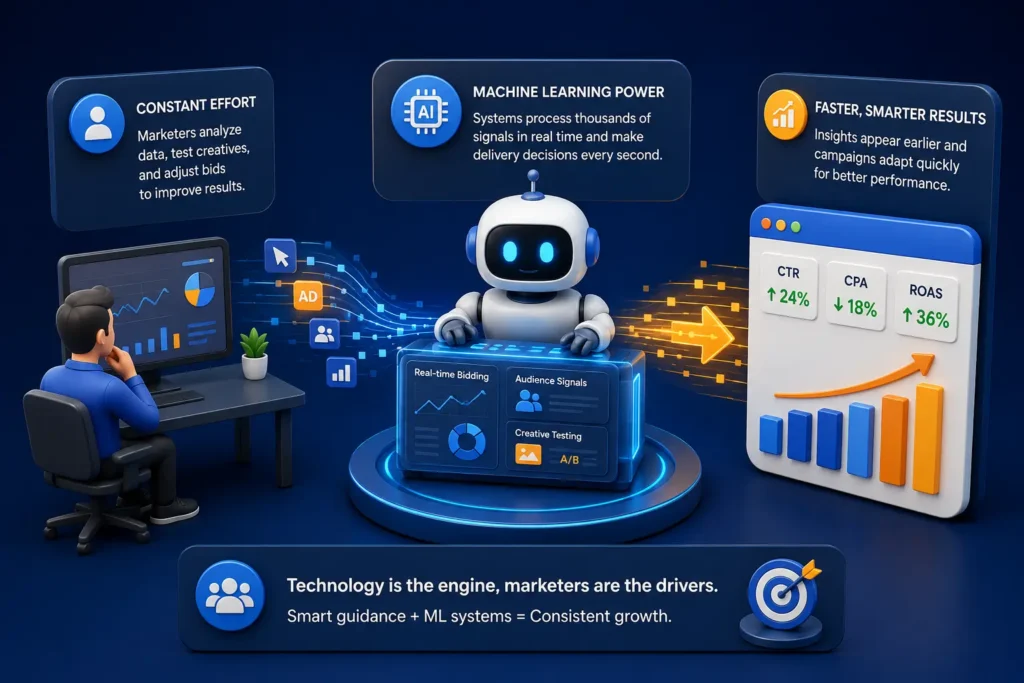
Machine learning systems now handle much of that repetitive analysis. They process signals from thousands of auctions per second, something a human strategist simply cannot replicate at the same speed or consistency across large accounts.
The result is not a replacement for marketing judgment but a faster feedback loop that surfaces patterns earlier than manual review ever could. Google Ads and Meta Ads both rely heavily on these systems already, using historical account data and real-time signals to shape delivery decisions moment by moment.
Marketers who understand how these models weigh signals can guide campaigns more effectively than those who simply switch on automation and walk away. Treating the technology as a collaborator rather than an autopilot tends to produce steadier, more predictable outcomes over a full quarter.
AI-Powered Campaign Bidding and Budget Optimization
Automated bidding systems evaluate device type, time of day, location, and past conversion behavior within milliseconds of an auction, then adjust bid amounts in response. Budget allocation shifts across campaigns and audiences based on which segments show the strongest signals for conversion, removing the guesswork behind manual bid adjustments. This reacts to market changes far quicker than checking dashboards once a day, improving efficiency across accounts with enough conversion volume.
Talk to a specialist about auditing your current bidding strategy before your next budget cycle.
Ready to Optimize Your Ad Budget with AI?
AI for Ad Creative and Copy Generation
Generative tools can produce dozens of headline, description, and image variations within minutes, then test combinations against live traffic to identify which ones perform best. This scale of testing would take a creative team weeks to replicate manually across ad sets and platforms. Human oversight still matters here, since brand tone, accuracy, and compliance checks require judgment that automated systems cannot fully replace on their own, especially in sensitive categories.
Explore how our creative team pairs AI-generated variations with brand-safe review before launch.
AI for Audience Targeting and Predictive Analytics
Predictive models analyze behavioral signals such as browsing patterns, past purchases, and engagement history to estimate which users are most likely to convert soon. This approach identifies intent-based similarities that simple demographic filters like age or location often miss across a large audience pool. Traditional segmentation groups people by broad categories, while predictive targeting groups them by likely future action, producing stronger match rates between ad spend and actual buyers.
Ask about building a predictive audience model tailored to your customer base.
The Role of First-Party Data in Better Results
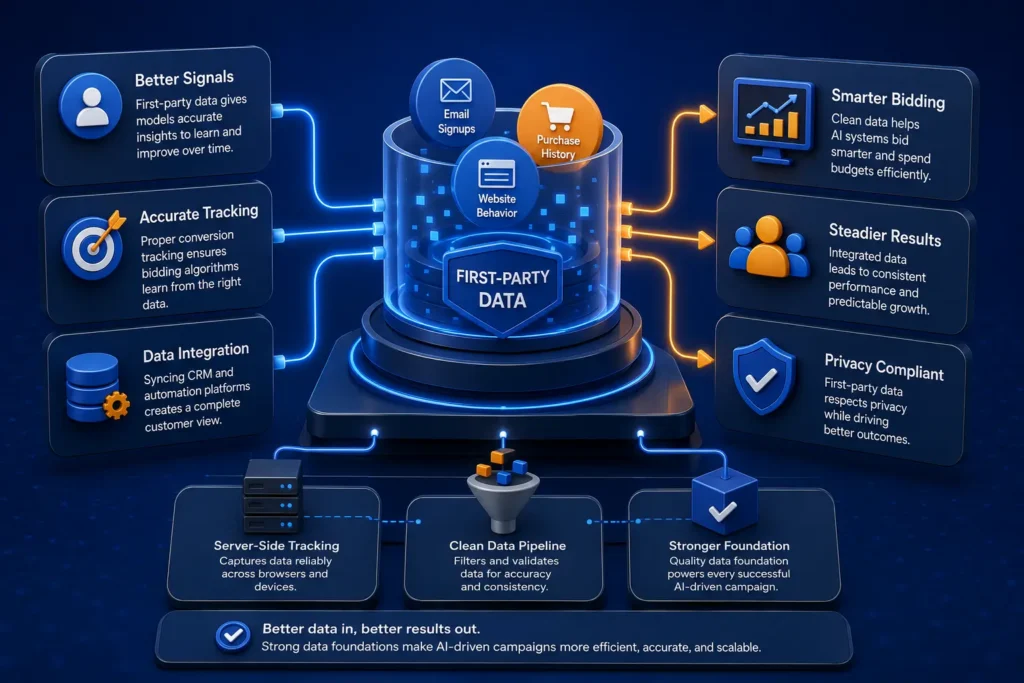
Privacy changes across browsers and platforms have made first-party data more valuable than ever for training these systems. Businesses that collect their own customer information through email signups, purchase history, and website behavior give their models cleaner signals to learn from over time.
Conversion tracking setup plays a direct role here too. Poorly configured tracking feeds inaccurate data into bidding algorithms, which can quietly waste ad budget for months before anyone notices the pattern. Marketing automation platforms that sync customer relationship data with ad accounts tend to produce steadier, more predictable results than accounts relying solely on platform-level tracking alone.
Agencies that help clients set up server-side tracking and clean data pipelines are, in effect, laying the groundwork that every AI-driven campaign depends on. Without that foundation, even the most advanced bidding model works with incomplete information.
How the Marketer’s Role Is Shifting, Not Disappearing
Automation handles execution tasks that used to consume hours of manual work, such as bid adjustments and basic A/B testing. That shift frees marketers to focus on strategy, offer positioning, and interpreting what the data actually means for the business.
Someone still needs to set goals, define what a qualified lead looks like, and catch when an algorithm optimizes toward the wrong outcome. A campaign can hit its target cost per click while attracting the wrong audience entirely, and only a person watching the bigger picture tends to catch that early.
Agencies that blend platform expertise with hands-on account management, rather than fully outsourcing decisions to software, generally deliver more consistent outcomes for clients. Businesses searching for the best digital marketing agency in Kerala often find that the strongest results come from teams who treat automation as a tool rather than a replacement for strategic thinking.
Common Misconceptions Worth Clearing Up
Many business owners assume that turning on automated bidding guarantees lower costs immediately. In reality, these systems need weeks of consistent conversion data before they start performing reliably, and switching settings too often resets that learning process from scratch.
Another common assumption treats AI-generated creative as a finished product rather than a starting point. Copy still needs a review for tone, accuracy, and legal compliance before it reaches a live audience, particularly in regulated industries like healthcare or education.
A third misconception assumes automation works the same way across every platform. Search auctions, social feeds, and programmatic display networks each weigh signals differently, so a strategy that performs well on one channel rarely transfers directly to another without adjustment.
A few practical points worth keeping in mind before scaling up automated campaigns:
- Conversion tracking must be accurate before bidding algorithms can learn properly
- Budgets need enough volume to give the model sufficient data to optimize against
- Creative testing works best with clear brand guidelines set in advance
- Predictive targeting improves as first-party data grows over time
Practical Considerations Before Adopting AI Marketing Tools
Not every business is ready to hand campaign decisions to an algorithm on day one. Accounts with low traffic or inconsistent conversion volume often see unstable results because the model never gathers enough data to learn reliably.
Choosing the right platform matters as much as the technology itself. Some marketing automation platforms specialize in bidding, others in creative testing, and few handle every layer of the funnel equally well, so matching the tool to the actual bottleneck saves time and budget.
Dotcom Creatives approaches this by starting with an account audit before recommending any automation layer, checking tracking accuracy and historical data quality first. That sequencing matters because automation built on flawed data tends to amplify the flaw rather than fix it.
Measuring Whether AI Campaigns Are Actually Working
Return on ad spend remains the clearest measure, but it should be viewed alongside cost per acquisition and lifetime customer value rather than in isolation. A campaign that lowers acquisition cost while attracting lower-value customers has not necessarily improved.
Comparing performance before and after automation adoption, using a consistent measurement window of at least four to six weeks, gives a clearer picture than judging results week to week. Short measurement windows often capture normal auction volatility rather than a genuine shift in performance.
Businesses evaluating these shifts often benefit from reading a broader resource such as Ready to Scale Your Digital Marketing with AI?, which covers how automation fits into wider marketing strategy beyond paid campaigns alone.
Frequently Asked Questions
Does AI in performance marketing replace the need for a marketing team?
No. It handles repetitive optimization tasks, but strategy, goal-setting, and creative judgment still require human direction and oversight.
How long does it take for automated bidding to start working well?
Most accounts need two to four weeks of steady conversion data before bidding algorithms stabilize and begin performing reliably.
Is AI-generated ad copy safe to publish without review?
No. It should always be checked for accuracy, brand tone, and compliance before going live, especially in regulated industries like healthcare.
What data does predictive targeting rely on?
It uses behavioral signals like browsing history, past purchases, and engagement patterns rather than only demographic details such as age or location.
Can small businesses benefit from these tools, or only large advertisers?
Small businesses can benefit too, though results depend on having enough conversion volume for the algorithms to learn from consistently over time.
Does switching automation settings frequently improve results faster?
No. Frequent changes reset the learning phase, so campaigns often perform better when settings are left stable for a few weeks at a time.
Final Thoughts
Automation has changed the mechanics of paid advertising, but it works best when paired with clear strategy, clean data, and someone watching the results with context. Businesses that treat these tools as an extension of good marketing practice, rather than a replacement for it, tend to see steadier growth over time.
Dotcom Creatives works with clients across e-commerce, education, and healthcare to combine automated optimization with hands-on account strategy, which is one reason clients continue to call it the best digital marketing agency in Thrissur for campaigns that need both technical precision and human oversight.