
This guide walks through what performance marketing services really cover, from paid search and paid social to affiliate and programmatic advertising. You will see how agencies price their work, how campaigns are measured against cost per acquisition and return on ad spend, and how to decide between hiring an agency or building a team in-house. By the end, you should be able to evaluate options with confidence and ask agencies the right questions before signing anything.
What Performance Marketing Services Actually Cover
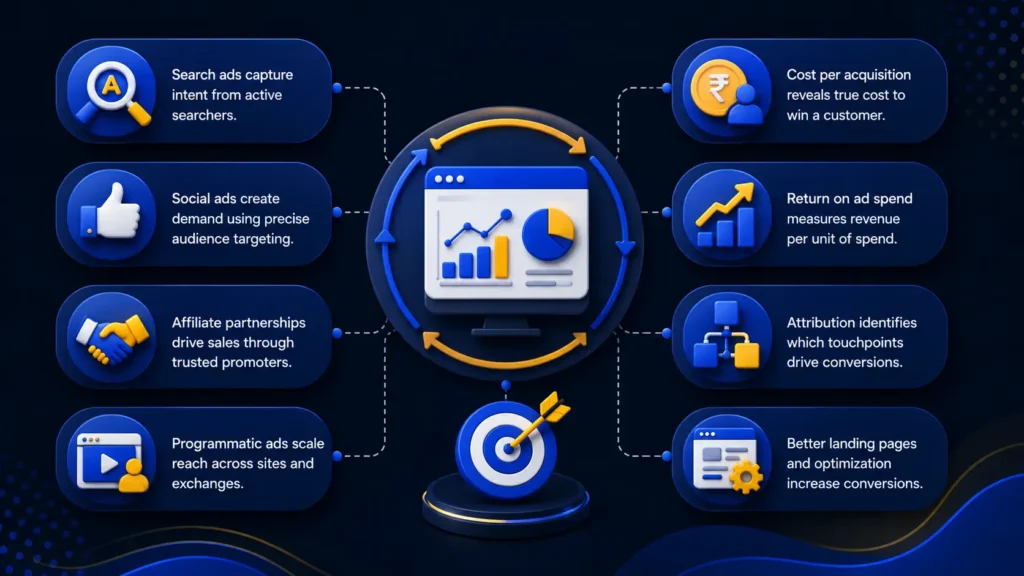
Performance marketing services combine several advertising channels under one measurable framework, where a business pays based on defined outcomes rather than fixed placement costs. Pay-per-click advertising through Google Ads sits at the center for many campaigns, since search intent is already high when someone types a query. Paid social campaigns on Meta Ads work differently, building demand through interruption-based targeting rather than capturing an existing search. Affiliate marketing and programmatic advertising round out the mix, letting brands scale reach across partner sites and ad exchanges without negotiating each placement manually.
Every channel gets tied back to a small set of numbers. Cost-per-acquisition tells a business what it actually spent to win one customer, and return on ad spend shows the revenue generated for every rupee or dollar put into a campaign. Attribution modeling then tries to work out which touchpoint, whether a search ad, a retargeting banner, or an organic post, gets credit for the eventual sale. Conversion rate optimization and landing page optimization decide whether that traffic actually converts once someone clicks.
Why Businesses of Every Size Are Shifting Toward Performance Marketing
E-commerce brands lean on performance marketing because purchase cycles are short and the data loop closes fast, letting a team see within days whether a campaign is profitable. Small businesses often start here because the spend can be scaled up or down weekly, which limits financial risk compared to a long-term brand campaign. Medium-sized companies tend to use it to fill gaps left by slower organic growth, running paid search alongside SEO while content and rankings mature. Large enterprises apply performance marketing at a different scale entirely, coordinating programmatic buys, retargeting pools, and multiple agencies across regions, where even small efficiency gains translate into significant budget savings.
How to Choose a Performance Marketing Agency
Picking the right partner matters more than picking the right channel, since a skilled team adjusts strategy as data comes in while a weak one repeats the same setup regardless of results.
What to Check Before Signing a Contract
Ask to see how a prospective agency reports results, not just what they claim to have achieved. A results-driven agency should be able to walk through a real dashboard, explain what CPA and ROAS looked like in a past account, and describe what changed between month one and month three. Reviewing case studies in a similar industry matters here, and checking how an agency ranks for something like best digital marketing agency in Thrissur can hint at whether they practice what they sell.
Red Flags to Watch For
- Vague answers about which platforms will actually run the ads
- Reluctance to share raw campaign data or dashboard access
- Pricing that has no connection to ad spend, scope, or deliverables
- Long-term contracts with no defined exit point
- Promises of guaranteed rankings or fixed return percentages
Performance Marketing Agency vs In-House
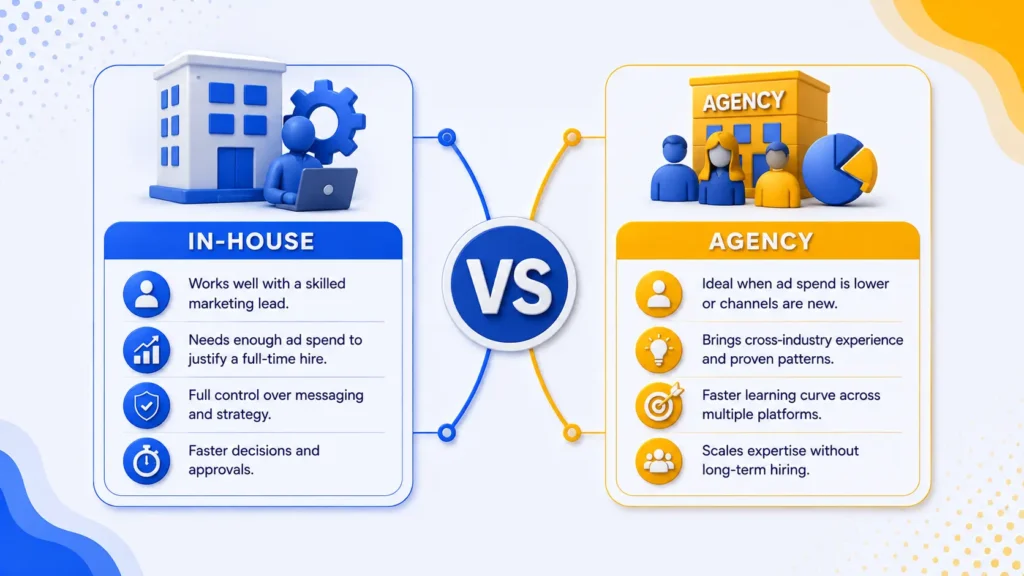
There is no universally correct answer here, and the decision usually comes down to budget size, internal skill, and how much control a business wants over daily execution.
When In-House Makes Sense
A company with a marketing lead who already understands paid media, and enough monthly ad spend to justify a dedicated hire, often benefits from building the function internally. Full control over messaging and faster approvals are the biggest advantages, since nothing has to pass through an external account manager.
When an Agency Makes Sense
Businesses without the ad spend to justify a full-time specialist, or those entering new channels for the first time, usually get more value from an agency. Agencies bring exposure across many accounts and industries, so patterns that took years to learn in-house are often already known on day one.
Performance Marketing Cost: What Businesses Should Expect
Pricing generally follows one of three structures. A percentage-of-ad-spend model charges a management fee calculated against monthly budget, which scales naturally as spend grows. A flat retainer keeps costs predictable regardless of budget size, which works well for businesses with a fixed monthly marketing allocation. Performance or commission-based pricing ties the agency’s fee to actual outcomes such as leads or sales, shifting more risk onto the agency itself.
What actually drives the number is industry competitiveness, the size of the monthly ad budget, and how many channels are being managed at once. A business running Google Ads alone will pay differently than one managing search, social, and affiliate campaigns together. Agencies that have built a reputation as the best digital marketing agency in Thrissur or in similar regional markets often price based on scope rather than a flat industry rate, so asking for a breakdown by channel is worth the conversation.
Getting the Most Out of a Performance Marketing Partnership
Results in the first month usually reflect testing rather than performance, since an agency needs time to find which audiences and keywords actually convert. By month three, budgets typically shift toward what the data has proven, and reporting should reflect that shift rather than repeating the same generic summary. Regular reporting cadence, whether weekly or biweekly, keeps both sides honest about what is working. An agency such as Dotcom Creativez treats this stage as a working relationship rather than a one-way report drop, which ties into the broader question of What Is Performance Marketing and How Does It Drive Measurable Growth? as channels and platforms keep shifting.
Frequently Asked Questions
What exactly counts as a performance marketing service?
It covers any paid advertising work billed or measured against defined outcomes, including PPC, paid social, affiliate marketing, and programmatic display, all tracked through metrics like CPA and ROAS rather than flat placement fees.
Is performance marketing suitable for a small or new business?
Yes, because budgets can start small and scale only once a campaign proves profitable, which limits financial exposure compared to traditional advertising formats that require a large upfront commitment.
How is performance marketing different from traditional digital marketing?
Traditional digital marketing often includes brand awareness work with no direct outcome tied to spend, while performance marketing ties every dollar to a measurable action such as a click, lead, or sale.
How soon can a business expect measurable results?
Early data usually appears within the first two to four weeks, though reliable performance patterns generally take a full budget testing cycle of six to eight weeks to emerge clearly.
Is it better to pay a percentage of ad spend or a flat fee?
Neither option is universally better; percentage-based pricing suits businesses with growing budgets, while a flat fee suits businesses that want predictable costs regardless of how much they spend on ads.
Can a business run performance marketing without hiring an agency?
Yes, though it requires someone with hands-on platform experience and enough time to manage testing, reporting, and optimization consistently, which is often the resource small teams lack.
Conclusion
Performance marketing services give a business a way to spend on advertising with a clear line back to results, whether that means leads, sales, or app installs. Choosing between an agency and an in-house team, and understanding how pricing models work, matters more than picking a single channel to focus on. Working with a team like Dotcom Creativez, or evaluating any partner against the same standards, comes down to transparency, realistic timelines, and a willingness to show the data behind every claim.