
Every plan to attract customers online eventually leads back to one place: the website. A strategy only pays off once it has a home where readers can find it, trust it, and act on it, and for most businesses that home is built on WordPress, the platform millions rely on to publish and manage what they create. This guide breaks down what that practice actually involves, why it matters, the formats it takes, and how a business gets started, all with that publishing reality in mind.
What Is Content Marketing?
Content marketing is the practice of creating and sharing useful, relevant material to attract a specific audience and guide them toward a business relationship, rather than interrupting them with direct advertising. It works by answering questions, solving problems, or entertaining a reader first, then earning trust that eventually converts into inquiries, sales, or loyalty.
Unlike a paid ad that disappears the moment a budget runs out, a well-built piece of content keeps working. A blog post can rank in search engines for years, a video can circulate long after it was filmed, and an email series can nurture new subscribers automatically. This compounding effect is what separates the approach from most other forms of promotion.
Why Content Marketing Matters for Business Growth
Businesses invest in this approach because it changes how customers discover, evaluate, and choose a brand. Instead of chasing attention through constant ad spend, a company builds a library of material that keeps generating organic reach long after publication.
Several outcomes make this worth the effort:
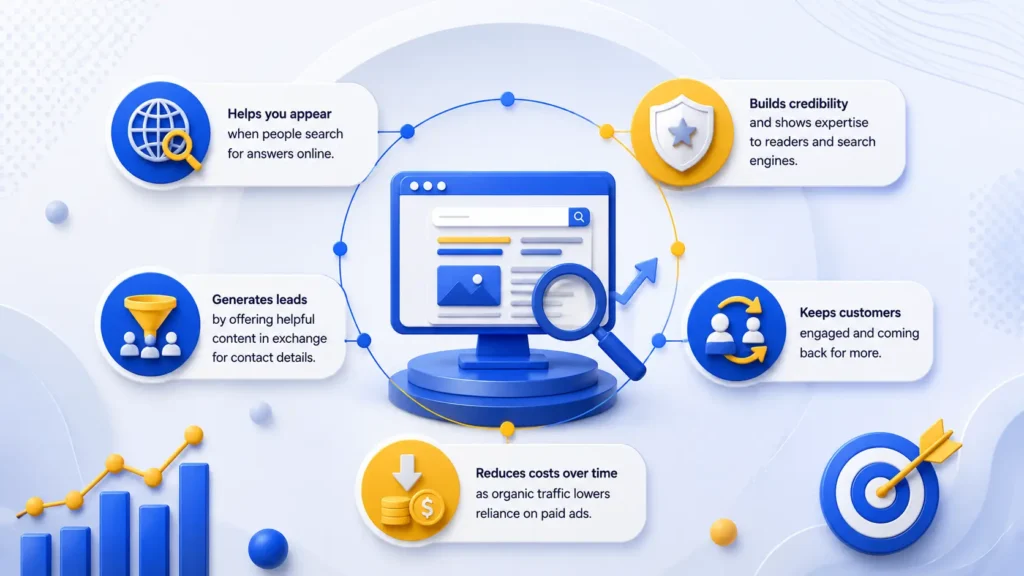
- Visibility in search engines. Well-structured, keyword-relevant pages help a business appear when potential customers are actively searching for answers.
- Trust and authority. Publishing accurate, well-reasoned material signals real expertise, which matters to both readers and search algorithms.
- Lead generation. Guides, comparisons, and how-to content give prospects a reason to share contact details in exchange for deeper value.
- Customer retention. Ongoing, useful content keeps a brand relevant to people who already bought once, encouraging repeat business.
- Lower acquisition costs over time. Organic traffic from older content reduces reliance on paid channels for every new visitor.
Consider a small home appliance retailer that starts publishing straightforward repair and maintenance guides on its site. None of those guides directly sell a product, yet each one answers a real question a customer types into a search engine. Over months, that retailer becomes the source people trust before they buy a replacement part or a new unit.
Types of Content You Can Use
A strategy rarely relies on a single format. Different formats suit different stages of the customer journey and different audience preferences.
- Blog content, used to target specific search queries and build topical authority around a subject.
- Video, effective for demonstrations, tutorials, and building a more personal connection with viewers.
- Social content, shorter and more immediate, designed for engagement and shareability rather than deep explanation.
- Email content, used to nurture existing leads and subscribers with consistent, direct communication.
- Infographics, which simplify data-heavy or process-heavy topics into a visual format that spreads easily.
- Illustrative case-study style content, where a business walks through a generic, clearly labeled scenario to explain how a service or product solves a problem, without presenting it as a real client story.
Most businesses combine two or three of these rather than attempting all of them at once.
How to Build Your Strategy
A strategy needs structure before it needs volume. Publishing without direction wastes effort and rarely produces measurable results.
Understanding Your Audience
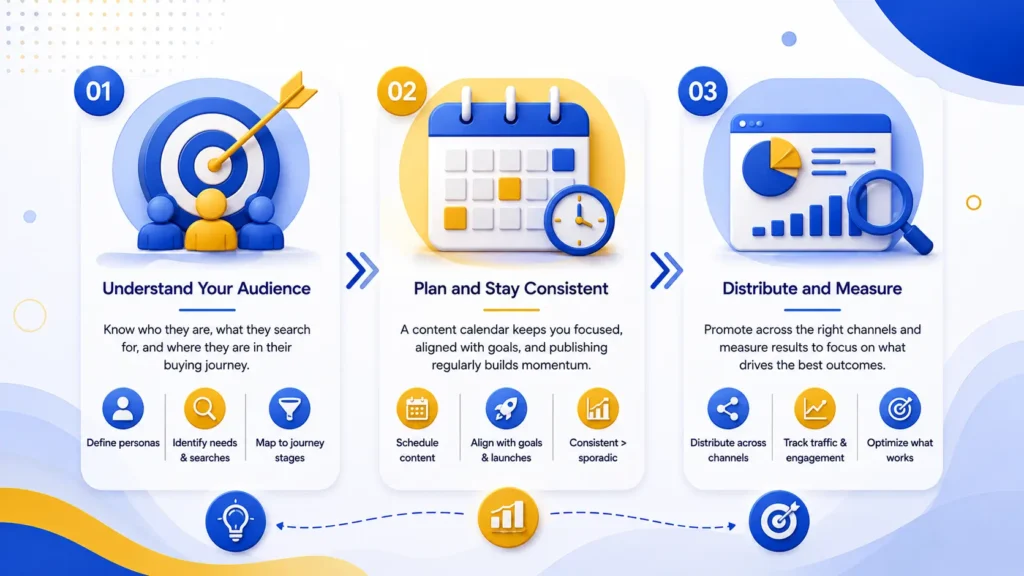
Every piece of content should be built around a defined audience persona: who they are, what they search for, and what stage of the customer journey they occupy. Content aimed at someone who has never heard of a category performs differently than content aimed at someone comparing two specific options.
Planning and Consistency
A content calendar keeps output predictable and aligned with business goals, seasonal demand, and product launches. Publishing consistently, even at a modest pace, tends to outperform sporadic bursts of activity followed by long gaps.
Distribution and Measurement
Creating valuable content is only half the strategy. Distribution through search engines, email, and social channels determines whether the right audience actually sees it. Tracking organic traffic, engagement, and conversion rates afterward shows which formats and topics deserve more investment.
Content and Your Website
None of this works without a technical foundation. A website has to load quickly, structure content clearly, and be easy for both readers and search engines to navigate, which is why WordPress remains a common choice for businesses that publish regularly. Its structure supports organized categories, clean URLs, and the kind of on-page SEO that supports long-term visibility.
Businesses that want a deeper look at how digital efforts connect to overall growth can refer to a related resource, Digital Marketing in 2026: The Key to Business Growth, which expands on how these pieces fit together beyond content alone.
For businesses in Kerala looking for hands-on support building and executing this kind of strategy, Dotcom Creativez works across SEO, web development, and content planning to help a website actually perform once the content is live. Companies searching for the best digital marketing agency in Kerala often need that combination of technical setup and consistent content output rather than either one alone.
Businesses based further north have similar needs, and the best digital marketing agency in Thrissur typically offers the same blend of website development and ongoing content support tailored to a smaller regional market.
Common Challenges Businesses Face
Most businesses run into a handful of recurring obstacles:
- Inconsistent publishing, where early enthusiasm fades once results take time to appear.
- Unclear audience targeting, which leads to content that reads well but attracts the wrong readers.
- Weak distribution, where good material never reaches enough people to matter.
- No measurement, making it impossible to know which content actually drives leads.
Addressing these usually means smaller, steadier output tied to a clear plan rather than occasional large pushes.
Frequently Asked Questions
What is the main goal of content marketing?
The main goal is to attract and retain a defined audience by providing genuinely useful material, which builds trust and eventually drives profitable customer action.
How long does it take to see results?
Most businesses start noticing measurable organic traffic and engagement within a few months of consistent publishing, though timelines vary by industry and competition.
Is this approach only for large businesses?
No. Small and medium businesses often benefit more directly, since they can target specific, less competitive topics that larger competitors overlook.
What is the difference between this approach and traditional advertising?
Advertising interrupts an audience to promote a product directly, while this approach earns attention by providing value first and building a relationship over time.
Do I need a blog to get started?
A blog is a common starting point because it directly supports search visibility, but video, email, and social content can all work alongside it or independently depending on the audience.
Conclusion
Businesses that treat content as a long-term asset, rather than a one-time campaign, tend to build the kind of visibility and trust that paid advertising alone cannot replicate. Getting there takes a clear audience, a consistent publishing plan, and a website built to support it. For businesses that want help putting these pieces together, Dotcom Creativez offers the strategy, development, and content execution needed to turn a website into a genuine growth channel.