
Every marketing rupee should prove what it brought back. That expectation sits at the centre of performance marketing, a model where brands pay for outcomes such as clicks, leads, or sales rather than hoping an advertisement worked. This guide explains how the approach functions, which channels power it, the numbers that matter most, and how to run campaigns that pay for themselves while keeping wasted budget to a minimum.
What Performance Marketing Actually Means
Performance marketing ties spending directly to results. Advertisers release payment only when a defined action occurs, such as a form submission, an app install, a purchase, or a phone call. Older advertising models ask you to buy space and hope attention follows. This approach flips that logic, letting you pay for the action itself instead of the exposure around it.
The word “performance” signals accountability above everything else. Platforms record each interaction, attribute it to its source, and report precisely what your money produced. A single sale can be traced back to the exact ad, keyword, and audience segment that triggered it, which removes most of the guesswork that once haunted marketing decisions.
How Performance Marketing Works Behind the Scenes
Three players usually shape any campaign: the advertiser chasing results, the platform or publisher displaying the ads, and the tracking technology recording what happens after a click. Once a visitor completes the target action, the system logs a conversion and charges the advertiser according to the pricing model agreed in advance.
Pricing bends to fit the goal. Campaigns may pay per click (PPC), per acquisition (CPA), per lead (CPL), or cost per thousand impressions (CPM) when reach carries more weight than an instant sale. Each model shifts financial risk to a different place and decides how tightly your spending connects to actual revenue.
Know about performance marketing services
The Core Channels That Power Performance Marketing
No single platform owns this space. Marketers blend several channels, each suited to a different moment in the buyer’s journey.
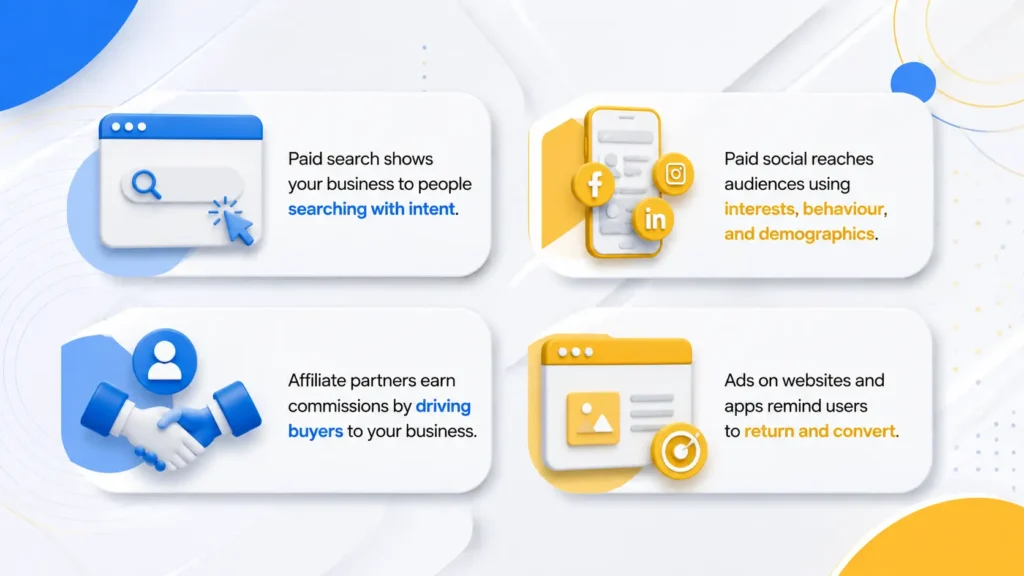
- Paid search puts your business in front of people actively typing what they need, catching intent at its sharpest point.
- Paid social uses networks like Instagram, Facebook, and LinkedIn to reach audiences by interest, behaviour, and demographic detail.
- Affiliate partnerships reward outside publishers who send buyers your way, spreading risk across a network of independent promoters.
- Display and native placements follow users across websites and apps, nudging them back toward a choice they nearly completed.
Blending these channels lets a brand meet prospects wherever their attention happens to sit online.
Metrics That Decide Whether a Campaign Succeeds
Numbers separate real strategy from expensive guessing. A handful of figures reveal quickly whether your money works or quietly leaks away.
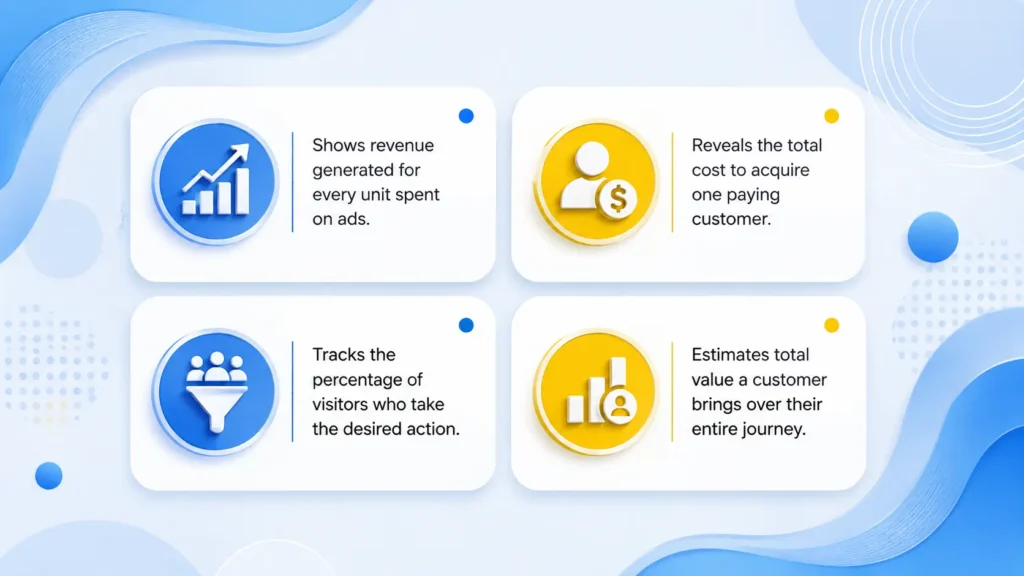
- Return on ad spend (ROAS) shows how much revenue every unit of spend produces.
- Cost per acquisition tells you what winning one customer actually costs.
- Conversion rate measures how many visitors complete the action you designed for.
- Customer lifetime value estimates a buyer’s total worth across the full relationship, not merely the first transaction.
Reading these together stops a familiar mistake: cheering cheap clicks that never mature into paying customers.
How Performance Marketing Differs From Brand Marketing
Brand marketing plants long-term recognition. It builds trust, shapes reputation, and keeps a name familiar, though its payoff resists exact measurement. Performance marketing pursues the opposite target, chasing immediate action you can count and trace.
Neither wins alone. A brand nobody recognises struggles to convert cold traffic, while pure awareness with no conversion path simply burns cash. Companies that grow steadily run both, using brand efforts to warm audiences that performance campaigns later convert into revenue.
Why Businesses Lean on This Model
Budget control pulls most companies in first. You set limits, monitor results as they arrive, and move money toward whatever performs best. A campaign that stops delivering can be paused within minutes rather than after a wasted quarter.
Scalability then seals the appeal. Once a channel returns more than it costs, you feed it further and grow output with real predictability. That clarity turns marketing from a gamble into a controllable engine, which explains why digital channels now sit at the core of most growth plans. Readers wanting the wider context can explore the guide titled “Why Digital Marketing Is Important for Business Growth in 2026 (A Complete Guide for Every Business),” which maps how these pieces connect.
Building a Performance Marketing Campaign Step by Step
Strong campaigns follow a rhythm, not luck. Begin with one measurable objective, whether leads, sales, or sign-ups, because vague goals only ever produce vague outcomes. Research your audience deeply enough to understand their problems, their language, and the triggers that move them to buy.
Design ads and landing pages that honour the same promise. A brilliant advertisement feeding a slow or confusing page throws away every click it earns. Launch small, collect data, then scale what proves itself while trimming whatever drags performance down.
Common Mistakes That Drain Budgets
Skilled teams still stumble over avoidable errors that quietly eat their spend.
- Chasing raw traffic instead of conversions fills dashboards with vanity numbers and empty sales pipelines.
- Neglecting the landing page sends warm visitors to a screen that kills their interest on arrival.
- Targeting too broadly spends money on people who were never going to buy anything.
- Judging results too soon, before enough data lands, kills winning campaigns and rewards losing ones.
Sidestepping these keeps budgets aimed at genuine growth rather than activity that only looks busy.
Choosing the Right Partner for Your Campaigns
Running these campaigns well demands strength across strategy, creative, analytics, and relentless testing. Plenty of businesses hand this work to specialists instead of stretching a small internal team past its limits.
A capable agency reads data honestly, adapts fast, and protects your profit rather than flattering surface metrics. Dotcom Creativez works with businesses that want every rupee tied to a clear outcome, and its standing as the best digital marketing agency in Kerala grows from that measurable discipline. Proximity helps when you value quick, hands-on collaboration, which is why many local brands search for the best digital marketing agency in Thrissur to keep their campaigns closely managed.
Where Performance Marketing Is Heading
Automation now handles bidding, targeting, and creative testing faster than any manual team could manage. Machine learning studies behaviour, predicts which users will convert, and reshapes campaigns while they run. Privacy shifts also push the field toward first-party data and cleaner consent, rewarding brands that gather their own audience insight instead of renting it.
The promise underneath stays fixed. Pay for results, measure everything, and improve without pause. Tools keep changing, yet that discipline holds its value across every trend.
Frequently Asked Questions
Is performance marketing only suitable for large companies?
Not at all. Smaller businesses often gain the most, since tight budgets demand accountable spending and this model shows exactly where each rupee travels.
How fast can performance marketing produce results?
Certain channels, paid search among them, can generate leads within days, though dependable patterns usually appear after a few weeks of data gathering and steady optimisation.
Can it succeed without a strong website or landing page?
Seldom. Ads merely open the journey, while a clear and fast page finishes it. Weak pages waste the very traffic you paid to attract.
Do performance marketing and SEO work well together?
They pair naturally. Paid campaigns deliver instant visibility, and organic search builds lasting, lower-cost traffic that compounds over months.
How much budget should a business begin with?
Enough to collect meaningful data without threatening survival. Starting modestly, learning what converts, then scaling beats gambling everything on one untested campaign.
Final Thoughts
Performance marketing rewards clarity above cleverness. When you fix your goal, track every action, and steer money toward what works, marketing stops feeling like a guessing game and starts running like a system you control. Brands that thrive treat each campaign as an experiment to refine, never a bill to settle and forget. Working with a team like Dotcom Creativez that shares this mindset turns patient testing into dependable, repeatable growth.