
Artificial Intelligence (AI) is no longer just a trendy term—it’s transforming how businesses advertise online. In Pay-Per-Click (PPC) marketing, especially through Google Ads, AI and machine learning are now the backbone of smart campaign optimization.
For digital marketers, entrepreneurs, and beginners, understanding this shift is crucial to staying ahead in a competitive online world.
In this blog, you’ll learn:
- What AI-driven PPC is
- How machine learning works in Google Ads
- Why it’s transforming campaigns
- Real-world success stories
- Practical tips to use AI effectively
What Is AI-Driven PPC?
PPC (Pay-Per-Click) advertising means advertisers pay each time someone clicks their ad. Google Ads is the largest PPC platform where businesses bid for placements in search results, YouTube videos, and partner websites.
Traditionally, marketers had to manually select keywords, set bids, and monitor performance. But with AI-driven PPC, machine learning takes control of optimization.
How It Works
- AI analyzes massive amounts of campaign data in real-time.
- It identifies audience behavior patterns, search intent, and conversion signals.
- Google Ads automatically adjusts bidding, targeting, and ad creatives for maximum performance.
Think of it as having a skilled assistant who constantly improves your ads—even while you sleep.
How Machine Learning Shapes Google Ads Campaigns
AI has revolutionized three key areas of PPC marketing:
Ad Targeting, Bidding Strategies, and Performance Analytics.
1. Smarter Ad Targeting
One of AI’s biggest strengths is its ability to reach the right audience without guesswork.
Instead of relying only on demographics, Google’s machine learning understands user intent—it predicts what people want even before they search.
How AI Improves Targeting
- Predictive Targeting: Uses browsing history to display ads to users likely to convert.
- Custom Audiences: Automatically built from patterns in your existing customer data.
- Dynamic Remarketing: Shows tailored ads to users who visited your site before.
- Lookalike Audiences: Find new users similar to your best-performing customers.
2. Intelligent Bidding Strategies
Bidding is at the core of PPC—it determines how often and where your ads appear.
Manual bidding can be inefficient, especially when ad auctions change in milliseconds.
Smart Bidding with AI
Machine learning evaluates multiple signals at once, including:
- Device type (mobile vs. desktop)
- Geographic location
- Time of day
- User intent and browsing history
- Predicted conversion probability
Smart Bidding Options in Google Ads
- Target CPA (Cost Per Acquisition): Sets bids to get as many conversions as possible at your desired cost.
- Target ROAS (Return on Ad Spend): Adjusts bids to maximize revenue based on your return goals.
- Maximize Conversions: Automatically uses your budget to get the highest number of conversions.
Result: Marketers spend budgets more wisely and reduce waste on unqualified clicks.
3. Real-Time Performance Analytics
Before AI, advertisers had to wait days or weeks to analyze campaign data.
Now, machine learning processes and acts on data instantly, offering:
- Automated dashboards that highlight trends and issues
- Real-time optimization suggestions for keywords and creatives
- Attribution modeling that tracks how users move through the buying journey
This allows advertisers to adapt faster and make data-driven decisions.
Benefits of AI-Driven PPC
Here are the top advantages summarized:
- Improved Efficiency – Automation saves time and effort.
- Better Accuracy – Targets audiences more precisely.
- Cost Savings – Reduces wasted ad spend.
- 24/7 Optimization – Campaigns improve continuously.
- Higher Conversions – Smarter targeting = more leads.
- Scalability – Easily manage multiple campaigns.
- Data-Driven Insights – Decisions based on facts, not assumptions.
Challenges of AI in PPC Advertising
AI isn’t perfect—automation comes with challenges.
Loss of Manual Control: Too much automation can limit human creativity.
Learning Phase Delays: AI needs time to collect data before performing well.
Data Privacy Concerns: AI relies on large datasets that must be compliant.
Budget Misalignment: Automated bidding may overspend without proper limits.
Over-Segmentation: Too-specific targeting can reduce reach.
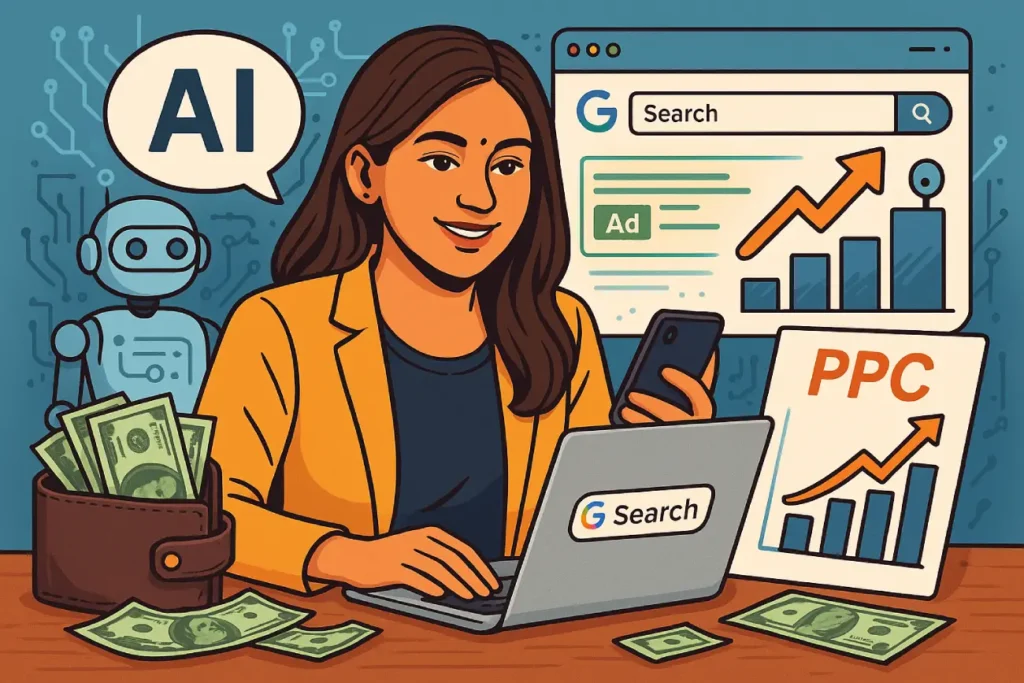
Real-World Examples of AI-Driven PPC Success
Example 1: E-commerce Brand Boosting Sales
An online fashion store used Google Smart Shopping campaigns powered by AI.
Results:
- Click-through rate increased by 35%
- ROAS improved from 4:1 to 6:1
- Bid and budget adjustments were fully automated
Example 2: Local Service Provider Increasing Leads
A home renovation business used Target CPA bidding and saw:
- 25% lower lead acquisition cost
- Ads displayed during high-intent periods (evenings/weekends)
- AI shifted more budget to mobile users with higher conversion rates
Example 3: SaaS Company Scaling Quickly
A SaaS company adopted Dynamic Search Ads (DSA). Instead of manually writing ad copy, Google generated headlines and descriptions automatically.
Results:
- 40% rise in conversions
- 20+ hours saved per month on keyword research
Future Trends in AI-Driven PPC
AI’s role in advertising will continue to evolve. Expect innovations like:
Hyper-Personalized Ads: Targeting individuals based on real-time behavior.
Voice Search Optimization: Adapting PPC campaigns for voice-based searches.
Predictive Budgets: Forecasting ad spend for maximum ROI.
Creative Automation: AI tests different ad visuals and copy automatically.
Cross-Tool Integration: Connecting Google Ads AI with CRM and analytics systems.
Practical Tips for Using AI in Google Ads Campaigns
- Start Small: Test AI features like Smart Bidding on one campaign.
- Monitor Performance: Don’t rely fully on automation—review regularly.
- Feed Quality Data: Better input = better AI output.
- Experiment with Ad Formats: Use Responsive Search Ads for A/B testing.
- Set Clear Goals: Define conversions, ROAS, or leads before running campaigns.
- Use Audience Insights: Refine who sees your ads with in-platform reports.
- Stay Updated: Keep learning as Google’s AI tools evolve rapidly.
Conclusion
AI-driven PPC is revolutionizing how businesses advertise online. With machine learning managing data and optimization, marketers can focus on creativity and strategy instead of manual tasks.
For beginners, it’s a shortcut to achieve strong results faster.
For experienced marketers, it’s a powerful tool to scale smarter and boost ROI.
Still, human insight matters—AI can’t replace creativity, storytelling, or understanding customer emotions.
If used strategically, AI can help you:
- Spend budgets wisely
- Drive high-quality traffic
- Predict campaign success before it happens